
Epicatechin,
does it really help with Myostatin inhibition and increased muscle mass and strength?
research showsIn an eight-week four-arm RCT of 62 older men with sarcopenia, standalone epicatechin increased appendicular muscle mass index by about 0.34 kg/m² and improved timed up-and-go, while resistance training plus epicatechin produced the largest strength and follistatin improvements. Myostatin fell only in the resistance-training and combination groups, so standalone inhibition was not established. A four-week cycling trial in 20 healthy adults and acute resistance and high-intensity exercise trials in samples of 11 were null. One limited positive trial conflicts with direct negative studies, supporting C with 45 points rather than D.
ads claimAdvertising expands short-term changes in circulating myostatin and follistatin into actual hypertrophy, release of genetic limits, strength, and vascularity. A circulating biomarker is not the same endpoint as muscle-tissue myostatin inhibition, increased muscle cross-sectional area, or long-term strength gain.
Useful facts when choosing a product
- In Korea, epicatechin is mainly available through cross-border powder, tablets, or capsules; identified products provide 200 mg per serving at 90% standardization or 200 mg plus 6 mg piperine.
- Early and sarcopenia studies used about 1 mg/kg/day, while the subsequent null exercise trial used 200 mg/day.
- Cocoa and green-tea extracts contain other flavanols and polyphenols and are not equivalent to pure epicatechin.
- Long-term safety of purified high doses, drug interactions from added piperine, and safety in pregnancy, lactation, or liver disease remain insufficiently established.
What the research actually shows
The 2014 human component by Gutierrez-Salmean and colleagues was an uncontrolled seven-day proof of concept in six middle-aged adults and did not assess muscle mass. The 2019 Mafi RCT assigned 62 men with sarcopenia to resistance training, standalone epicatechin, their combination, or placebo for eight weeks. Standalone epicatechin increased appendicular muscle mass index by about 0.34 kg/m² and improved timed up-and-go, while the combination produced the largest leg-press, chest-press, and follistatin changes. Myostatin decreased only in the resistance-training and combination groups, not with standalone epicatechin. In contrast, a 2018 trial in 20 healthy adults found 200 mg/day during four weeks of cycling null for muscle myostatin and anaerobic adaptation. Acute 2020 trials in samples of 11 were null for vasodilation, nitric oxide, and high-intensity performance. Cocoa and green-tea extracts were not pooled as pure-epicatechin evidence.
Why this is classified as C (45)
The eight-week sarcopenia RCT provides limited positive standalone evidence through an approximately 0.34 kg/m² increase in appendicular muscle mass index and improved timed up-and-go. Direct trials in healthy adults were null, and myostatin decreased only in resistance-training groups, leaving standalone inhibition unproven. One limited positive study conflicting with direct negative studies supports C with 45 points rather than D. Extract studies were not automatically attributed to pure epicatechin.
Counterpoint. The exercise-combination signal in older adults with sarcopenia deserves replication. An independent study should compare pure epicatechin with placebo under identical resistance training and measure DXA or MRI muscle mass and prospectively specified strength outcomes over an adequate duration.
Rejudgment record. Reassessment (cross-check reflected) — Limited positive standalone muscle-index and timed-up-and-go findings in 62 older adults with sarcopenia conflict with direct null trials in healthy adults; myostatin fell only in training groups, and extract evidence was excluded from automatic attribution
Sub-claim grades by effect
This ingredient is marketed for several effects. A single overall grade blends strong and weak claims together, so each effect is graded separately here. The overall grade reflects the strongest disconfirming or core claim.
| Effect (sub-claim) | Grade | Basis |
|---|---|---|
| Improved strength and muscle mass in older adults with sarcopenia | C | Small standalone epicatechin benefit in a 62-person trial |
| Increased hypertrophy and strength in healthy adults | D | Direct trials were null or conflicting |
| Direct myostatin inhibition | ? | Standalone epicatechin inhibition was not shown; decreases occurred only in resistance-training groups |
Cross-check — Codex and Claude
Evidence Table
| Study | Design | Sample | Funding | Endpoint | Result | Weight |
|---|---|---|---|---|---|---|
| Gutierrez-Salmean et al. 2014 | Seven-day uncontrolled human proof of concept plus animal research | 6 | Unknown | Grip strength, circulating follistatin-to-myostatin ratio, and muscle-regulatory proteins | Signals in grip strength and the circulating ratio; no muscle-mass measurement and no control group. | Preliminary and limited |
| Mafi et al. 2019 | Eight-week four-arm randomized double-blind trial | 62 | Unknown | Leg and chest press, muscle-mass index, timed up-and-go, and circulating follistatin and myostatin | Standalone epicatechin increased appendicular muscle mass index by about 0.34 kg/m² and improved timed up-and-go; strength and follistatin improved most with combination treatment, and myostatin fell only in resistance-training groups. | Positive and limited |
| Schwarz et al. 2018 | Four-week randomized double-blind placebo-controlled exercise trial | 20 | Vital Pharmaceuticals supplied the study product | Muscle myostatin mRNA, Wingate performance, peak oxygen uptake, and mitochondrial proteins | No added effect on myostatin or anaerobic adaptation; relative peak oxygen uptake and SDH adaptation improved only with placebo. | Key and null |
| Schwarz et al. 2020 | Two acute randomized balanced placebo-controlled crossover studies | 11 | Vital Pharmaceuticals supplied the study product | Brachial-artery diameter, nitric-oxide metabolites, and CrossFit completion time | No difference from placebo in vasodilation, nitric oxide, or high-intensity exercise performance. | Key and null |
Receipt — 4 References
All 4 cited sources were verified for existence at the original page (as of 2026-07-17).
Reviewed and approved: Chamgap Editorial Team · Approval date: 2026-07-17 · Corrections: none
Cite this verdict
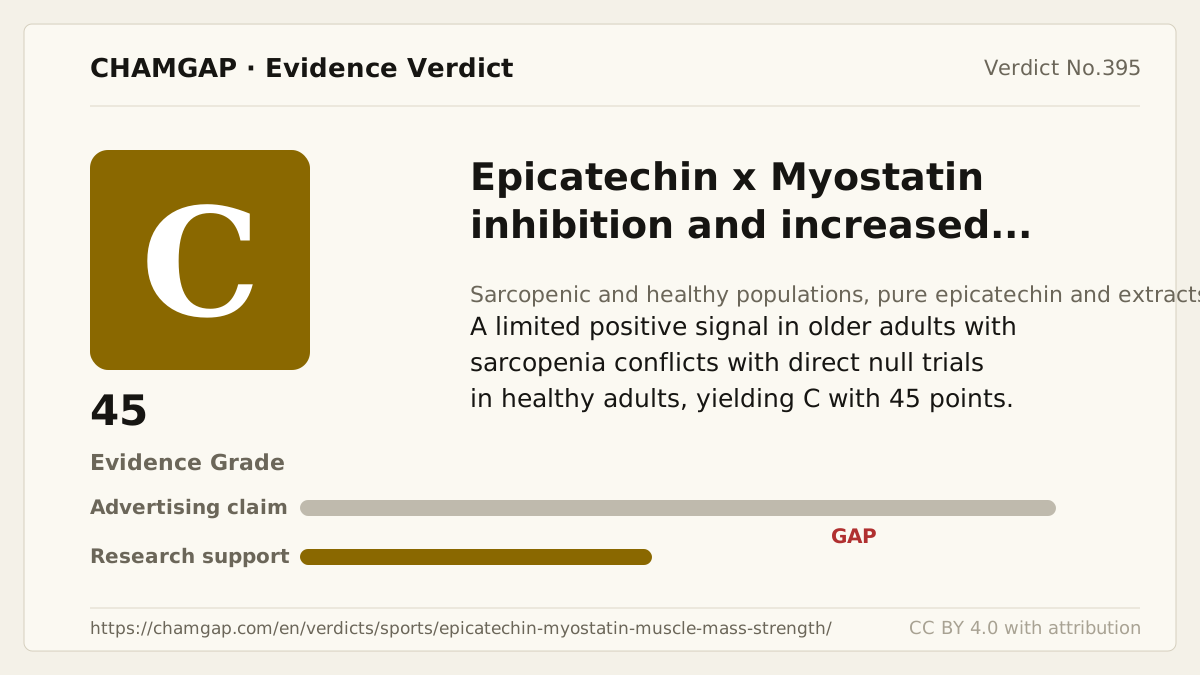
[Chamgap] Epicatechin x myostatin inhibition, muscle mass, and strength — Evidence Grade C·45. 4 cited sources checked. Source: https://chamgap.com/en/verdicts/sports/epicatechin-myostatin-muscle-mass-strength/ · CC BY 4.0CC BY 4.0 — free to use with attribution; do not distort grades, numbers, or verdict meaning.
What this document does and does not do
Chamgap is an information source. It reports what research has and has not confirmed; it does not tell readers what to take or buy. That decision belongs to readers and, when needed, medical or legal professionals. This verdict reflects literature available up to the search date and may change as new research appears. Nothing here is medical advice.