
Dense double-sock system,
does it really help with Reduction in boot-related foot blisters during military training?
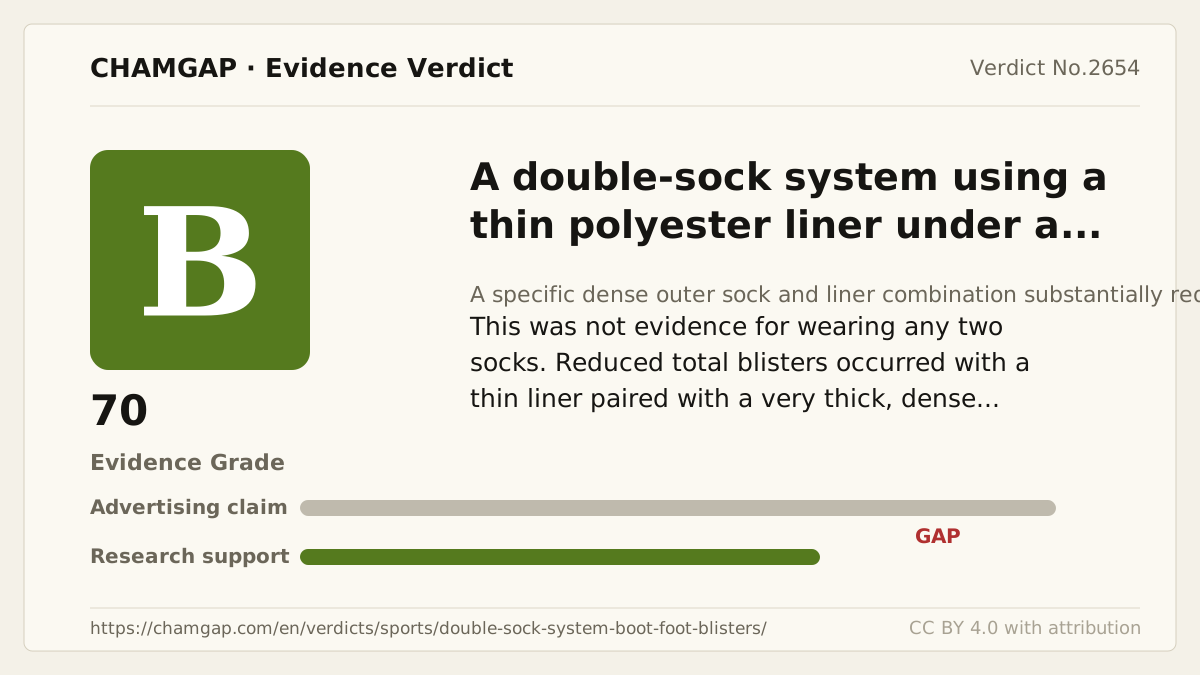
research showsThe grade is B with 70 points. In a prospective comparison of 357 male U.S. Marine recruits, blister incidence was 40% with the dense prototype outer sock plus liner, 69% with the standard military sock, and 77% with the standard sock plus liner, P<.001. Blisters or cellulitis requiring medical care were 11% versus 24%. The contrast was large, but this was one study and the accessible report did not verify allocation methods, arm denominators, assessor masking, or funding.
ads claimMarketing cannot generalize this to any liner, any wool sock, or all double-socking. Benefit appeared with a specific dense outer sock plus liner, while a liner under the standard sock did not reduce total blisters.
Useful facts when choosing a product
- The effective system paired a thin polyester liner with a very thick, dense wool-polypropylene outer sock.
- Total blister incidence was 40% with the prototype combination, 69% with the standard sock, and 77% with standard plus liner.
- An existing blister-prevention verdict addresses a different intervention such as paper tape and cannot be counted as replication of this sock system.
What the research actually shows
The 1996 study by Knapik JJ, Hamlet MP, Thompson KJ, and Jones BH assigned 357 male Marine recruits at Parris Island, South Carolina, to a standard wool-cotton-nylon-Spandex military sock, that standard sock plus a thin polyester liner, or a very thick dense prototype wool-polypropylene outer sock plus the same liner. Total blister incidence was 69%, 77%, and 40%, respectively, with P<.001 for the prototype combination versus either control. Blisters or cellulitis requiring medical attention were 24%, 9%, and 11%. No trial-registration number exists because this 1996 military study predates trial registration. No separate funding, acknowledgment, or conflict statement was verified, so independence was not counted as a strength.
Why this is classified as B (70)
A large absolute difference in actual blister events is limited by one study with unclear allocation, arm denominators, assessor masking, and funding disclosure, giving B with 70 points.
Counterpoint. Thick socks can reduce boot volume or retain moisture and may increase friction for some users. Proper boot fit and wrinkle-free dry socks remain essential.
Rejudgment record. Cross-check applied — Cross-checked 357 participants, the three sock systems, total and severe blister percentages, and pre-registration-era status against the Military Medicine report while separating unverified denominators, allocation, and funding
| Endpoint | H | Hard endpoint - actual events such as death |
| Replication | R1 | Single confirmatory trial |
| Independence | I1 | Mixed funding sources |
| Effect size | E+ | Meets the clinically important threshold |
The scoring table and the verdict agree (B).
Sub-claim grades by effect
This ingredient is marketed for several effects. A single overall grade blends strong and weak claims together, so each effect is graded separately here. The overall grade reflects the strongest disconfirming or core claim.
| Effect (sub-claim) | Grade | Basis |
|---|---|---|
| Prevention of total foot blisters with dense outer sock plus liner | B | Rates were 40% versus 69% with the standard sock. |
| Prevention of total blisters by adding a liner to the standard military sock | D | Total blister incidence was 77% and did not decrease. |
Cross-check — Codex and Claude
Evidence Table
| Study | Design | Sample | Funding | Endpoint | Result | Weight |
|---|---|---|---|---|---|---|
| Knapik JJ, Hamlet MP, Thompson KJ, Jones BH. 1996 | Three-arm prospective comparison in male Marine recruits; allocation method not verified | 357 | No separate funding or conflict statement verified | Foot blister incidence and blisters or cellulitis requiring medical attention | Prototype outer sock plus liner 40% versus standard 69% and standard plus liner 77%, P<.001; severe events 11% versus 24% and 9% | Single trial with a large event contrast; allocation, arm denominators, and funding unverified |
Receipt — 1 References
Of 1 cited sources, 1 had limited original-page access (blocked or summary-only) and were verified via index/summary, marked partial; the rest were verified at the original page. As of 2026-08-15.
Reviewed and approved: Chamgap Editorial Team · Approval date: 2026-08-15 · Corrections: none
Cite this verdict
[Chamgap] Dense double-sock system x prevention of boot-related foot blisters — Evidence Grade B·70. 1 cited sources checked. Source: https://chamgap.com/en/verdicts/sports/double-sock-system-boot-foot-blisters/ · CC BY 4.0CC BY 4.0 — free to use with attribution; do not distort grades, numbers, or verdict meaning.
What this document does and does not do
Chamgap is an information source. It reports what research has and has not confirmed; it does not tell readers what to take or buy. That decision belongs to readers and, when needed, medical or legal professionals. This verdict reflects literature available up to the search date and may change as new research appears. Nothing here is medical advice.