
Cooling vest during warm-up,
does it really help with Improved 5-km running performance in the heat?
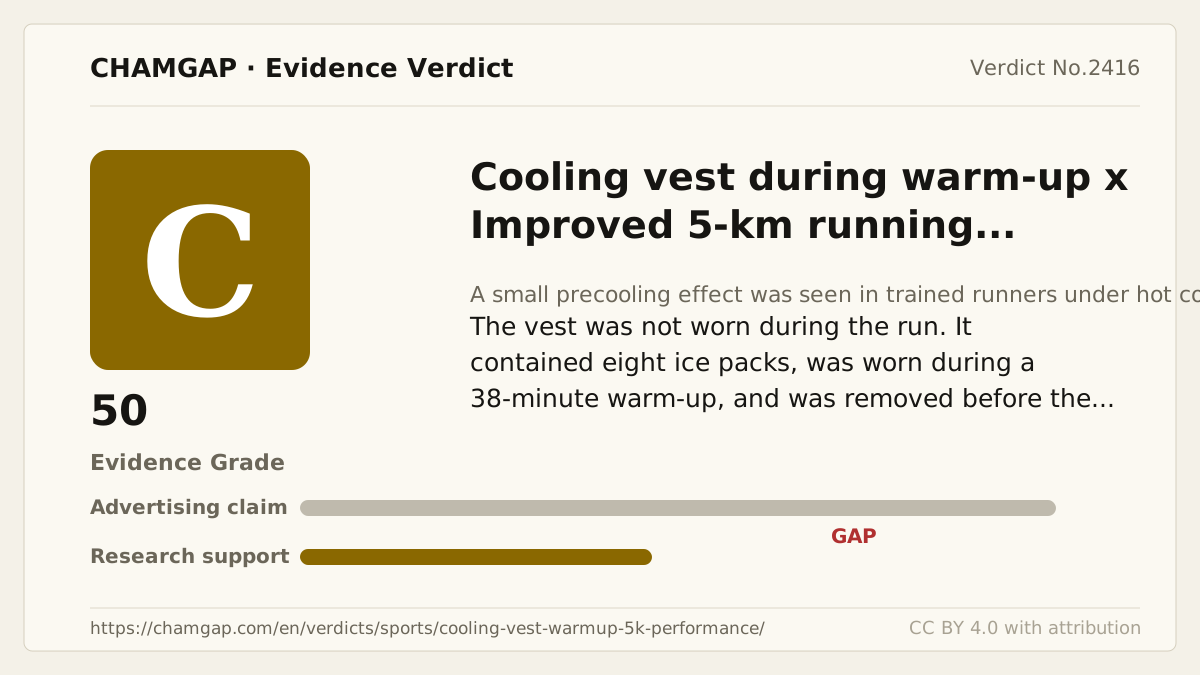
research showsThe grade is C with 50 points. In a crossover trial of 17 trained collegiate or club distance runners, 5-km time at 32°C and 50% relative humidity improved by 13 seconds, or 1.1%, after cooling-vest warm-up. The standardized difference was only about 0.10.
ads claimCooling and ice vests are sold in Korea, but pack placement, weight, and cooling duration vary. This result is limited to trained runners using precooling in hot conditions and does not establish benefit during-race wear, in recreational runners, or in cooler weather.
Useful facts when choosing a product
- The vest was worn for a 38-minute warm-up and removed before running.
- The comparator was a regular T-shirt, not an uncooled vest.
- Conditions were 32°C and 50% relative humidity.
- Participants were 17 competitive trained runners.
- Conditions were counterbalanced and separated by at least two days.
What the research actually shows
Arngrímsson et al. studied 17 heat-acclimatized competitive collegiate or club middle- and long-distance runners, nine men and eight women. They completed two conditions at 32°C and 50% relative humidity in counterbalanced order, separated by at least two days. During a 38-minute active warm-up they wore either an eight-ice-pack neoprene vest or a regular T-shirt, then removed it before a simulated treadmill 5-km race. Mean times were 1134 seconds (SD 132) and 1147 seconds (SD 130), P<.05; 12 of 17 ran faster after cooling. Funding was stated as “funded by the Sports Medicine and Sports Science Committee of USA Track and Field.” Provision of the cooling vest and measurement equipment was not stated.
Why this is classified as C (50)
A small positive trial in the heat is limited by a very small effect, 17 participants, and absence of an uncooled vest control.
Counterpoint. Thirteen seconds may matter in competition, but the reconstructed interval was wide and the standardized effect very small.
Rejudgment record. Cross-check applied — The intervention, comparator, environment, funding, and participant-level times were checked in the original article; variance and an approximate CI were reconstructed.
| Endpoint | P | Patient-reported treatment goal - the symptom is the goal |
| Replication | R1 | Single confirmatory trial |
| Independence | I2 | Decisive evidence is publicly or non-profit funded |
| Effect size | E~ | Statistically positive but below the threshold |
The scoring table and the verdict agree (C).
Sub-claim grades by effect
This ingredient is marketed for several effects. A single overall grade blends strong and weak claims together, so each effect is graded separately here. The overall grade reflects the strongest disconfirming or core claim.
| Effect (sub-claim) | Grade | Basis |
|---|---|---|
| A cooling vest during warm-up improves 5-km performance in the heat | C | A small improvement was found in 17 trained runners. |
Cross-check — Codex and Claude
Evidence Table
| Study | Design | Sample | Funding | Endpoint | Result | Weight |
|---|---|---|---|---|---|---|
| Study 1 | Repeated-measures crossover trial | 17 | funded by the Sports Medicine and Sports Science Committee of USA Track and Field | 5-km time at 32°C and 50% relative humidity | 1134±132 vs 1147±130 seconds; mean difference about 13 seconds; P<.05 | Pivotal evidence |
Receipt — 2 References
All 2 cited sources were verified for existence at the original page (as of 2026-08-07).
Reviewed and approved: Chamgap Editorial Team · Approval date: 2026-08-07 · Corrections: none
Cite this verdict
[Chamgap] Cooling-vest warm-up × 5-km performance in the heat — Evidence Grade C·50. 2 cited sources checked. Source: https://chamgap.com/en/verdicts/sports/cooling-vest-warmup-5k-performance/ · CC BY 4.0CC BY 4.0 — free to use with attribution; do not distort grades, numbers, or verdict meaning.
What this document does and does not do
Chamgap is an information source. It reports what research has and has not confirmed; it does not tell readers what to take or buy. That decision belongs to readers and, when needed, medical or legal professionals. This verdict reflects literature available up to the search date and may change as new research appears. Nothing here is medical advice.