
Beta-alanine,
does it really help with Exercise performance (high-intensity and endurance)?
research showsWhen beta-alanine is taken at 4-6 g/day for at least 2-4 weeks, small improvement signals recur for high-intensity exercise performance lasting around 1-4 minutes. However, effects are clearer in exercise-capacity tests such as time-to-exhaustion than in actual race or competition records, and claims for long-distance endurance or strength gains have weak evidence.
ads claimPre-workout products commonly use phrases such as 'lactate buffering,' 'endurance,' 'high-intensity performance,' and 'tingling is normal.' However, this is a cumulative-loading ingredient rather than an immediate-effect ingredient, and tingling is not an efficacy marker but a dose-related paresthesia.
Useful facts when choosing a product
- The research dose is usually 4-6 g/day for 2-10 weeks, and paresthesia may be reduced by divided dosing or sustained-release forms.
- The best-matched exercise duration is roughly 1-4 minutes, or more broadly 0.5-10 minutes of high-intensity performance.
- Increased muscle carnosine is a mechanistic marker; the grade was judged by actual performance measures.
- The representative adverse effect is tingling of the face and hands (paresthesia), and long-term data are limited.
What the research actually shows
The Hobson 2012 meta-analysis included 15 double-blind placebo-controlled studies and 360 participants, found a significant overall performance effect, and estimated a median 2.85% improvement versus placebo at a mean total intake of 179 g. The effect was stronger in exercise-capacity tests, while actual performance tests were not statistically clear. The Trexler 2015 ISSN position stand concluded that 4-6 g/day for at least 2-4 weeks increases muscle carnosine and is more evident in 1-4 minute open-endpoint/time-trial exercise. The Saunders 2017 BJSM meta-analysis also reported a small effect for 0.5-10 minute exercise, but effect sizes were small and there was between-study heterogeneity.
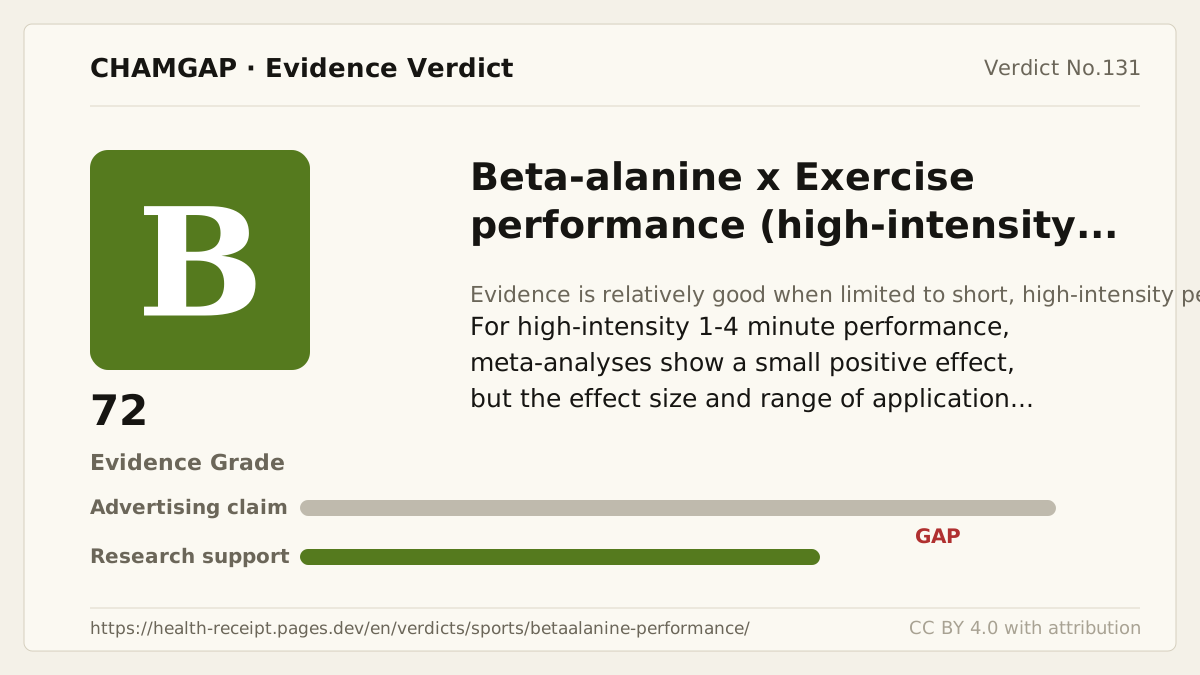
Why this is classified as B (72)
Because direct performance RCTs and meta-analyses exist, this corresponds to B. However, the effect is relatively small, weighted more toward exercise-capacity tests, and claims for long-distance endurance and strength are weak, so it is placed in the upper-middle B range at 72 points.
Counterpoint. When the sport, training status, and test duration fit, a small difference may matter. This judgment does not include general fatigue or long-distance endurance claims outside that range.
Rejudgment record. Draft — Positive human RCT and meta-analysis evidence, but small effect and limited scope.
Cross-check — Codex and Claude
Evidence Table
| Study | Design | Sample | Funding | Endpoint | Result | Weight |
|---|---|---|---|---|---|---|
| Hobson RM et al. 2012 | Meta-analysis | 360 | Mixed/many studies supplied supplements | Exercise performance and exercise capacity | Overall performance effects and improvements in exercise-capacity tests were significant, with an estimated median 2.85% improvement. | Core |
| Saunders B et al. 2017 | Systematic review and meta-analysis | Mixed | Exercise-performance effects by duration | The clearest signal was a small improvement in 0.5-10 minute exercise. | Core | |
| Trexler ET et al. 2015 | Position stand | ISSN/possible author conflicts of interest | Performance and safety | Summarized 4-6 g/day intake for at least 2-4 weeks and improvement in 1-4 minute exercise performance. | Supporting | |
| Baguet A et al. 2010 | Randomized placebo-controlled trial | Unknown/possible supplement provision | 2,000 m rowing time trial | Showed a signal that 2000 m rowing performance improved by several seconds versus placebo. | Supporting |
Receipt — 4 References
All 4 cited sources were verified for existence at the original page (as of 2026-07-09).
Reviewed and approved: Chamgap Editorial Team · Approval date: 2026-07-09 · Corrections: none
Cite this verdict
[Chamgap] Beta-alanine x exercise performance (high-intensity and endurance) — Evidence Grade B·72. 4 cited sources checked. Source: https://chamgap.com/en/verdicts/sports/betaalanine-performance/ · CC BY 4.0CC BY 4.0 — free to use with attribution; do not distort grades, numbers, or verdict meaning.
What this document does and does not do
Chamgap is an information source. It reports what research has and has not confirmed; it does not tell readers what to take or buy. That decision belongs to readers and, when needed, medical or legal professionals. This verdict reflects literature available up to the search date and may change as new research appears. Nothing here is medical advice.