
Bee pollen,
does it really help with Improved endurance, physical performance, and post-exercise recovery?
research showsBee pollen contains nutrients, but placebo-controlled exercise trials repeatedly failed to reproduce objective benefits in maximal oxygen uptake, running or swimming performance, or strength, resulting in an F grade. Nutrient density is not clinical evidence of improved athletic capacity, and robust human trials do not directly support better recovery.
ads claimMarketing links protein, amino acids, vitamins, and antioxidants to endurance, energy, and muscle recovery. Nutrient content and clinical effects on performance or recovery are separate questions, and objective results from placebo-controlled exercise trials did not support that link.
Useful facts when choosing a product
- In South Korea, bee pollen is sold online as raw granules, powder, and capsules; labeled intake ranges from gram quantities of raw material to milligram quantities of extracts depending on the product.
- The Chandler and Hawkins trial used 400 mg/day for 75 days, while the Maughan and Evans trial used a pollen extract for six weeks.
- Plant species, collection region, bee processing, and extraction method alter composition and allergens, so equivalence between study products and marketed products is not established.
- Anaphylaxis with urticaria and respiratory symptoms has been reported after bee-pollen ingestion, and cross-reactivity with airborne pollens has been demonstrated.
What the research actually shows
Steben and Boudreaux assigned 18 male high-school cross-country runners for 12 weeks; the Pollitabs/Cernitin pollen-extract preparation did not improve three-mile performance. Maughan and Evans gave Pollitabs/Cernitin pollen extract or placebo for six weeks to 20 adolescent swimmers training daily and found no between-group benefit in maximal oxygen uptake. These two studies used pollen extracts rather than direct whole bee pollen. Chandler and Hawkins gave 400 mg of direct bee pollen or placebo for 75 days to 46 healthy adults and found no objective benefit across six tests including maximal oxygen uptake, pulmonary function, and grip strength. Repeated negative evidence applies to objective athletic performance, while post-exercise recovery remains unknown because direct literature is insufficient. Allergy and anaphylaxis are separate safety concerns.
Why this is classified as F (8)
Objective performance endpoints were repeatedly null in different placebo-controlled trials, supporting F for repeated refutation rather than D. The high-attrition 2021 exploratory trial and nutrient-composition analyses carry less weight than repeated negative endurance and performance results, resulting in F with 8 points. Allergy risk is separated into safety rather than used to lower efficacy.
Counterpoint. Reduced missed training days and selected body-composition or subjective signals have appeared in individual studies. They do not constitute replicated efficacy for endurance, objective athletic performance, or post-exercise recovery.
Rejudgment record. Reassessment (cross-check reflected) — Objective athletic benefits were repeatedly null across different placebo-controlled exercise trials, and direct recovery evidence is absent, meeting the repeated-refutation criterion
Sub-claim grades by effect
This ingredient is marketed for several effects. A single overall grade blends strong and weak claims together, so each effect is graded separately here. The overall grade reflects the strongest disconfirming or core claim.
| Effect (sub-claim) | Grade | Basis |
|---|---|---|
| Improved objective endurance and athletic performance | F | Repeatedly null in placebo-controlled trials |
| Post-exercise recovery | ? | Insufficient direct literature |
Cross-check — Codex and Claude
Evidence Table
| Study | Design | Sample | Funding | Endpoint | Result | Weight |
|---|---|---|---|---|---|---|
| Steben RE, Boudreaux P. 1978 | Twelve-week randomized double-blind placebo-controlled nutrition and exercise trial | 18 | Unknown | Running performance, blood potassium, hemoglobin, and hematocrit | The pollen-extract group had no advantage over placebo in blood measures or running performance. | Key negative |
| Maughan RJ, Evans SP. 1982 | Six-week placebo-controlled trial | 20 | Unknown | Maximal oxygen uptake, vital capacity, and missed training days | Maximal oxygen uptake increased similarly in both groups, and the authors concluded that there was no positive performance benefit. | Key negative |
| Chandler JV, Hawkins JD. 1985 | Seventy-five-day double-blind placebo-controlled trial | 46 | Unknown | Six objective tests including maximal oxygen uptake, pulmonary function, and grip strength | Bee pollen 400 mg/day did not improve objective exercise-performance measures versus placebo. | Key negative |
| Sugiura S et al. 2021 | Sixteen-week placebo-controlled athlete trial | Details unknown | Body composition, subjective stress, strength-training records, and a 1,000-meter run | Selected signals favored muscle mass and physical stress, but substantial attrition led the authors to call for repeat testing. | Conflicting, exploratory |
Receipt — 5 References
All 5 cited sources were verified for existence at the original page (as of 2026-07-17).
Reviewed and approved: Chamgap Editorial Team · Approval date: 2026-07-17 · Corrections: none
Cite this verdict
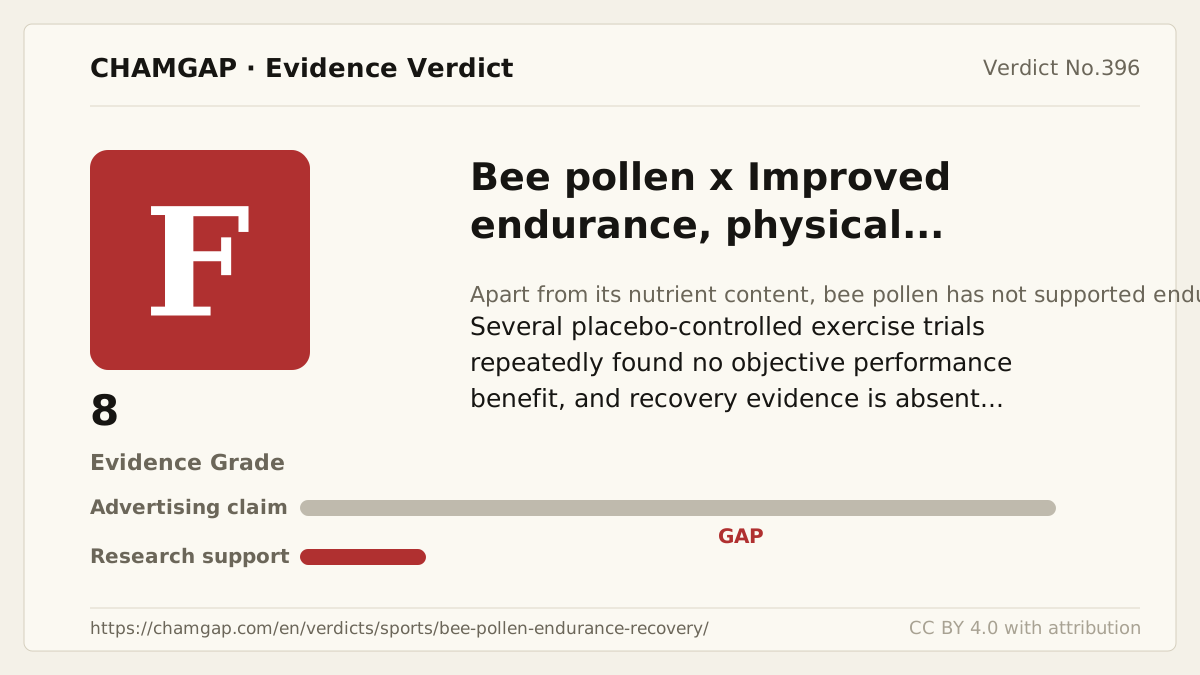
[Chamgap] Bee pollen x improved endurance, physical performance, and post-exercise recovery — Evidence Grade F·8. 5 cited sources checked. Source: https://chamgap.com/en/verdicts/sports/bee-pollen-endurance-recovery/ · CC BY 4.0CC BY 4.0 — free to use with attribution; do not distort grades, numbers, or verdict meaning.
What this document does and does not do
Chamgap is an information source. It reports what research has and has not confirmed; it does not tell readers what to take or buy. That decision belongs to readers and, when needed, medical or legal professionals. This verdict reflects literature available up to the search date and may change as new research appears. Nothing here is medical advice.