
L-tryptophan,
does it really help with Sleep and mood?
research showsL-tryptophan has old, small-study signals that sleep measures may improve slightly at 1 g/day or more. However, for chronic insomnia treatment, the AASM guideline did not recommend it because of insufficient evidence, and for mood and depression, the Cochrane review found only 2 high-quality studies with 64 participants, so the conclusion is weak.
ads claimProduct detail pages often combine phrases such as 'serotonin,' 'melatonin precursor,' 'a comfortable night,' and 'positive mood.' However, being a precursor is mechanistic evidence, and actual clinical effects on sleep and mood must be verified separately.
Useful facts when choosing a product
- Meaningful signals in sleep studies are generally mentioned at 1 g/day or more.
- There are interaction concerns when used with serotonergic drugs such as SSRIs, SNRIs, MAOIs, and triptans.
- In 1989-1990, eosinophilia-myalgia syndrome issues related to tryptophan products occurred, and causation and contamination issues remain part of the safety assessment.
- Evidence for treating depression or anxiety is low quality even when combined with 5-HTP.
What the research actually shows
Recent meta-analysis in the sleep field pooled multiple human studies and reported some signals for sleep quality, sleep latency, and total sleep time at 1 g/day or more, but study size and design were not uniform. The AASM 2017 pharmacologic guideline for chronic insomnia suggested not using tryptophan for sleep-onset or sleep-maintenance insomnia. For mood, the Shaw 2002 Cochrane review found more than 108 studies of 5-HTP and tryptophan, but only 2 RCTs with 64 participants passed inclusion criteria, and the evidence was not conclusive.
Why this is classified as C (47)
This is a composite claim combining sleep and mood. Sleep has some positive signals, so it is not ? or D, but AASM is negative regarding evidence for clinical insomnia treatment. For mood, sample size and quality are very limited in the Cochrane review. Therefore it is assigned C, 47 points.
Counterpoint. There may be small signals for temporary decreases in sleep quality, but the evidence is insufficient to generalize to chronic insomnia or depressive-disorder treatment.
Rejudgment record. Draft — Limited human evidence, negative guideline position, and insufficient Cochrane evidence.
Cross-check — Codex and Claude
Evidence Table
| Study | Design | Sample | Funding | Endpoint | Result | Weight |
|---|---|---|---|---|---|---|
| Sutanto CN et al. 2022 | Systematic review and meta-analysis | Mixed | Sleep quality, latency, and total sleep time | Reported signals for improvement in some sleep measures at 1 g/day or more, but studies were heterogeneous. | Supporting | |
| Sateia MJ et al. 2017 AASM | Clinical practice guideline | Professional society | Chronic insomnia | Suggested not using tryptophan to treat sleep-onset or sleep-maintenance insomnia. | Core counterexample | |
| Shaw KA et al. 2002 | Cochrane review | 64 | Independent review | Depressive symptoms | 5-HTP/tryptophan appeared better than placebo, but the quality of evidence was not conclusive. | Core |
Receipt — 3 References
All 3 cited sources were verified for existence at the original page (as of 2026-07-09).
Reviewed and approved: Chamgap Editorial Team · Approval date: 2026-07-09 · Corrections: none
Cite this verdict
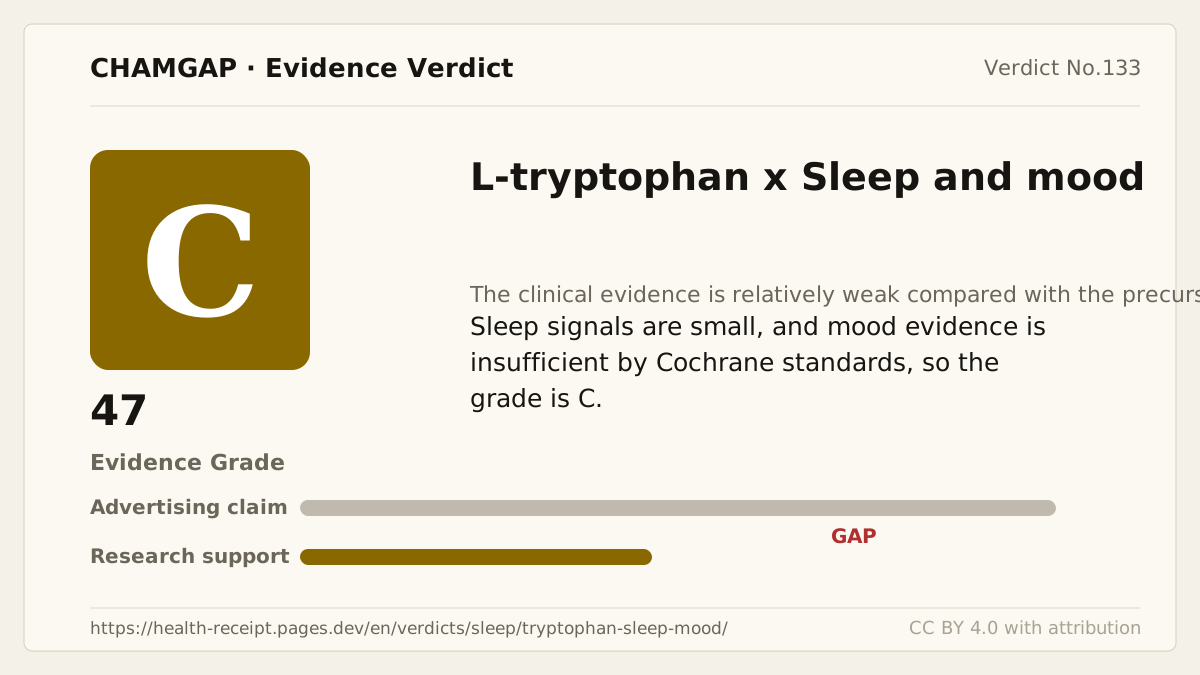
[Chamgap] L-tryptophan x sleep and mood — Evidence Grade C·47. 3 cited sources checked. Source: https://chamgap.com/en/verdicts/sleep/tryptophan-sleep-mood/ · CC BY 4.0CC BY 4.0 — free to use with attribution; do not distort grades, numbers, or verdict meaning.
What this document does and does not do
Chamgap is an information source. It reports what research has and has not confirmed; it does not tell readers what to take or buy. That decision belongs to readers and, when needed, medical or legal professionals. This verdict reflects literature available up to the search date and may change as new research appears. Nothing here is medical advice.