
Glycine,
does it really help with Sleep?
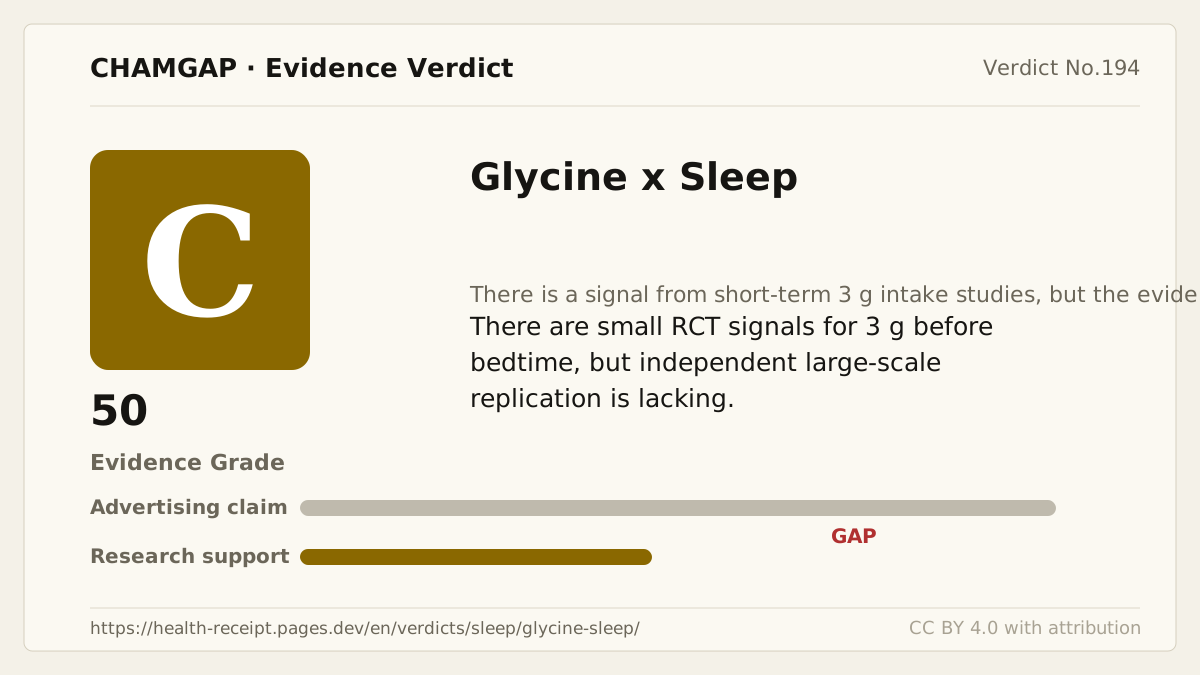
research showsTaking 3 g glycine before bedtime has signals of improvement in subjective sleep quality, next-day sleepiness and fatigue, and some PSG measures in small crossover RCTs involving healthy adults or sleep-restriction settings. However, the studies are small and mostly clustered in the same research line, so it is difficult to regard the evidence as confirmatory.
ads claimAdvertisements mention "deep sleep," "sleep quality," and "waking refreshed the next day." The research evidence is mainly short-term 3 g intake and subjective scales or small physiological measures.
Useful facts when choosing a product
- The sleep-study dose is usually glycine 3 g taken 30-60 minutes before bedtime.
- The amount of glycine in magnesium glycinate may be far below the 3 g research dose.
- Common adverse effects include gastrointestinal discomfort and loose stools, and long-term high-dose data are limited.
- Possible interactions with some psychiatric medications such as clozapine are mentioned in the literature.
What the research actually shows
Inagawa 2006 reported improved subjective sleep quality after 3 g glycine before bedtime in healthy volunteers with sleep complaints. Yamadera 2007 reported that 3 g glycine was accompanied by subjective sleep-quality improvement and some PSG changes. Bannai 2012 reported that 3 g glycine lowered next-day sleepiness and fatigue in 10 men under partial sleep restriction. A 2023 review summarized sleep-quality, cognition, and fatigue signals in 7 of 8 studies, but the study sizes were small.
Why this is classified as C (50)
There are direct sleep RCT signals, but the samples and reproducibility are small, so this is 50 points, the middle of C.
Counterpoint. Long-term treatment effects in patients diagnosed with insomnia should be distinguished from short-term sleep-quality signals in healthy adults.
Rejudgment record. Draft — Positive small direct sleep RCTs, but insufficient independent large-scale replication
Cross-check — Codex and Claude
Evidence Table
| Study | Design | Sample | Funding | Endpoint | Result | Weight |
|---|---|---|---|---|---|---|
| Yamadera W et al. 2007 | Double-blind placebo-controlled crossover trial | Ajinomoto-related | Subjective sleep quality and PSG | Subjective sleep quality and some PSG changes were reported with 3 g glycine. | Core | |
| Bannai M et al. 2012 | Randomized double-blind crossover trial | 10 | Ajinomoto-related | Next-day sleepiness, fatigue, and performance after sleep restriction | Next-day sleepiness and fatigue were lower after 3 g glycine intake. | Core |
| Inagawa K et al. 2006 | Placebo-controlled crossover trial | Ajinomoto-related | Subjective sleep quality | Reported a subjective sleep-quality improvement signal with 3 g glycine before bedtime. | Supporting |
Receipt — 3 References
All 3 cited sources were verified for existence at the original page (as of 2026-07-10).
Reviewed and approved: Chamgap Editorial Team · Approval date: 2026-07-10 · Corrections: none
Cite this verdict
[Chamgap] Glycine x sleep — Evidence Grade C·50. 3 cited sources checked. Source: https://chamgap.com/en/verdicts/sleep/glycine-sleep/ · CC BY 4.0CC BY 4.0 — free to use with attribution; do not distort grades, numbers, or verdict meaning.
What this document does and does not do
Chamgap is an information source. It reports what research has and has not confirmed; it does not tell readers what to take or buy. That decision belongs to readers and, when needed, medical or legal professionals. This verdict reflects literature available up to the search date and may change as new research appears. Nothing here is medical advice.