
Proteoglycan,
does it really help with Skin and joints?
research showsThe skin and joint efficacy of salmon nasal cartilage proteoglycan is graded C. The skin trials reported positive short-term results but are concentrated in manufacturer-funded or manufacturer-affiliated research, while the single-ingredient joint trial found no significant placebo-adjusted effects on pain, function, or major cartilage-metabolism measures in the full cohort and reported only post hoc subgroup signals. Safety is classified as Good because no related serious adverse events were reported in short-term trials of 10 to 20 mg.
ads claimAdvertisements mention 'salmon nasal cartilage,' 'proteoglycan,' 'joint cushioning,' and 'skin moisture/elasticity.' Verifiable public evidence remains at the level of biological explanations or studies of related ingredients.
Useful facts when choosing a product
- Proteoglycan is a component of articular cartilage, but that does not mean it is delivered unchanged to the target tissue after ingestion.
- Because it is a fish-derived ingredient, fish allergy and quality standardization are important.
- Evidence for chondroitin, collagen, or hyaluronic acid was not applied unchanged to this ingredient.
- No score is assigned until the original human RCT text is verified.
What the research actually shows
Bai 2025 (PMID 40613544) was a double-blind placebo-controlled trial of salmon nasal cartilage proteoglycan 20 mg/day for 56 days, with 66 enrolled and 61 analyzed. It reported changes in moisture of 19.35% (P<.01), elasticity of 24.08% (P<.001), roughness of 21.85% (P<.01), and some wrinkles, but many P<.001 values were within-group changes and not every measure was P<.001 versus placebo. Shanghai Huiwen Biotech funded the study and all authors were affiliated with its R&D center, while the paper declared no conflict of interest. Tomonaga 2017 (PMID 28672901) was a 10 mg/day, 16-week double-blind placebo-controlled trial with 60 enrolled and 55 analyzed. In the full cohort, cartilage-metabolism biomarkers including C1,2C and PIICP and clinical JKOM/VAS pain and function did not significantly differ from placebo. P<.05 differences in C1,2C appeared only in the post hoc severe subgroup with JKOM≥41 and the persistent-pain subgroup; Ichimaru Pharcos funded the study and some investigators worked in its R&D department. Takahashi 2015 was a company-linked double-blind trial of 5 mg/day for 2 weeks in N=19 and reported P<.05 changes in some skin measures. Mano 2017 was an N=60, 12-week trial of a combination containing proteoglycan 16 mg and undenatured type II collagen 16 mg, so the effect of proteoglycan alone cannot be isolated. Short-term RCTs of 10 to 20 mg reported no serious adverse events related to the study product, but long-term data are limited.
Why this is classified as C (46)
Under methodology ①, the joint evidence is limited to a maximum of C because it centers on cartilage-metabolism surrogate markers, full-cohort clinical pain, function, and biomarker results were null, and a signal appeared only in post hoc subgroups. Under methodology ②-b, the skin evidence is limited to a maximum of C because all positive trials are small and manufacturer-linked without independent replication. The subgrades are skin C and joint C, with joint at the lower end of C because the full-cohort results were null. Because direct human RCTs exist, ? does not apply.
Counterpoint. Short-term skin measures and a biomarker signal in selected joint subgroups exist, but manufacturer linkage, within-group analyses, post hoc subgroups, and a combination product prevent these findings from establishing independently replicated, ingredient-specific clinical efficacy.
Rejudgment record. Reassessment (?→C) — Applied methodology ① for surrogate-centered evidence, null full-cohort results, and post hoc subgroup limitations, and ②-b for small manufacturer-linked positive studies without independent replication; skin C, joint C (lower end)
Sub-claim grades by effect
This ingredient is marketed for several effects. A single overall grade blends strong and weak claims together, so each effect is graded separately here. The overall grade reflects the strongest disconfirming or core claim.
| Effect (sub-claim) | Grade | Basis |
|---|---|---|
| Skin | C | Positive double-blind placebo-controlled RCT (Bai 2025, N=66) but with an undisclosed manufacturer conflict of interest |
| Joint | C | Tomonaga 2017 (N=55) was null in the whole group; signal only on surrogate markers in a post-hoc subgroup |
Cross-check — Codex and Claude
Evidence Table
| Study | Design | Sample | Funding | Endpoint | Result | Weight |
|---|---|---|---|---|---|---|
| Bai W et al. 2025 (PMID 40613544) | 56-day randomized double-blind placebo-controlled trial | 61 | Funded by Shanghai Huiwen Biotech; all authors affiliated with its R&D center | Instrument-measured skin moisture, elasticity, roughness, wrinkles, pigmentation, and related measures | At 20 mg/day, moisture changed by 19.35% (P<.01), elasticity by 24.08% (P<.001), roughness by 21.85% (P<.01), with improvement in some wrinkles. Many P<.001 values were within-group changes, not placebo-adjusted results for every measure. | Core; manufacturer-linked |
| Tomonaga A et al. 2017 (PMID 28672901) | 16-week randomized double-blind placebo-controlled trial | 55 | Funded by Ichimaru Pharcos; some investigators affiliated with its R&D department | Cartilage-metabolism biomarkers including C1,2C and PIICP, and JKOM/VAS pain and function | At 10 mg/day, full-cohort biomarkers and clinical pain and function were null versus placebo. C1,2C P<.05 was limited to post hoc JKOM≥41 and persistent-pain subgroups. | Core; surrogate marker and post hoc subgroup |
| Takahashi T et al. 2015 | 2-week randomized double-blind controlled trial | 19 | Investigators affiliated with ingredient companies including Ichimaru Pharcos | Skin moisture, transepidermal water loss, elasticity, and related measures | At 5 mg/day, some skin measures reached P<.05; the trial was very small and short. | Supporting; manufacturer-linked |
| Mano T et al. 2017 | 12-week randomized double-blind placebo-controlled combination trial | 60 | Affiliated with salmon nasal cartilage ingredient and product companies | JOA, JKOM, KSS, and VAS joint function and symptoms | The product combined proteoglycan 16 mg with undenatured type II collagen 16 mg, so the effect of proteoglycan alone cannot be isolated. | Combination; indirect |
Receipt — 5 References
All 5 cited sources were verified for existence at the original page (as of 2026-07-11).
Reviewed and approved: Chamgap Editorial Team · Approval date: 2026-07-11 · Corrections: 1
Correction log — 1
Corrections applied to this verdict, in chronological order. Changes are logged, not erased.
- 2026-07-11 · Re-adjudication (grade changed) — The previous 'judgment deferred (?)' was based on not confirming that direct human RCTs exist, but skin (Bai 2025, PMID 40613544) and joint (Tomonaga 2017, PMID 28672901) double-blind placebo-controlled RCTs do exist. Because real RCTs exist, this is C, not '?' (skin positive but manufacturer conflict of interest; joint on surrogate markers and a post-hoc subgroup). The mis-cited glucosamine/chondroitin study (Clegg 2006) was removed and replaced with the actual proteoglycan RCTs. Found in the 2026-07-11 internal audit. (grade ?→C)
Cite this verdict
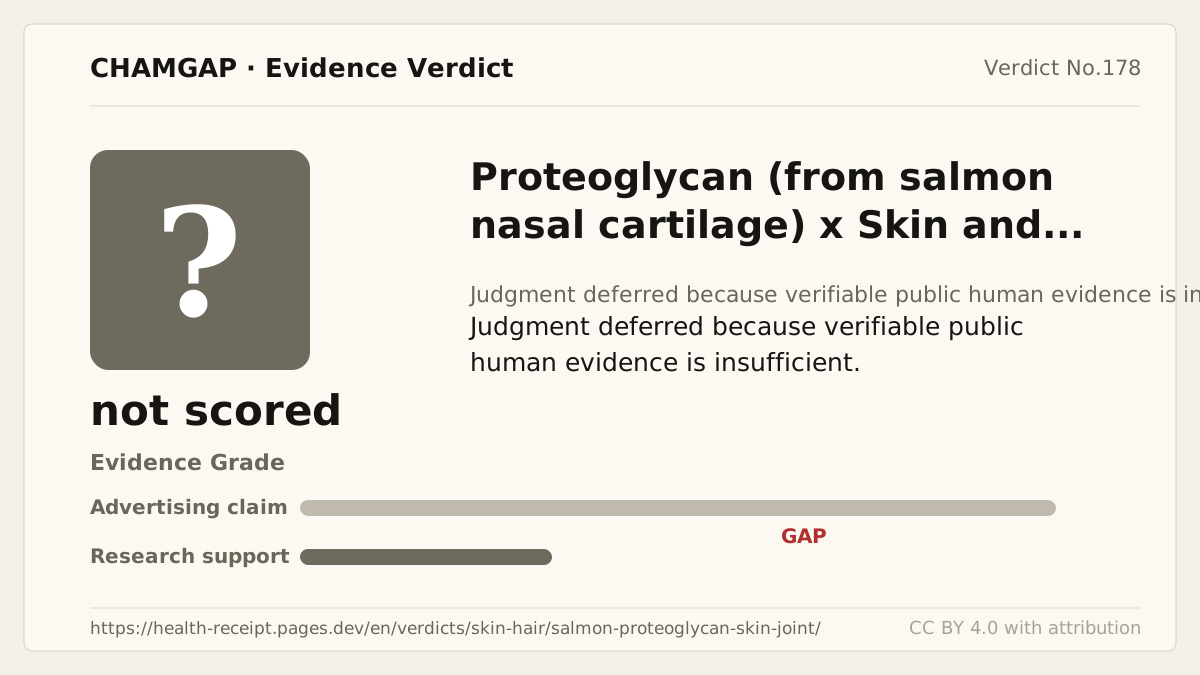
[Chamgap] Proteoglycan (from Salmon Nasal Cartilage) × Skin and Joints — Evidence Grade C·46. 5 cited sources checked. Source: https://chamgap.com/en/verdicts/skin-hair/salmon-proteoglycan-skin-joint/ · CC BY 4.0CC BY 4.0 — free to use with attribution; do not distort grades, numbers, or verdict meaning.
What this document does and does not do
Chamgap is an information source. It reports what research has and has not confirmed; it does not tell readers what to take or buy. That decision belongs to readers and, when needed, medical or legal professionals. This verdict reflects literature available up to the search date and may change as new research appears. Nothing here is medical advice.