
Probiotics,
does it really help with Atopic dermatitis and eczema?
research showsFor treatment of existing atopic dermatitis and eczema, a Cochrane treatment review synthesized 39 RCTs with 2,599 participants and concluded that patient- or parent-rated symptoms showed little to no difference, and quality of life showed no difference. A SCORAD difference of -3.91 points was reported, but this is below the MCID of 8.7 points, so it is difficult to call the treatment evidence evidence-based. Evidence for infant prevention and evidence for treatment of existing atopy are separate.
ads claimProducts mention the 'gut-skin axis,' 'atopy probiotics,' 'itching,' and 'skin immunity.' The evidence can be interpreted only when strain name, CFU, timing of administration, and prevention/treatment distinction match.
Useful facts when choosing a product
- Probiotic effects differ by strain, dose, and target population and cannot be combined as general "lactic acid bacteria."
- In immunocompromised people, central venous catheter use, severe illness, and premature infants, rare risks of bacteremia and fungemia have been reported.
- Prevention studies and treatment studies have different endpoints and populations.
- The strains listed on food or general supplement labels need to be confirmed as the same as the RCT strains.
What the research actually shows
The Makrgeorgou 2018 Cochrane treatment review summarized 39 RCTs with 2,599 participants and found that probiotics made little or no difference to patient- or parent-rated symptoms and made no difference to quality of life. The investigator-rated SCORAD mean difference was reported as -3.91 points, but this is clinically small because it is below the MCID of 8.7 points. Some studies with Lactobacillus fermentum VRI-003 PCC, Lactobacillus rhamnosus, and multi-strain products reported SCORAD improvement signals, but strains, ages, severity, and concomitant treatment differed. Meta-analyses on infant prevention deal with administration during pregnancy, lactation, and infancy and specific strain combinations, so they are not used as upward evidence for judging treatment of existing atopy.
Why this is classified as D (35)
Using the treatment claim as the standard, the Cochrane synthesis of 39 RCTs and 2,599 participants found little to no difference in patient- or parent-rated symptoms, no difference in QoL, and SCORAD -3.91 points below the MCID of 8.7 points, so this is D at 35 points. Infant-prevention evidence is a separate judgment issue.
Counterpoint. A prevention signal for a specific strain is not direct evidence of treatment efficacy.
Rejudgment record. Draft — In a Cochrane treatment review of 39 RCTs and 2,599 participants, patient/parent symptoms showed little to no difference, QoL showed no difference, and SCORAD -3.91 points was below the MCID of 8.7 points
Cross-check — Codex and Claude
Evidence Table
| Study | Design | Sample | Funding | Endpoint | Result | Weight |
|---|---|---|---|---|---|---|
| Makrgeorgou A et al. 2018 | Cochrane systematic review and meta-analysis | 2,599 | Cochrane/academic | Eczema symptoms, SCORAD, and quality of life | Clinically meaningful improvement in symptom scores was not confirmed. | Core |
| Weston S et al. 2005 | Randomized placebo-controlled trial | 56 | Possible ingredient/industry relation | SCORAD | There was a signal of SCORAD improvement with Lactobacillus fermentum VRI-003 PCC. | Supporting |
| Zuccotti G et al. 2015 | Systematic review and meta-analysis | Academic | Prevention of eczema development | Reported a prevention signal, but this is a different claim from treatment efficacy. | Separate |
Receipt — 4 References
All 4 cited sources were verified for existence at the original page (as of 2026-07-10).
Reviewed and approved: Chamgap Editorial Team · Approval date: 2026-07-10 · Corrections: none
Cite this verdict
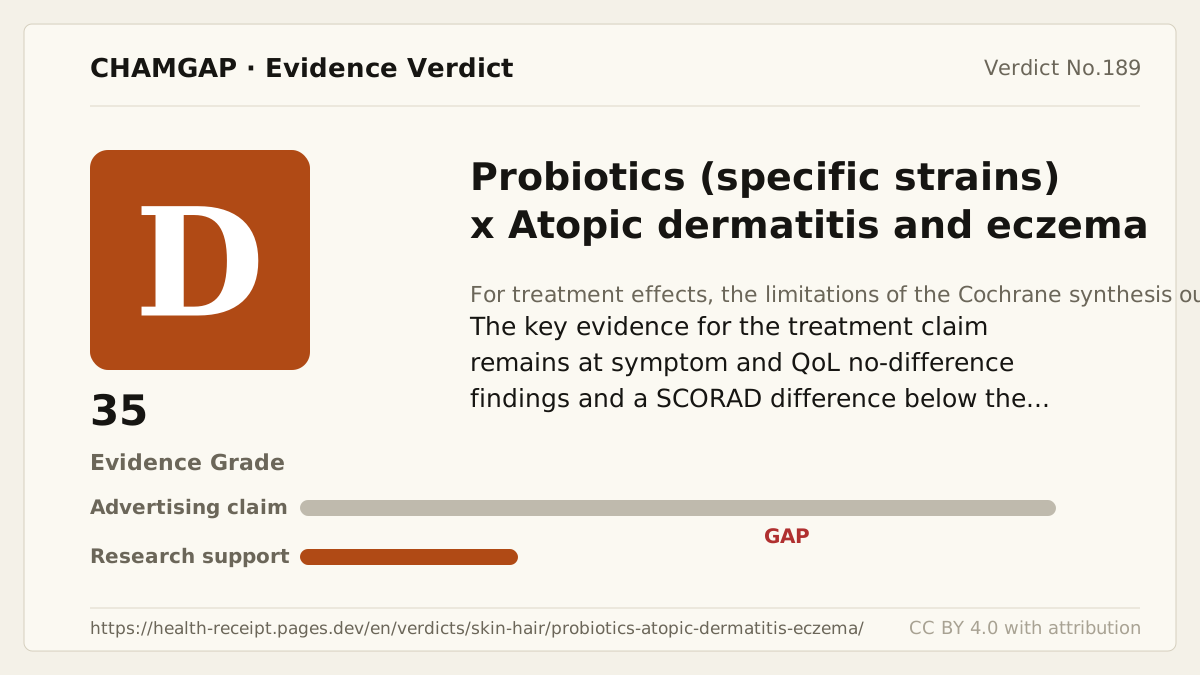
[Chamgap] Probiotics (specific strains) x atopic dermatitis and eczema — Evidence Grade D·35. 4 cited sources checked. Source: https://chamgap.com/en/verdicts/skin-hair/probiotics-atopic-dermatitis-eczema/ · CC BY 4.0CC BY 4.0 — free to use with attribution; do not distort grades, numbers, or verdict meaning.
What this document does and does not do
Chamgap is an information source. It reports what research has and has not confirmed; it does not tell readers what to take or buy. That decision belongs to readers and, when needed, medical or legal professionals. This verdict reflects literature available up to the search date and may change as new research appears. Nothing here is medical advice.