
Wild green oat extract,
does it really help with Improvement of stress, mood, and focus?
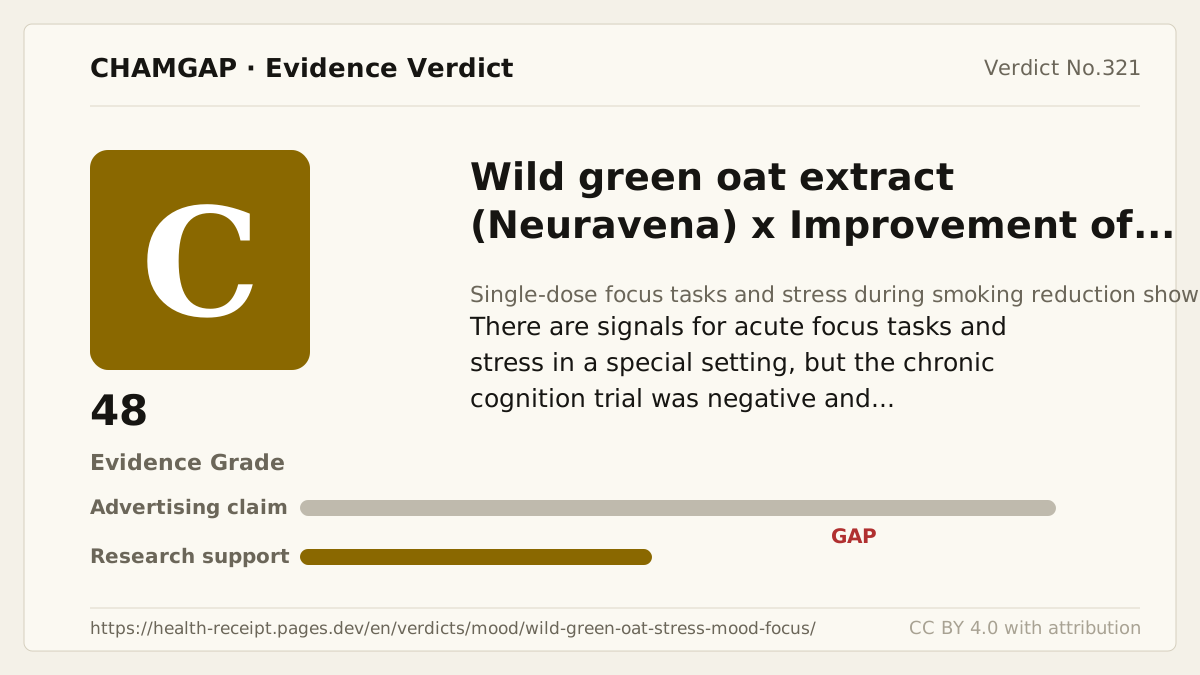
research showsSmall randomized trials of Neuravena reported better processing speed and selected memory or attention tasks after a single dose, and a trial in smokers reducing or stopping smoking found improvements in perceived stress and some quality-of-life measures. However, a 12-week trial found no sustained cognitive benefit, all studies were concentrated on a proprietary extract with ingredient-company support, and no clinical mood-disorder outcome was established, so the grade is C.
ads claimProduct descriptions may combine focus, calmness, stress adaptation, mood, and general wellbeing into one sustained effect. Published evidence is limited to single-dose cognitive tasks and self-reported outcomes in the special setting of smoking reduction or cessation; long-term cognitive enhancement and improvement of mood disorders have not been established.
Useful facts when choosing a product
- The studied Neuravena is a proprietary hydroethanolic extract of oat aerial parts and is not interchangeable with oat foods or other green-oat extracts.
- A representative acute cognition dose was a single 800 mg dose, while chronic trials used 900 to 1,500 mg/day for eight to 12 weeks.
- Outcomes included computerized cognitive tasks, EEG, perceived stress, and quality of life.
- Published trials generally reported good tolerability, but long-term safety data across diverse populations are limited.
What the research actually shows
The 2017 crossover trial by Kennedy and colleagues gave single doses of Neuravena 800 or 1,600 mg to middle-aged adults with self-reported memory decline and found improved global processing speed and selected memory and executive tasks at 800 mg. The 2021 trial by Martinez-Horta and colleagues reported faster responses and changes in EEG event-related potentials after a single 800 mg dose in 20 healthy adults. The 2012 crossover trial by Wong and colleagues gave 1,500 mg/day for 12 weeks to 37 healthy older adults and found no difference from placebo in any cognitive measure. The 2024 trial by Friling and colleagues reported improved perceived stress and selected quality-of-life measures after 900 mg/day for eight weeks in 145 smokers attempting reduction or cessation, but the proprietary ingredient was linked to Frutarom/IFF, ingredient-company employees were coauthors, and the company supported trial conduct.
Why this is classified as C (48)
Several RCTs provide acute focus and processing-speed signals and a stress signal in a special setting, but the 12-week cognition trial in 37 participants was negative, findings were selective, and all key studies were concentrated on a Frutarom/IFF-linked proprietary ingredient with industry support. There is also no clinical mood-disorder endpoint, resulting in C with 48 points.
Counterpoint. Signals for single-dose cognitive tasks and stress during smoking reduction remain for the exact Neuravena formulation. This judgment does not extend those signals to sustained focus enhancement or treatment of depression or anxiety.
Rejudgment record. Reassessment (cross-check reflected) — Some positive acute cognitive-task and special-setting stress findings, but a negative 12-week cognition trial, selective outcomes, concentration on proprietary Neuravena with industry support, and no clinical mood-disorder endpoint
Sub-claim grades by effect
This ingredient is marketed for several effects. A single overall grade blends strong and weak claims together, so each effect is graded separately here. The overall grade reflects the strongest disconfirming or core claim.
| Effect (sub-claim) | Grade | Basis |
|---|---|---|
| Single-dose processing speed and attention | C | Several small proprietary-ingredient RCTs were positive on selected tasks, but findings are selective and industry-concentrated. |
| Sustained cognition | D | Null long-term trial in 37 participants. |
| Stress | C | Limited to a smoking-cessation population and sponsored evidence. |
Cross-check — Codex and Claude
Evidence Table
| Study | Design | Sample | Funding | Endpoint | Result | Weight |
|---|---|---|---|---|---|---|
| Kennedy DO et al. 2017 | Randomized double-blind placebo-controlled repeated crossover trial | 1600 | Supported by Frutarom Switzerland with company employees as coauthors | Processing speed, attention, memory, and executive function | The 800 mg dose improved global processing speed and selected memory and executive tasks, without consistent improvement across all domains. | Key |
| Wong RHX et al. 2012 | Randomized double-blind placebo-controlled crossover trial | 12 | Financial and product support from Frutarom Switzerland | Cognitive tests including Stroop and an attention-concentration index | No significant difference in any individual test or in the overall attention-concentration index. | Key |
| Martinez-Horta S et al. 2021 | Randomized double-blind placebo-controlled trial | 800 | Supported by Frutarom with company employees as coauthors | Reaction time, accuracy, and EEG event-related potentials | Faster performance and ERP changes in the active group in a single-dose trial of 20 participants. | Supportive |
| Friling M et al. 2024 | Randomized double-blind placebo-controlled trial | 8 | Supported by IFF Health with company employees as coauthors and external trial staff hired by the company | Perceived stress, quality of life, sleep, cognition, and smoking reduction | Improved perceived stress and selected quality-of-life measures in the special population of smokers reducing or stopping smoking. | Supportive |
Receipt — 4 References
All 4 cited sources were verified for existence at the original page (as of 2026-07-11).
Reviewed and approved: Chamgap Editorial Team · Approval date: 2026-07-11 · Corrections: none
Cite this verdict
[Chamgap] Wild green oat extract (Neuravena) × Improvement of stress, mood, and focus — Evidence Grade C·48. 4 cited sources checked. Source: https://chamgap.com/en/verdicts/mood/wild-green-oat-stress-mood-focus/ · CC BY 4.0CC BY 4.0 — free to use with attribution; do not distort grades, numbers, or verdict meaning.
What this document does and does not do
Chamgap is an information source. It reports what research has and has not confirmed; it does not tell readers what to take or buy. That decision belongs to readers and, when needed, medical or legal professionals. This verdict reflects literature available up to the search date and may change as new research appears. Nothing here is medical advice.