
Passionflower,
does it really help with Anxiety and sleep?
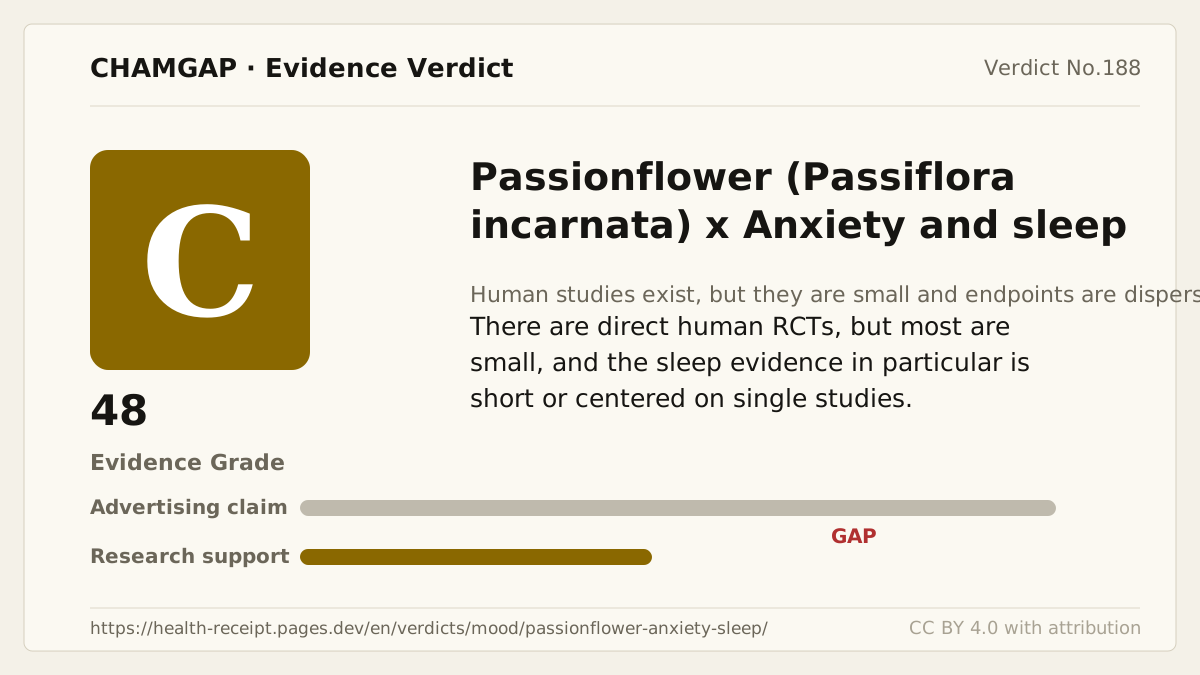
research showsPassionflower has human studies related to anxiety and sleep, but Cochrane-style assessment is cautious about confirming clinical efficacy in anxiety disorders, and EMA-style traditional-use assessment is regulatory-neutral context. The human clinical studies are few and small and have methodological flaws, so it is difficult to view the whole combined anxiety-and-sleep claim as B.
ads claimAdvertisements mention 'natural calming,' 'anxiety relief,' and 'sound sleep' together. In the research, anxiety endpoints differ from one another, including single-dose preoperative anxiety and GAD symptom scales, and sleep endpoints are short-term subjective scales.
Useful facts when choosing a product
- Study formulations vary, including extracts, syrups, tablets, and teas.
- Sleepiness may increase when combined with sedatives or alcohol.
- Safety data during pregnancy and lactation are limited, and caution during pregnancy has traditionally been mentioned.
- Preoperative anxiety studies should be read separately from evidence for chronic anxiety and insomnia.
What the research actually shows
Akhondzadeh 2001 compared Passiflora extract with oxazepam for 4 weeks in 36 people with GAD and reported similar HAMA reduction, but there was no placebo group and it was not an equivalence design. The Miyasaka 2007 Cochrane review summarized that effect conclusions were limited because the number of studies was small and methodological limitations were present. Movafegh 2008 reported that a single 500 mg dose lowered preoperative anxiety in 60 outpatients undergoing surgery. Ngan 2011 reported that 1 week of passionflower tea improved subjective sleep quality in a crossover trial of 41 healthy adults. EMA-style traditional-use assessment is regulatory-neutral material summarizing long-term use practices and is not counted as evidence confirming clinical efficacy.
Why this is classified as C (48)
There are human studies on anxiety and sleep, but they are few and small with methodological flaws, and Cochrane/EMA-style assessments are cautious about confirming clinical efficacy, so this is C at 48 points.
Counterpoint. Single-dose preoperative anxiety and long-term anxiety or sleep-aid claims cannot be combined at the same strength of evidence.
Rejudgment record. Draft — Human anxiety and sleep studies exist, but they are few and have methodological flaws, and Cochrane/EMA-style assessments limit confirmation of clinical efficacy
Cross-check — Codex and Claude
Evidence Table
| Study | Design | Sample | Funding | Endpoint | Result | Weight |
|---|---|---|---|---|---|---|
| Akhondzadeh S et al. 2001 | Double-blind randomized active-comparator pilot | 36 | Academic/unclear | HAMA | Reported that HAMA reductions were similar with Passiflora and oxazepam. | Supporting |
| Miyasaka LS et al. 2007 | Cochrane systematic review | Cochrane/academic | Anxiety disorders | Assessed that conclusions were limited because evidence was sparse and methodological limitations were substantial. | Core | |
| Movafegh A et al. 2008 | Randomized double-blind placebo-controlled trial | 60 | Academic/unclear | Preoperative anxiety VAS | Preoperative anxiety was lower than placebo after a single dose of Passiflora. | Supporting |
| Ngan A & Conduit R 2011 | Double-blind placebo-controlled crossover trial | 41 | Academic/unclear | Sleep diary and sleep quality | One week of passionflower tea improved subjective sleep quality. | Supporting |
Receipt — 4 References
All 4 cited sources were verified for existence at the original page (as of 2026-07-10).
Reviewed and approved: Chamgap Editorial Team · Approval date: 2026-07-10 · Corrections: none
Cite this verdict
[Chamgap] Passionflower x anxiety and sleep — Evidence Grade C·48. 4 cited sources checked. Source: https://chamgap.com/en/verdicts/mood/passionflower-anxiety-sleep/ · CC BY 4.0CC BY 4.0 — free to use with attribution; do not distort grades, numbers, or verdict meaning.
What this document does and does not do
Chamgap is an information source. It reports what research has and has not confirmed; it does not tell readers what to take or buy. That decision belongs to readers and, when needed, medical or legal professionals. This verdict reflects literature available up to the search date and may change as new research appears. Nothing here is medical advice.