
Mucuna pruriens,
does it really help with Improvement of dopamine and mood?
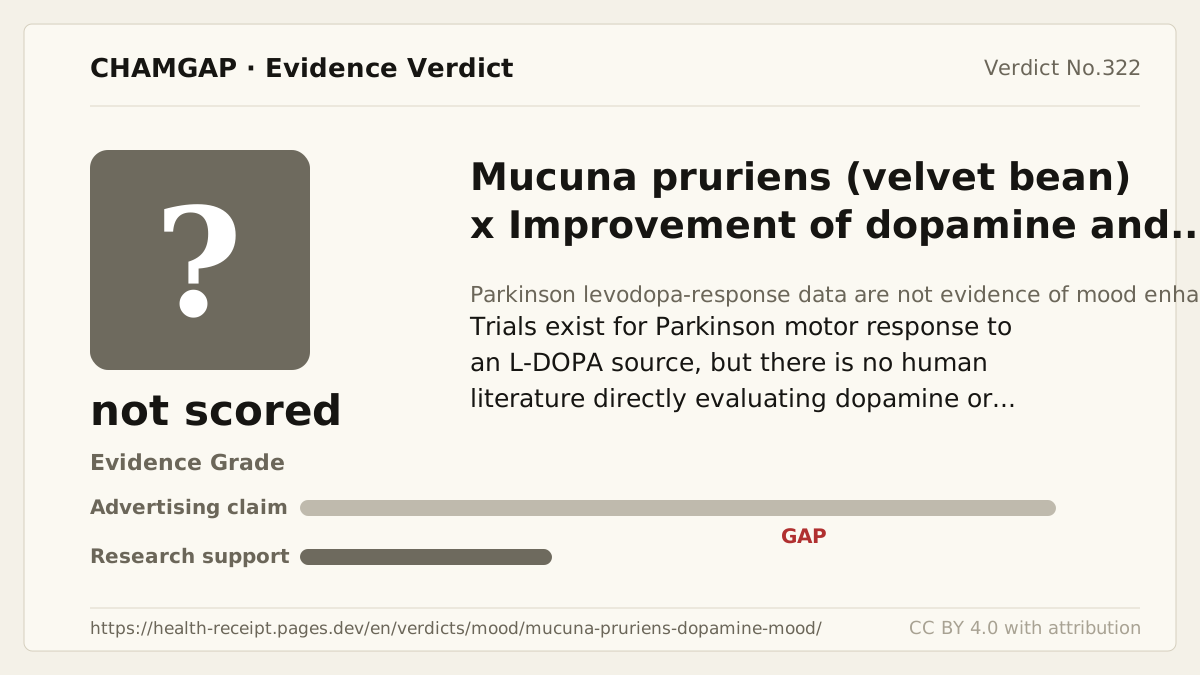
research showsMucuna seeds contain L-DOPA, and several human trials have examined motor response in people with Parkinson disease. However, no ingredient-only human efficacy trial assessing brain dopamine or mood in the general population was identified, so this claim receives a question-mark grade. Evidence for Parkinson motor symptoms is a separate subclaim.
ads claimProduct descriptions may extend L-DOPA content and Parkinson pharmacology to claims such as dopamine booster, motivation, happiness, mood, and focus. Published human evidence directly concerns levodopa response in Parkinson disease, not mood enhancement in the general population.
Useful facts when choosing a product
- L-DOPA content in Mucuna seeds varies by cultivar, processing, and product.
- Parkinson studies often used several grams to tens of grams of seed powder, limiting direct comparison with supplement extract capsules.
- Levodopa-related adverse effects can include nausea, dizziness, hypotension, dyskinesia, and changes in impulse control.
- Pharmacologic interactions are possible with dopaminergic drugs, monoamine oxidase inhibitors, antipsychotics, and other medicines.
What the research actually shows
The 2004 trial by Katzenschlager and colleagues and the 2017 trial by Cilia and colleagues administered Mucuna as a quantified L-DOPA treatment for Parkinson disease and compared its motor response with standard levodopa preparations. The five trials with 108 participants in the 2025 systematic review by Hammoud and colleagues and the 32-person 12-month trial by Cilia and colleagues in 2026 were in the same Parkinson-treatment setting; they were not null trials of dopamine or mood improvement in the general population. A nonrandomized before-and-after study in infertile men was likewise not a randomized trial of mood in the general population. Note: Parkinson motor symptoms have evidence as a separate subclaim, but they are outside the scope of this judgment.
Why this is classified as ?
The human efficacy literature for the intended claim of dopamine and mood improvement in the general population was not identified, so the grade is a question mark rather than D. Parkinson motor-effect RCTs exist but involve a different population, purpose, and dose and were not substituted into the overall rating.
Counterpoint. Human evidence that Mucuna can serve as an L-DOPA source in Parkinson disease remains. This judgment does not deny that pharmacologic effect; it separates it from extrapolation to general mood enhancement.
Rejudgment record. Reassessment (cross-check reflected) — No ingredient-only human efficacy trial of dopamine or mood improvement in the general population; existing RCTs evaluate the separate claim of motor response to an L-DOPA source in Parkinson disease
Cross-check — Codex and Claude
Evidence Table
| Study | Design | Sample | Funding | Endpoint | Result | Weight |
|---|---|---|---|---|---|---|
| Katzenschlager R et al. 2004 | Randomized double-blind crossover trial | 8 | Unknown | L-DOPA pharmacokinetics, UPDRS motor score, and on time | Mucuna 30 g had faster onset and longer on time than standard levodopa/carbidopa. | Indirect |
| Cilia R et al. 2017 | Randomized controlled double-blind crossover trial | 18 | Led by nonprofit research institutions with no commercial support reported | Motor response at 90 and 180 minutes, on time, dyskinesia, and adverse events | A single dose of Mucuna showed noninferior motor response to levodopa preparations. | Indirect |
| Hammoud F et al. 2025 | Systematic review of clinical trials | 108 | Unknown | Parkinson motor symptoms, on time, and treatment complications | Summarized signals for Parkinson motor effects but included no general-population mood trial. | Indirect |
| Cilia R et al. 2026 | Multicenter randomized open-label phase 2 trial | 12 | Nonprofit and academic research | Quality of life, MDS-UPDRS, nonmotor symptoms, and safety | Mucuna and standard levodopa groups had similar outcomes across several Parkinson measures over 12 months. | Indirect |
Receipt — 4 References
All 4 cited sources were verified for existence at the original page (as of 2026-07-11).
Reviewed and approved: Chamgap Editorial Team · Approval date: 2026-07-11 · Corrections: none
Cite this verdict
[Chamgap] Mucuna pruriens (velvet bean) × Improvement of dopamine and mood — Evidence Grade ?. 4 cited sources checked. Source: https://chamgap.com/en/verdicts/mood/mucuna-pruriens-dopamine-mood/ · CC BY 4.0CC BY 4.0 — free to use with attribution; do not distort grades, numbers, or verdict meaning.
What this document does and does not do
Chamgap is an information source. It reports what research has and has not confirmed; it does not tell readers what to take or buy. That decision belongs to readers and, when needed, medical or legal professionals. This verdict reflects literature available up to the search date and may change as new research appears. Nothing here is medical advice.