
Lemon balm,
does it really help with Stress, anxiety, and sleep?
research showsLemon balm has positive signals from small RCTs and a 2021 meta-analysis for anxiety, stress, and mood scales. Some sleep studies also exist, but many involve combination products with valerian and other ingredients rather than lemon balm alone, so this is a stress- and anxiety-centered C judgment.
ads claimProduct and tea advertising emphasizes 'tension relief,' 'stress care,' 'restful sleep,' 'GABA,' and 'rosmarinic acid.' Tea drinking, extract capsules, and combination sleep formulations differ in content and evidence.
Useful facts when choosing a product
- Research formulations vary widely, including dried-leaf tea, standardized extract, beverages or yogurt, and capsules.
- Sleep studies often include mixed herbal products such as valerian.
- Drowsiness, headache, and gastrointestinal discomfort are possible, and sedation may overlap when combined with sedatives or alcohol.
- Theoretical interaction potential is mentioned for people with thyroid disease or those taking thyroid medications.
What the research actually shows
Kennedy 2002/2004 acute RCTs reported that lemon balm extract may affect calmness and some cognitive performance during stress-inducing tasks. Scholey-line studies reported anxiety and mood-marker signals within 1-3 hours using lemon balm extract in beverage or yogurt forms. The Ghazizadeh 2021 systematic review and meta-analysis reported signals that lemon balm reduced anxiety (SMD about -0.98) and depression (SMD about -0.47), but it specified limitations in study number and heterogeneity. For sleep, there are some RCTs in groups such as post-cardiac-surgery patients and lemon balm plus valerian combination studies, so the evidence for lemon balm alone is weaker.
Why this is classified as C (54)
Human positive signals recur for subjective anxiety and stress scales, placing it near the upper end of C. However, sleep-alone evidence is weak, and limitations from study size, formulation heterogeneity, and short-term subjective scales are large, so it is not raised to B. It is judged C, 54 points.
Counterpoint. The ritual relaxation effect of one cup of tea should be distinguished from the effect of standardized-extract RCTs. The evidence also cannot be read directly as treatment evidence for clinical anxiety disorder or insomnia.
Rejudgment record. Draft — Human RCT and meta-analysis signals exist, but studies are small, use subjective scales, and sleep evidence is limited by combination products.
Cross-check — Codex and Claude
Evidence Table
| Study | Design | Sample | Funding | Endpoint | Result | Weight |
|---|---|---|---|---|---|---|
| Ghazizadeh J et al. 2021 | Systematic review and meta-analysis | Mixed | Anxiety and depression scales | Reported signals for reduced anxiety and depression scales, but noted heterogeneity and limited study number. | Core | |
| Kennedy DO et al. 2002/2004 | Randomized placebo-controlled acute study | Unknown/possible extract-related ties | Mood and cognition during stress tasks | Reported signals for changes in calmness and some cognitive and mood measures. | Supporting | |
| Scholey A et al. 2014 | Randomized placebo-controlled trial | Possible industry ties | Anxiety and mood | Reported signals for improved anxiety and mood measures with a lemon-balm-containing beverage/yogurt. | Supporting | |
| Study 4 | Randomized placebo-controlled trial | Mixed | Sleep quality | Some sleep-improvement signals exist, but evidence for lemon balm alone is mixed with combination-product evidence. | Supporting |
Receipt — 4 References
All 4 cited sources were verified for existence at the original page (as of 2026-07-09).
Reviewed and approved: Chamgap Editorial Team · Approval date: 2026-07-09 · Corrections: none
Cite this verdict
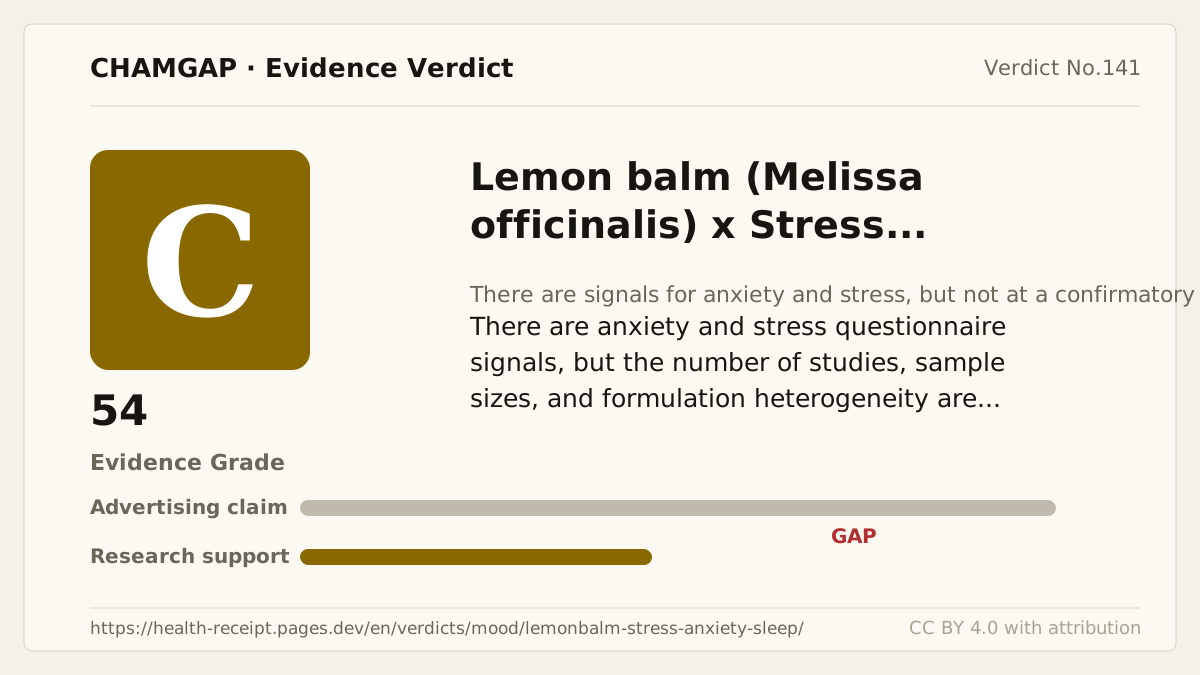
[Chamgap] Lemon balm (Melissa officinalis) x stress, anxiety, and sleep — Evidence Grade C·54. 4 cited sources checked. Source: https://chamgap.com/en/verdicts/mood/lemonbalm-stress-anxiety-sleep/ · CC BY 4.0CC BY 4.0 — free to use with attribution; do not distort grades, numbers, or verdict meaning.
What this document does and does not do
Chamgap is an information source. It reports what research has and has not confirmed; it does not tell readers what to take or buy. That decision belongs to readers and, when needed, medical or legal professionals. This verdict reflects literature available up to the search date and may change as new research appears. Nothing here is medical advice.