
Chamomile,
does it really help with Anxiety and sleep?
research showsChamomile extract has a small RCT signal for anxiety symptoms in GAD, and for sleep there are signals of improvement in subjective sleep quality in studies of postpartum women and older adults. However, the anxiety studies are small, the sleep studies are short-term and small, and the evidence that insomnia clinical endpoints improve consistently is weak.
ads claimAdvertisements mention 'tension relief,' 'sound sleep,' and 'caffeine-free nighttime tea' together. In the research, anxiety scales and sleep-quality scales are separated, and the data are limited for generalizing to an insomnia treatment effect.
Useful facts when choosing a product
- Study doses differ from one another, such as extract 220-1500 mg/day or 1 cup/day of tea.
- If there is a history of allergy to Asteraceae/Compositae or ragweed, hypersensitivity reactions are possible.
- In contexts involving anticoagulants, sedatives, pregnancy, or lactation, interactions and safety need to be checked.
- Tea products and standardized capsule studies are difficult to treat as evidence for the same dose.
What the research actually shows
Amsterdam 2009 reported that, in 57 people with mild-to-moderate GAD, chamomile extract showed a greater reduction in HAMA than placebo. The Mao 2016/2017 long-term study included an open-label lead-in with 179 people and re-randomized 93 responders; relapse time was not significant, but it reported a signal for maintained reduction in GAD symptoms. Chang 2016 found that 2 weeks of chamomile tea in 80 postpartum women with sleep problems improved sleep quality and depression scores short term, but the effect disappeared at follow-up. Adib-Hajbaghery 2017 found improved PSQI after 200 mg twice daily for 28 days in 60 older adults, but it was a small single-blind study.
Why this is classified as C (57)
There are direct human RCT signals, but the study size and the inconsistency of sleep clinical endpoints are insufficient to raise the entire combined anxiety-and-sleep claim to B, so it is placed at 57 points, the upper part of C.
Counterpoint. When studies of anxiety symptom relief and studies of sleep quality are separated, the evidence on the anxiety side is relatively more direct.
Rejudgment record. Draft — Small direct RCTs and short-term sleep-quality studies exist, but there is insufficient independent large-scale replication for the whole combined claim
Cross-check — Codex and Claude
Evidence Table
| Study | Design | Sample | Funding | Endpoint | Result | Weight |
|---|---|---|---|---|---|---|
| Amsterdam JD et al. 2009 | Randomized double-blind placebo-controlled trial | 57 | NCCAM/academic | HAMA and other GAD symptom scales | The chamomile extract group had a greater reduction in HAMA than placebo. | Core |
| Mao JJ et al. 2016/2017 | Long-term randomized placebo-controlled maintenance study | 93 | NCCIH/NCI | GAD relapse and symptom scales | The difference in relapse time was not clear, and there was a signal for maintained symptom reduction. | Core |
| Chang SM & Chen CH 2016 | Randomized controlled trial | 80 | Academic/unclear | PSQI and depression scores | There was a signal for improved sleep quality immediately after 2 weeks of intake, but it was not maintained at 4-week follow-up. | Supporting |
| Adib-Hajbaghery M & Mousavi SN 2017 | Single-blind randomized controlled trial | 60 | Academic/unclear | PSQI | Sleep quality improved more than control after 200 mg twice daily for 28 days. | Supporting |
Receipt — 4 References
All 4 cited sources were verified for existence at the original page (as of 2026-07-10).
Reviewed and approved: Chamgap Editorial Team · Approval date: 2026-07-10 · Corrections: none
Cite this verdict
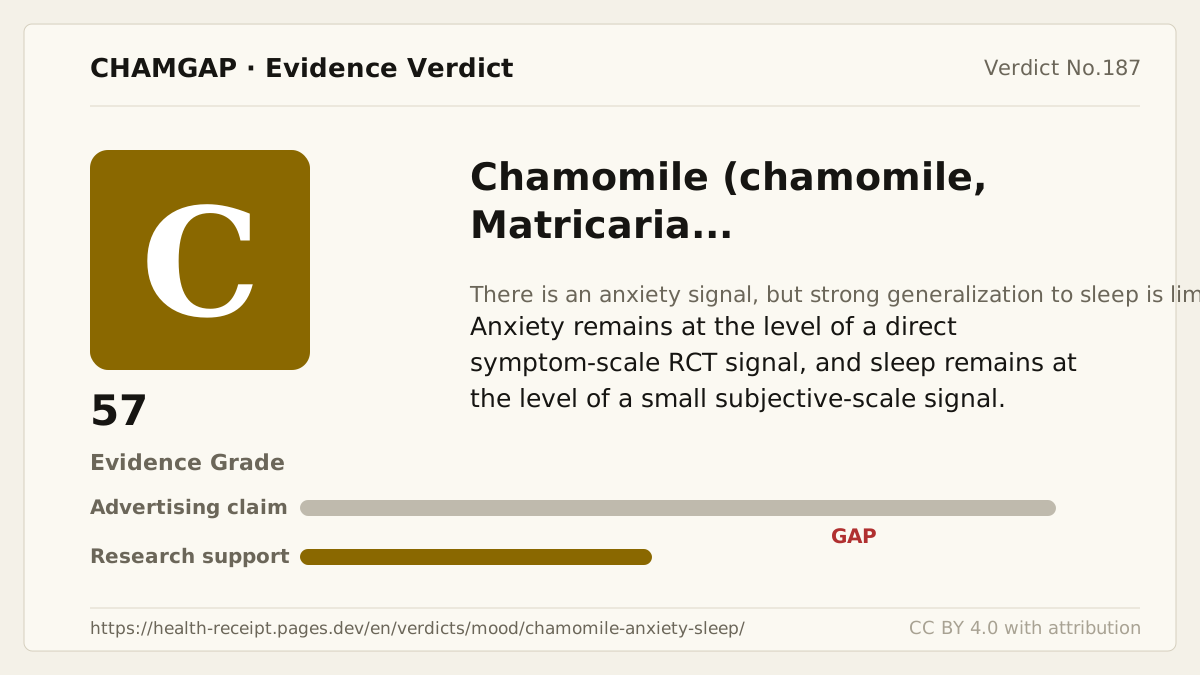
[Chamgap] Chamomile x anxiety and sleep — Evidence Grade C·57. 4 cited sources checked. Source: https://chamgap.com/en/verdicts/mood/chamomile-anxiety-sleep/ · CC BY 4.0CC BY 4.0 — free to use with attribution; do not distort grades, numbers, or verdict meaning.
What this document does and does not do
Chamgap is an information source. It reports what research has and has not confirmed; it does not tell readers what to take or buy. That decision belongs to readers and, when needed, medical or legal professionals. This verdict reflects literature available up to the search date and may change as new research appears. Nothing here is medical advice.