
American skullcap,
does it really help with Relief of anxiety and tension?
research showsTwo small double-blind studies in healthy volunteers exist, but the between-group result on the Beck Anxiety Inventory was null in a 43-person crossover trial published in 2014, and its mood signal was limited by carryover and low baseline anxiety. There is no repeated validation in patients with clinical anxiety disorders, resulting in C.
ads claimProduct descriptions may extend traditional calming use and a mood-scale signal in healthy volunteers to treatment of anxiety disorders, immediate sedation, or improved sleep. Direct evidence comes from short studies in healthy volunteers.
Useful facts when choosing a product
- The 2014 trial used S. lateriflora 350 mg three times daily for two weeks per period.
- American skullcap is a different species from Chinese skullcap, Scutellaria baicalensis.
- Commercial products have a history of substitution with other skullcap species or adulteration with potentially hepatotoxic germander.
- Reports of skullcap-associated liver injury often involve mixtures and species-identity problems, leaving the magnitude of risk from authentic S. lateriflora uncertain.
What the research actually shows
The 2003 double-blind placebo-controlled crossover study by Wolfson and Hoffmann reported an anxiolytic effect in healthy volunteers, but the PubMed abstract does not provide adequate sample-size and numerical details. The 2014 trial by Brock and colleagues randomized 43 healthy participants to sequences of skullcap 350 mg three times daily and placebo for two weeks each. The between-group BAI difference was not significant (p=0.191), while total mood disturbance improved but interpretation was limited by carryover, low baseline anxiety, and baseline imbalance between groups.
Why this is classified as C (40)
Only two small controlled studies in healthy volunteers are available, the primary BAI result in the better-described study was null, and carryover and baseline imbalance limit the positive mood result. With no repeated clinical-anxiety evidence, the rating is at the bottom of C with 40 points.
Counterpoint. Improvement in total mood disturbance and the early anxiolytic signal remain. This judgment does not extend to treatment of diagnosed anxiety disorders or to other Scutellaria species.
Rejudgment record. Reassessment (cross-check reflected) — Only two small double-blind studies in healthy volunteers are available, the between-group BAI result in the 43-person later trial was null, and the positive mood result is limited by carryover and baseline imbalance
Cross-check — Codex and Claude
Evidence Table
| Study | Design | Sample | Funding | Endpoint | Result | Weight |
|---|---|---|---|---|---|---|
| Wolfson P, Hoffmann DL. 2003 | Double-blind placebo-controlled crossover trial | Author affiliated with Phytos Inc. | Anxiety scale | Reported an anxiolytic effect, but numerical and methodological details in the public abstract are limited. | Supportive | |
| Brock C et al. 2014 | Randomized double-blind placebo-controlled crossover trial | 2 | Unknown | BAI, total mood disturbance, energy, and cognition | The between-group BAI result was null; total mood disturbance improved, but carryover and baseline imbalance were present. | Key |
| Brock C et al. 2013 | Botanical identity and compositional analysis of commercial material | Unknown | Species identity and flavonoid fingerprint | Described a history of substitution with other skullcap species and adulteration with germander as safety and reproducibility concerns. | Safety |
Receipt — 3 References
All 3 cited sources were verified for existence at the original page (as of 2026-07-11).
Reviewed and approved: Chamgap Editorial Team · Approval date: 2026-07-11 · Corrections: none
Cite this verdict
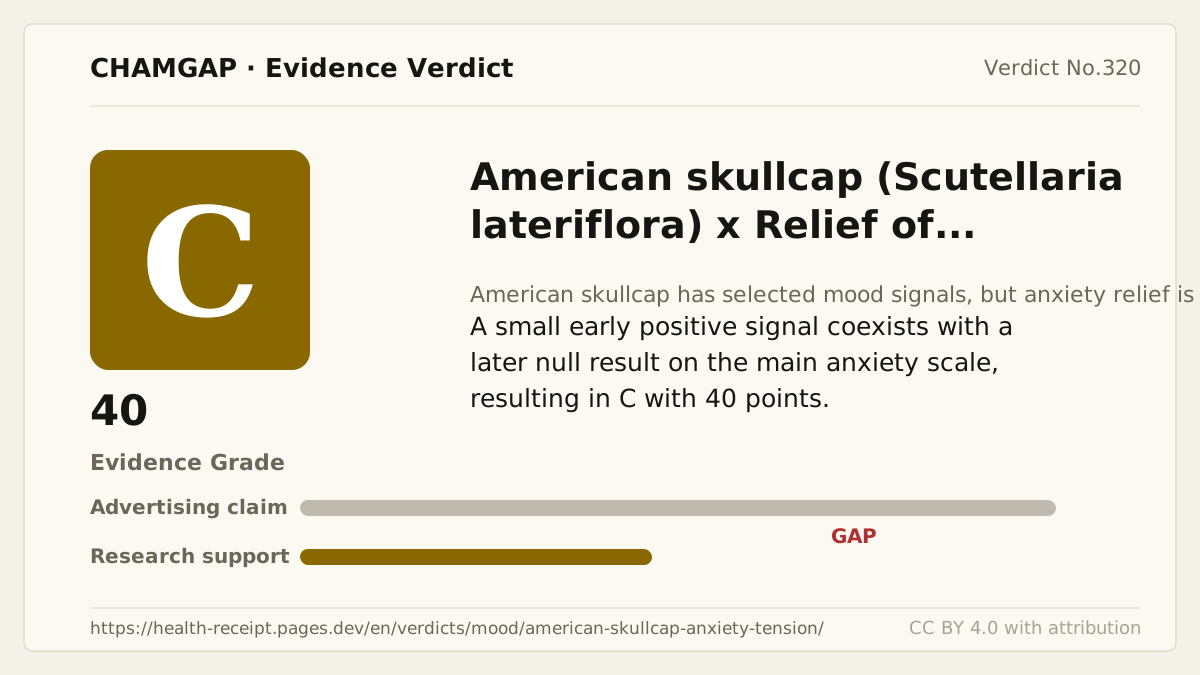
[Chamgap] American skullcap (Scutellaria lateriflora) × Relief of anxiety and tension — Evidence Grade C·40. 3 cited sources checked. Source: https://chamgap.com/en/verdicts/mood/american-skullcap-anxiety-tension/ · CC BY 4.0CC BY 4.0 — free to use with attribution; do not distort grades, numbers, or verdict meaning.
What this document does and does not do
Chamgap is an information source. It reports what research has and has not confirmed; it does not tell readers what to take or buy. That decision belongs to readers and, when needed, medical or legal professionals. This verdict reflects literature available up to the search date and may change as new research appears. Nothing here is medical advice.