
5-HTP,
does it really help with Mood, appetite, and sleep?
research shows5-HTP has old small-study signals for depressive symptoms, appetite, and sleep, but modern large independent RCT evidence is lacking. The Cochrane review concluded that for depression there were only 2 high-quality studies with 64 participants, and appetite and weight studies were also small and old.
ads claimAdvertising bundles 'happy hormone,' 'serotonin,' 'appetite suppression,' and 'deep sleep' into one message. However, depression, appetite, and sleep are different clinical endpoints, and their evidence levels also differ.
Useful facts when choosing a product
- Supplement doses commonly use 50-200 mg per serving, but older studies sometimes used higher total amounts.
- Caution is needed when combined with serotonergic drugs or herbs such as SSRIs, SNRIs, MAOIs, triptans, and St. John's wort.
- Adverse effects such as nausea, diarrhea, drowsiness, and vivid dreams are reported.
- The relationship with EMS includes contamination issues, but Cochrane also noted safety uncertainty.
What the research actually shows
The Shaw 2002 Cochrane review examined 5-HTP and tryptophan studies for depression and stated that only 2 RCTs, totaling 64 participants, were eligible for inclusion. Effect estimates looked better than placebo, but study quality was low and not conclusive. For appetite and weight, small RCTs by Cangiano 1992/1998 showed signals that 5-HTP reduced food intake and body weight, but samples were small, duration was short, and the studies are distant from modern obesity-treatment research standards. Sleep evidence centers on the mechanism as a melatonin precursor and some small or combination-product studies, so the evidence for 5-HTP alone is weak.
Why this is classified as C (43)
For depression and appetite, there are positive human signals, so this is not ? or D. However, the core evidence is old and small, and sleep-alone claims are weaker. Reflecting composite-claim separation and safety uncertainty, it is judged at the lower end of C, 43 points.
Counterpoint. Depression, insomnia, and appetite problems under drug treatment have a different risk-benefit context from general supplement use. This judgment is an evidence grade for general health-functional-food style claims.
Rejudgment record. Draft — Human signals exist, but quality is low, claims are composite, and safety requires caution.
Cross-check — Codex and Claude
Evidence Table
| Study | Design | Sample | Funding | Endpoint | Result | Weight |
|---|---|---|---|---|---|---|
| Shaw KA et al. 2002 | Cochrane review | 64 | Independent review | Depressive symptoms | There was a signal versus placebo, but the quality of evidence was not conclusive. | Core |
| Cangiano C et al. 1992 | Randomized placebo-controlled trial | Unknown | Food intake and body weight | Reported a signal that 5-HTP reduced food intake and body weight. | Supporting | |
| Cangiano C et al. 1998 | Randomized placebo-controlled trial | 2 | Unknown | Calorie intake and body weight | Reported a short-term signal for reduced food intake. | Supporting |
| Turner EH et al. 2006 | Narrative review | Unknown | Evidence and safety for serotonin precursors | Summarized the pharmacology, limited clinical evidence, and interaction potential of 5-HTP. | Supporting |
Receipt — 3 References
All 3 cited sources were verified for existence at the original page (as of 2026-07-09).
Reviewed and approved: Chamgap Editorial Team · Approval date: 2026-07-09 · Corrections: none
Cite this verdict
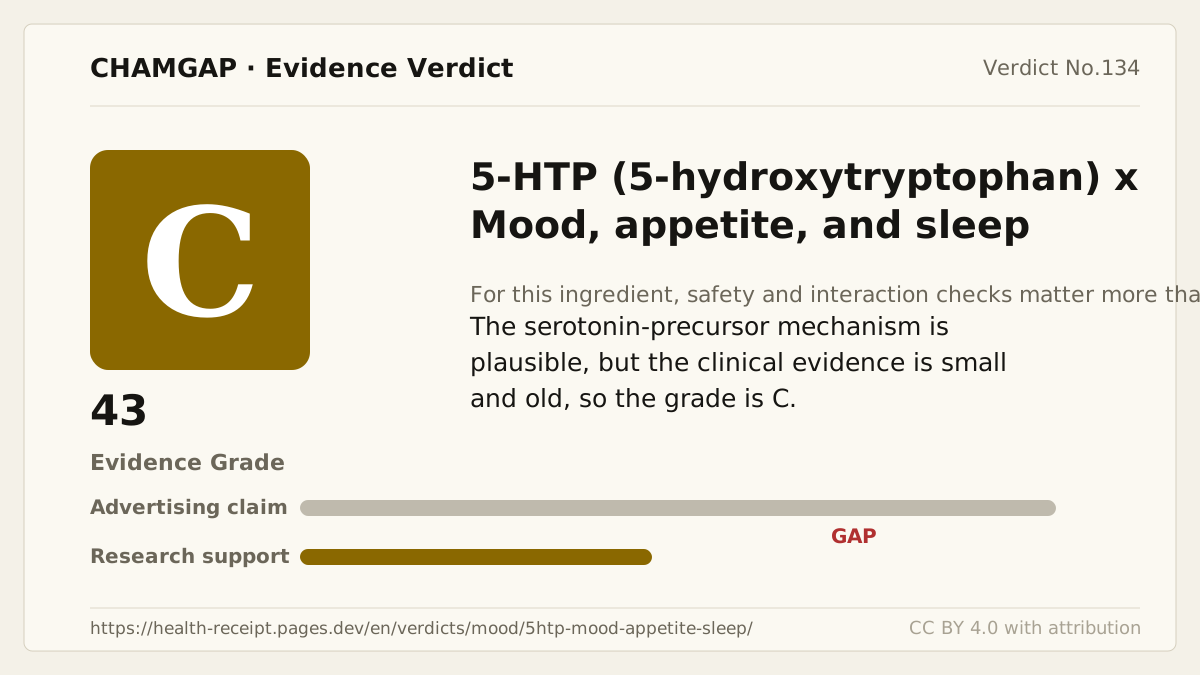
[Chamgap] 5-HTP x mood, appetite, and sleep — Evidence Grade C·43. 3 cited sources checked. Source: https://chamgap.com/en/verdicts/mood/5htp-mood-appetite-sleep/ · CC BY 4.0CC BY 4.0 — free to use with attribution; do not distort grades, numbers, or verdict meaning.
What this document does and does not do
Chamgap is an information source. It reports what research has and has not confirmed; it does not tell readers what to take or buy. That decision belongs to readers and, when needed, medical or legal professionals. This verdict reflects literature available up to the search date and may change as new research appears. Nothing here is medical advice.