
Saw palmetto,
does it really help with prostate health (urination) and hair-loss relief?
research showsThe claim that saw palmetto “improves prostate health (urination)” has not been repeatedly confirmed in the highest-reliability human evidence. Large placebo-controlled trials funded independently rather than by manufacturers (NIH), STEP with 225 participants and CAMUS with 369 participants, and the updated Cochrane meta-analysis integrating them (27 studies, 4,656 participants) found that urinary symptom scores, urinary flow, and quality of life were all “little to no different” from placebo, and no improvement appeared even when the dose was raised up to three times the usual dose (CAMUS’s prespecified primary endpoint was not significant between groups). Studies reporting “effectiveness” were generally small (Kimura 66 participants), compared against another drug rather than placebo (Alcaraz, active control tamsulosin), or were manufacturer-sponsored/conducted trials. The hair-loss-relief claim has weaker and more heterogeneous evidence; review authors wrote that “robust high-quality data are lacking,” and positive results are concentrated in manufacturer-owned product trials (Sudeep, VISPO). Based on public materials, the functionality recognized by the Korean MFDS is within the scope of “may help maintain prostate health,” which is an expression about “maintenance” and is on a different level from “symptom treatment” or “urination improvement” (details of individual labeling and regulatory judgment are outside the scope of this verification and remain follow-up targets). In short, the grade for this judgment is F: although safety issues are not large, the core claim that “urination improves” has repeatedly shown no effect in the highest-quality human evidence, and hair-loss relief lacks high-quality evidence.
ads claimDomestic advertisements are observed to use expressions that go beyond the MFDS-recognized wording (“may help maintain prostate health”). As a public-copy example, NZ Origin (Costco) links “people who lose sleep every night because of urination / people whose urination speed has fallen and who feel residual urine” to “recommended for these people,” which appears to imply improvement of nocturia, residual urine, and urination speed, raising the possibility of misleading symptom-improvement impression beyond the recognized “maintenance” scope (failure pattern B1: surrogate/symptom confusion). Atomy, Dr. Esther, and others are confirmed to state “maintenance of prostate health” plus “improvement of endurance,” without explicitly stating urination improvement. Some brands’ “DHT inhibition -> hair-loss suppression” framing is outside MFDS-recognized functionality, and based on public materials, no food/health functional food recognized for hair-loss prevention or treatment efficacy in Korea was confirmed. Whether individual advertising violates regulations or is subject to enforcement is outside the scope of this verification (follow-up target). Core mismatch: advertising gives the impression that “urination improves / it is good for hair loss,” but large independent placebo-controlled trials and the updated Cochrane meta-analysis did not confirm urination improvement, and hair-loss efficacy is outside the recognized scope.
Useful facts when choosing a product
- Based on public materials, the MFDS-recognized functionality is within the scope of “may help maintain prostate health,” and the functional (marker) component is known to be lauric acid. Products labeled with daily lauric-acid intake around 70~115 mg are confirmed, but detailed specifications such as notified-type/individually recognized classification are outside the scope of this verification (follow-up target).
- Doses in large placebo-controlled trials (320~960 mg/day) overlap with usual commercial product doses, although formulation differences such as U.S. large-trial extracts versus hexane extracts make “whether it is null even in the same formulation” a separate issue. This judgment states only the fact that CAMUS’s 960 mg/day high-dose condition still had a negative primary endpoint.
- “Maintenance of prostate health” is within the recognized wording, but “symptom treatment” and “improvement of urination (nocturia/residual urine)” are different in scope and level. Whether advertisements connecting nocturia or residual urine sensation as if improved are misleading under regulation is outside the scope of this verification (follow-up target).
- Based on public materials, no food/health functional food recognized in Korea for hair-loss prevention or treatment efficacy was confirmed. Whether “hair-loss relief” labeling/advertising for saw palmetto is unfair advertising is outside the scope of this verification (follow-up target).
- Example products for sale (based on public labeling): Atomy saw palmetto fruit extract 320 mg/capsule, Dr. Esther Saw Palmetto & Octacosanol 500 mg, NZ Origin (Costco) lauric acid 115 mg plus octacosanol, zinc, etc. They are generally confirmed as health functional foods labeled for “maintenance of prostate health,” but the accuracy of individual product labeling remains a follow-up confirmation target.
- Safety: saw palmetto is well tolerated and has few serious adverse-effect signals (Cochrane also concluded adverse events are little to no different from placebo). However, the fact that urinary effect is no different from placebo and the fact that it is safe are separate facts.
What the research actually shows
Urination/prostate: large, independent, placebo-controlled evidence consistently shows no improvement. STEP (NEJM 2006, PMID 16467543): 320 mg/day for 12 months, 225 men with BPH, independent NIH funding. Between-group AUASI difference 0.04 points and peak urinary flow difference 0.43 mL/min; all non-significant. CAMUS (JAMA 2011, PMID 21954478): dose escalation 320 -> 640 -> 960 mg/day, 369 men, NIDDK funding. Prespecified primary endpoint (72-week AUASI change) was saw palmetto -2.20 points vs placebo -2.99 points, not significant between groups; improvement was not confirmed even at three times the standard high dose. Updated Cochrane review (2023/2024, CD001423.pub4, PMC11216968): integrated 27 placebo-controlled studies and 4,656 men. For both short term (3~6 months) and long term (12~17 months), saw palmetto made “little to no difference” versus placebo in urinary symptoms and quality of life (high-certainty short-term evidence), and adverse events were also “little to no difference” (moderate certainty); it concluded saw palmetto alone has “little to no benefit.” Conversely, positive signals have lower evidence quality: Alcaraz 2021 (PMID 34588509) compared with tamsulosin rather than placebo (active control, 737 participants, IPSS p=0.117), so it does not show superiority over placebo and has manufacturer (Pierre Fabre) interests; Kimura 2024 (PMC12423462) was a small (66 participants), short-term, manufacturer (YAWATA)-sponsored trial in healthy adults rather than patients, and only sub-urinary indicators were significant. Hair loss: Evron 2020 review (PMID 33313047) mentions improvement signals (hair quality 60%, hair count 27%, density 83.3%), but the authors concluded “robust high-quality data are lacking”; Sudeep 2023 (PMC10648974) was a manufacturer (Vidya Herbs) own product (VISPO) and self-conducted trial, with density improvement only 5~8%. Overall: prostate urination improvement is repeatedly confirmed to have no effect in the highest-quality evidence, and hair loss lacks high-quality human evidence.
Why this is classified as F
Because this is a compound claim (prostate/urination + hair loss), endpoints are scored separately and then synthesized. [Prostate/urination endpoint] The core claim that “saw palmetto improves urination” was found to have “little to no difference” from placebo in the most reliable types of evidence: large, independent (NIH), placebo-controlled RCTs (STEP, CAMUS) and an updated high-quality meta-analysis (Cochrane 2023/2024, 27 studies, 4,656 participants). The prespecified primary endpoint of CAMUS was not significant even at a high dose three times the usual dose. This corresponds to F, because no effect has been repeatedly confirmed in high-quality human evidence. The original judgment stayed at D on the ground that this was not strong disconfirmation of being harmful or worse than placebo, but methodologically F includes not only “disproof of the claim” but also “repeated confirmation of no effect in good-quality studies”; safety (no different from placebo) is a separate axis from efficacy grade. Therefore F is coherent with the evidence hierarchy for the urinary endpoint. [Hair-loss endpoint] The evidence is weaker than for urination: review authors explicitly stated that high-quality data are lacking, and positive trials are limited to manufacturer-owned products and small effects, so alone this endpoint is around D~? (literature insufficient). Under 2-1 chapter ③, a weak secondary endpoint (hair loss D~?) does not raise the core endpoint (urination F), and urination, the MFDS-recognized functionality and main marketing axis, governs the overall grade. The overall grade is judged F. Note: F applies to the efficacy claim that symptoms/objective indicators improve versus placebo; it does not deny the narrow MFDS-recognized “maintenance of prostate health” functional expression itself or product safety.
Counterpoint. Opposing perspectives are also recorded. (1) Specific-formulation debate: Alcaraz 2021 and others report that hexane extract (HESr, Permixon) has a different component profile from the extracts used in U.S. large trials and showed improvement similar to tamsulosin; this is the counterargument that “not all saw palmetto is the same” (failure pattern E3: formulation separation). However, this trial was active-controlled, not placebo-controlled, and had manufacturer interests, so it is not direct evidence of being better than placebo. Thus F is strongest for the extract families used in the U.S. large trials, and repeated placebo-controlled evidence for specific hexane formulations is relatively thin. (2) Signal in the general population: Kimura 2024 found that in healthy adults with mild symptoms, a population different from large patient RCTs, some indicators such as daytime urination frequency and discomfort improved significantly versus placebo; different results may be possible in early/mild symptom groups. However, this is small, short-term, manufacturer-sponsored, and significant only on sub-indicators, requiring confirmation with multiple-comparison correction and perceptible effect size (B1). (3) Safety: saw palmetto is well tolerated and has few serious adverse-effect signals (Cochrane also found adverse events “little to no difference” from placebo). These counterarguments are not “there is definitely an effect,” but only “there is room for further research under specific conditions/formulations,” and they do not overturn the current highest-quality evidence conclusion of “little to no difference.”
Sub-claim grades by effect
This ingredient is marketed for several effects. A single overall grade blends strong and weak claims together, so each effect is graded separately here. The overall grade reflects the strongest disconfirming or core claim.
| Effect (sub-claim) | Grade | Basis |
|---|---|---|
| Urination/prostate | F | Null repeatedly in large independent placebo-controlled RCTs (STEP, CAMUS) and Cochrane meta-analyses |
| Hair loss | D | Little high-quality human evidence (mostly small or preclinical) |
Cross-check — Codex and Claude
Evidence Table
| Study | Design | Sample | Funding | Endpoint | Result | Weight |
|---|---|---|---|---|---|---|
| Franco JVA, Trivisonno L, Sgarbossa NJ et al. 2023 | meta-analysis and RCTs | 4,656 | manufacturer/industry involvement possible | urination | Updated Cochrane meta-analysis integrating 27 placebo-controlled studies and 4,656 men. Saw palmetto alone/combined made “little to no difference” versus placebo in urinary symptoms and quality of life (high-certainty short-term evidence), and adverse events were also “little to no difference” (moderate certainty). | core |
| Bent S, Kane C, Shinohara K et al. 2006 | double-blind randomized controlled trial | 225 | manufacturer/industry involvement possible | liver | Double-blind placebo-controlled RCT, 225 men with BPH, 320 mg/day for 12 months. AUASI between-group difference was 0.04 points and peak urinary flow difference was 0.43 mL/min; both were non-significant (no difference from placebo). Independent NIH funding (K08 AT01338, R01 DK56199). | core |
| Study 3 | double-blind randomized controlled trial | 369 | manufacturer/industry involvement possible | Double-blind placebo-controlled dose-escalation RCT, 369 men, 320 -> 640 -> 960 mg/day for 72 weeks. AUASI change was saw palmetto -2.20 points vs placebo -2.99 points, with placebo better by 0.79 points; improvement failed even at three times the standard high dose. NIDDK/NIH funding. | core | |
| Study 4 | not specified | 737 | manufacturer/industry involvement possible | liver | Active-control (not placebo) observation-based matched analysis, 737 patients (tamsulosin 353, hexane extract 384), 6 months. IPSS improvement was 5.0 vs 4.5 points (p=0.117, non-significant between groups), so the two treatments were similar. This is not evidence of superiority versus placebo. | core |
| Kimura M, Ishii I, Baba A, Takara T 2024 | double-blind randomized controlled trial | 66 | manufacturer/industry involvement possible | liver and urination | Placebo-controlled RCT, but small (66 participants), short (12 weeks), and in healthy Japanese adults rather than patients. At 320 mg/day, sub-indicators of daytime urination frequency and discomfort improved significantly more than placebo, conflicting with negative results in large patient RCTs. | supporting |
| Evron E, Juhasz M, Babadjouni A, Mesinkovska NA 2020 | systematic review and RCTs | 2 | manufacturer/industry involvement possible | hair loss and hair | Systematic review on hair loss (5 RCTs plus 2 cohorts). It mentions some improvement signals (hair quality 60%, total hair count 27%, density 83.3%), but the authors’ conclusion is “robust high-quality data are lacking,” and large RCTs are needed. | supporting |
| Sudeep HV, Rashmi S, Jestin TV et al. 2023 | randomized controlled trial | 80 | manufacturer/industry involvement possible | hair loss | Placebo-controlled RCT in hair loss, 80 enrolled and 73 completed (20 per group), 16 weeks. Oral VISPO reduced hair loss by up to 29% and increased density by 5.17%; topical VISPO reduced hair loss by 22% and increased density by 7.61%. Significant, but effect sizes were small and limited to the standardized oil. | supporting |
Receipt — 7 References
All 7 cited sources were verified for existence at the original page (as of 2026-07-06).
Reviewed and approved: Chamgap Editorial Team · Approval date: 2026-07-06 · Corrections: none
Cite this verdict
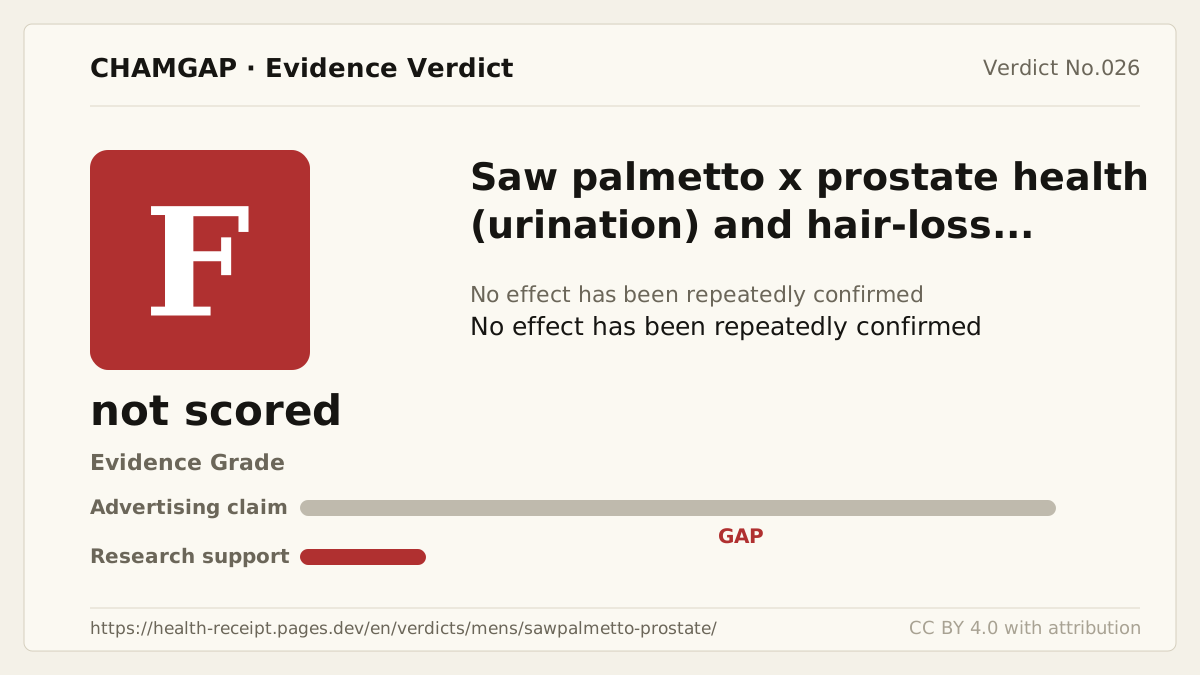
[Chamgap] Saw palmetto x prostate and hair loss — Evidence Grade F. 7 cited sources checked. Source: https://chamgap.com/en/verdicts/mens/sawpalmetto-prostate/ · CC BY 4.0CC BY 4.0 — free to use with attribution; do not distort grades, numbers, or verdict meaning.
What this document does and does not do
Chamgap is an information source. It reports what research has and has not confirmed; it does not tell readers what to take or buy. That decision belongs to readers and, when needed, medical or legal professionals. This verdict reflects literature available up to the search date and may change as new research appears. Nothing here is medical advice.