
D-aspartic acid,
does it really help with Increase in testosterone and muscle?
research showsAn early 12-day unblinded study reported higher testosterone, but subsequent independent controlled trials in resistance-trained men did not reproduce benefits for testosterone, strength, or lean-mass gain at 3 g/day, and lower testosterone was reported at 6 g/day. A 12-week RCT also found no added training adaptation, supporting F.
ads claimAdvertisements use claims such as 'raises testosterone 42%,' 'natural hormone booster,' and 'increases muscle and strength.' The 42% figure relies on an early short unblinded result and conflicts with subsequent controlled trials.
Useful facts when choosing a product
- Human trials mainly used 3 g/day or 6 g/day.
- Resistance training increased strength and hypertrophy in both groups, but D-aspartic acid added no benefit.
- A 6 g/day dose was associated with lower total and free testosterone.
- Long-term safety data are limited, and irritability, headache, and sensations of rapid heartbeat were reported in some research.
What the research actually shows
Topo 2009 gave about 3.12 g/day to 23 men for 12 days and reported higher testosterone, but the study was small and unblinded. Willoughby 2013 reported no added effects of 3 g/day on hormones, body composition, or strength during 28 days of resistance training. Melville 2015 reported no effect at 3 g/day and lower total and free testosterone at 6 g/day. Melville 2017 found no added testosterone, hypertrophy, or strength benefit in a 12-week RCT of 6 g/day.
Why this is classified as F (12)
Three more rigorous independent placebo-controlled trials repeatedly found null or opposite results for hormones and training adaptation, outweighing one early positive study. Repeated evidence of no effect supports F with 12 points.
Counterpoint. Untrained people or those with low baseline testosterone have not been adequately tested. This uncertainty does not change the repeated null result for claims aimed at resistance-trained men.
Rejudgment record. New judgment — Unlike the early unblinded positive study, independent placebo-controlled trials in resistance-trained men repeatedly found no testosterone, strength, or hypertrophy benefit, with a decrease at high dose
Sub-claim grades by effect
This ingredient is marketed for several effects. A single overall grade blends strong and weak claims together, so each effect is graded separately here. The overall grade reflects the strongest disconfirming or core claim.
| Effect (sub-claim) | Grade | Basis |
|---|---|---|
| Increase in testosterone | F | Independent controlled trials were repeatedly null, and testosterone decreased at 6 g/day. |
| Increase in muscle and strength | F | No added supplement effect beyond training-related gains was repeatedly demonstrated. |
Cross-check — Codex and Claude
Evidence Table
| Study | Design | Sample | Funding | Endpoint | Result | Weight |
|---|---|---|---|---|---|---|
| Topo E et al. 2009 | Unblinded comparative clinical and mechanistic study | 23 | Unknown | LH and testosterone | Reported increases after 12 days, but the study was small, unblinded, and did not assess training outcomes. | Counterevidence |
| Willoughby DS, Leutholtz B. 2013 | Randomized double-blind placebo-controlled trial | 20 | Independent university research; details unclear | Hormones, body composition, and strength | At 3 g/day for 28 days, there was no added testosterone, muscle, or strength effect versus placebo. | Key |
| Melville GW et al. 2015 | Randomized double-blind dose-controlled trial | 24 | University research; no conflicts reported | Total and free testosterone and other hormones | The 3 g/day dose was null and 6 g/day lowered total and free testosterone. | Key |
| Melville GW et al. 2017 | Twelve-week randomized double-blind placebo-controlled trial | 22 | Academic research at Western Sydney University | Testosterone, muscle cross-sectional area, and strength | There was no added testosterone or training-adaptation benefit at 6 g/day. | Decisive |
Receipt — 4 References
All 4 cited sources were verified for existence at the original page (as of 2026-07-11).
Reviewed and approved: Chamgap Editorial Team · Approval date: 2026-07-11 · Corrections: none
Cite this verdict
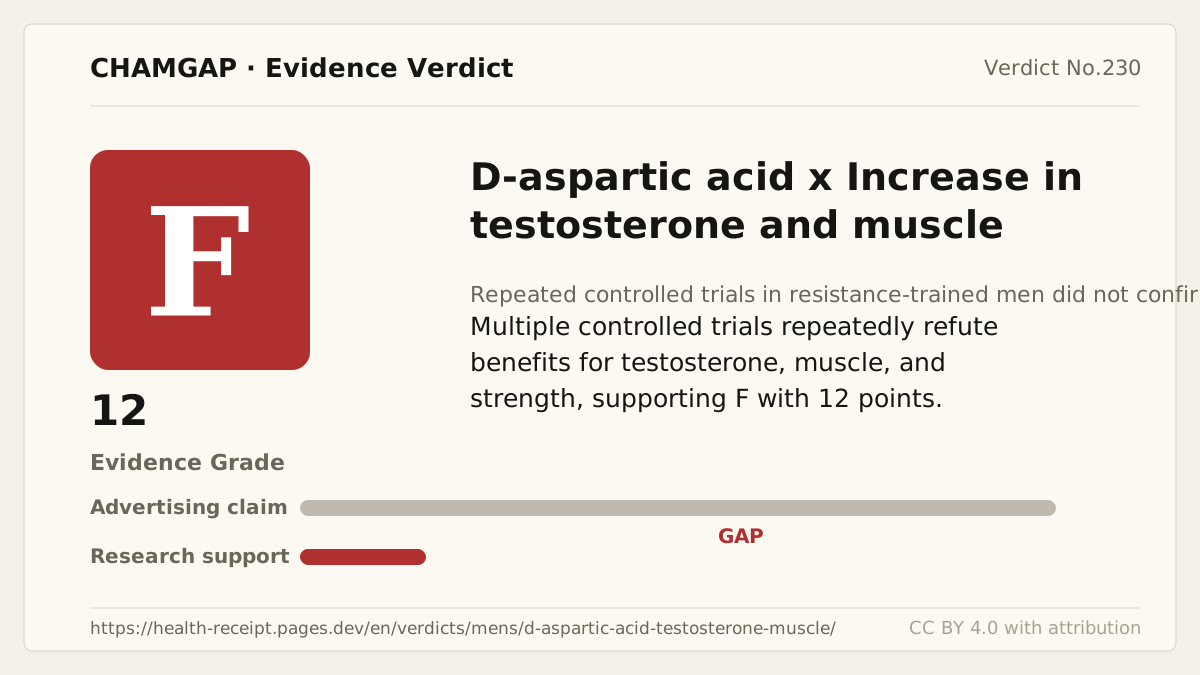
[Chamgap] D-aspartic acid x increase in testosterone and muscle — Evidence Grade F·12. 4 cited sources checked. Source: https://chamgap.com/en/verdicts/mens/d-aspartic-acid-testosterone-muscle/ · CC BY 4.0CC BY 4.0 — free to use with attribution; do not distort grades, numbers, or verdict meaning.
What this document does and does not do
Chamgap is an information source. It reports what research has and has not confirmed; it does not tell readers what to take or buy. That decision belongs to readers and, when needed, medical or legal professionals. This verdict reflects literature available up to the search date and may change as new research appears. Nothing here is medical advice.