
White willow bark extract,
does it really help with Relief of osteoarthritis pain?
research showsThe extract-only trials cited here did not test white willow, Salix alba. The positive 78-person trial used S. purpurea x daphnoides, while the larger negative 127-person trial used S. daphnoides. All six RCTs in the 2023 meta-analysis were at high risk of bias, and some tested combination products. This C rating therefore applies to standardized Salix spp. bark extracts, not S. alba alone.
ads claimAdvertisements use phrases such as 'natural aspirin,' 'calms joint inflammation,' and 'painkiller substitute.' Trials measured short-term symptom scores for specific standardized extracts, not structural improvement or drug equivalence.
Useful facts when choosing a product
- The main extract-only RCTs used a formulation standardized to 240 mg/day of salicin.
- Trial durations were short at two and six weeks.
- The positive trial used S. purpurea x daphnoides, while the larger negative trial used S. daphnoides.
- Salicylate-related safety requires separate assessment; willow bark should not be treated as identical to aspirin.
What the research actually shows
Schmid 2001 gave an S. purpurea x daphnoides extract for two weeks to 78 people with hip or knee osteoarthritis and reported WOMAC pain improvement. Biegert 2004 assigned 127 people with osteoarthritis to an S. daphnoides extract, diclofenac, or placebo and found no significant extract-placebo difference. Lin 2023 pooled six RCTs with 329 participants involving Salix spp.; all trials were at high risk of bias and some tested combinations. No key trial establishes efficacy of S. alba alone.
Why this is classified as C (44)
Short RCTs and a meta-analysis of standardized Salix spp. extracts prevent D, but the positive 78-person trial conflicts with a larger negative 127-person trial, all six pooled RCTs were at high risk of bias, some used combinations, and evidence for S. alba alone is essentially absent. The result is low C with 44 points.
Counterpoint. A short-term pain signal remains for a specific standardized Salix spp. extract. It does not extend to S. alba alone, every willow product, long-term structural improvement, or aspirin-equivalent safety.
Rejudgment record. Reassessment (cross-check reflected) — The positive trial used S. purpurea x daphnoides, the larger negative trial used S. daphnoides, evidence for S. alba alone is absent, and all six pooled RCTs were at high risk of bias with some combination products
Cross-check — Codex and Claude
Evidence Table
| Study | Design | Sample | Funding | Endpoint | Result | Weight |
|---|---|---|---|---|---|---|
| Schmid B et al. 2001 | Randomized double-blind placebo-controlled RCT | 78 | Unknown | WOMAC pain and function | An S. purpurea x daphnoides extract reduced WOMAC pain by about 14% over two weeks and was positive versus placebo. | Key positive |
| Biegert C et al. 2004 | Six-week randomized double-blind placebo- and active-controlled RCT | 127 | Unknown | WOMAC pain | The S. daphnoides extract-placebo difference was -2.8 mm, 95% CI -12.1 to 6.4, p=0.55; diclofenac was positive. | Key negative |
| Lin CR et al. 2023 | Systematic review and meta-analysis of RCTs | 329 | No external funding | Arthritis pain, function, and adverse events | Pooled pain and function were positive, but all six RCTs were at high risk of bias and some used combination products. | Key synthesis |
Receipt — 3 References
All 3 cited sources were verified for existence at the original page (as of 2026-07-11).
Reviewed and approved: Chamgap Editorial Team · Approval date: 2026-07-11 · Corrections: none
Cite this verdict
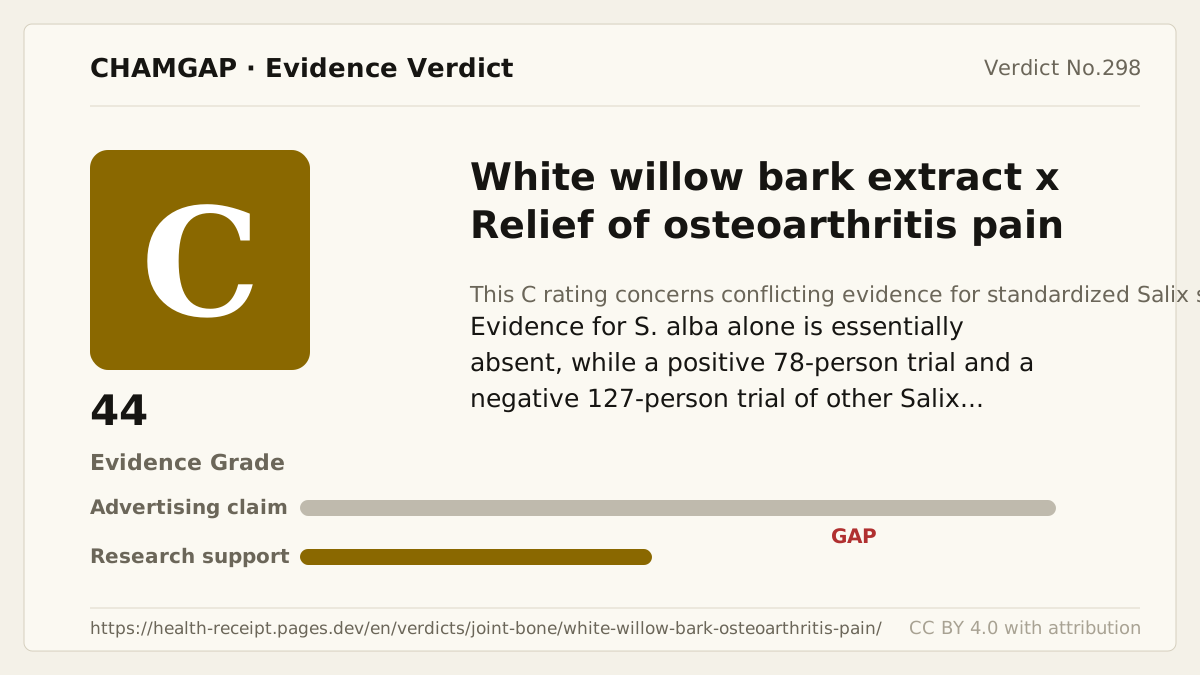
[Chamgap] White willow bark extract x relief of osteoarthritis pain — Evidence Grade C·44. 3 cited sources checked. Source: https://chamgap.com/en/verdicts/joint-bone/white-willow-bark-osteoarthritis-pain/ · CC BY 4.0CC BY 4.0 — free to use with attribution; do not distort grades, numbers, or verdict meaning.
What this document does and does not do
Chamgap is an information source. It reports what research has and has not confirmed; it does not tell readers what to take or buy. That decision belongs to readers and, when needed, medical or legal professionals. This verdict reflects literature available up to the search date and may change as new research appears. Nothing here is medical advice.