
Strontium citrate,
does it really help with Increased bone mineral density and fracture prevention?
research showsThe only positive RCT tested a combination of melatonin, strontium citrate, vitamin D3, and vitamin K2 in just 11 participants per group. Strontium can replace calcium in bone and overestimate DXA bone density by about 9% to 11%, so a numerical increase cannot be read directly as efficacy. Fracture data concern the different prescription drug strontium ranelate, and no human efficacy literature for strontium citrate alone was identified; the rating is deferred.
ads claimAdvertisements place 'higher bone density' beside fracture data from prescription strontium ranelate. Direct citrate data consist of a combination DXA trial and bone-accumulation studies, not fracture RCTs of the same salt.
Useful facts when choosing a product
- MOTS used 450 mg/day of strontium citrate together with three other ingredients.
- Bone strontium can physically raise DXA readings.
- Strontium ranelate and strontium citrate are different salts.
- Long-term cardiovascular safety data for non-ranelate strontium are limited.
What the research actually shows
The Maria 2017 MOTS randomized 22 postmenopausal women with osteopenia, 11 per group, to placebo or a combination of melatonin, strontium citrate, vitamin D3, and vitamin K2 for one year. DXA readings increased, but the four components could not be separated. Moise 2014 and 2016 measured bone strontium accumulation and were exposure studies without efficacy endpoints. Liao 2010 showed that replacement of bone calcium by strontium can overestimate DXA BMD by about 9% to 11%, depending on the device. Fracture RCTs concern ranelate, not citrate.
Why this is classified as ?
The positive evidence is limited to an 11-per-group four-ingredient RCT that cannot isolate citrate, and strontium-related DXA overestimation prevents reading the numerical increase as direct efficacy. Because human efficacy literature for citrate alone is absent, the grade is unknown rather than D and the score is null.
Counterpoint. Combination-product DXA changes and human bone accumulation remain exposure signals. A future citrate-alone trial of bone strength or fractures can be rated separately.
Rejudgment record. Reassessment (cross-check reflected) — The only positive RCT used melatonin, citrate, D3, and K2 in 11 participants per group; DXA may be overestimated by 9% to 11%, and no human efficacy literature for citrate alone was identified
Cross-check — Codex and Claude
Evidence Table
| Study | Design | Sample | Funding | Endpoint | Result | Weight |
|---|---|---|---|---|---|---|
| Maria S et al. 2017 | One-year double-blind placebo-controlled combination RCT | 22 | Unknown | DXA BMD, bone-turnover markers, and estimated fracture risk | The four-ingredient combination increased spine BMD by 4.3% and femoral-neck BMD by 2.2%; citrate alone cannot be credited. | Key indirect, combination |
| Moise H et al. 2014·2016 | Self-supplementation observation with bone X-ray fluorescence | 8 | Canadian academic research support | Bone strontium accumulation and half-life | Confirmed accumulation and long retention during citrate use, without an efficacy endpoint. | Mechanistic |
| Liao J et al. 2010 | Theoretical and phantom validation across DXA devices | 4 | Unknown | BMD measurement bias caused by strontium | Replacing 1% of calcium atoms could overestimate DXA by roughly 6% to 11%, depending on the device. | Interpretation key |
Receipt — 3 References
All 3 cited sources were verified for existence at the original page (as of 2026-07-11).
Reviewed and approved: Chamgap Editorial Team · Approval date: 2026-07-11 · Corrections: none
Cite this verdict
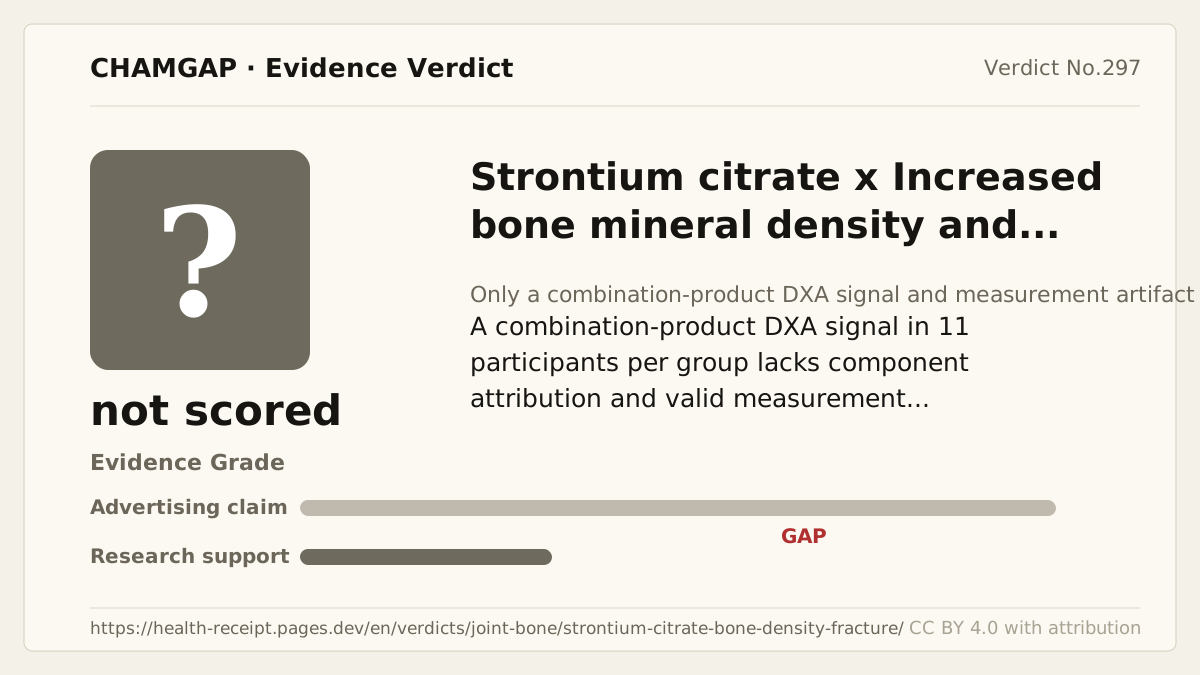
[Chamgap] Strontium citrate x increased bone mineral density and fracture prevention — Evidence Grade ?. 3 cited sources checked. Source: https://chamgap.com/en/verdicts/joint-bone/strontium-citrate-bone-density-fracture/ · CC BY 4.0CC BY 4.0 — free to use with attribution; do not distort grades, numbers, or verdict meaning.
What this document does and does not do
Chamgap is an information source. It reports what research has and has not confirmed; it does not tell readers what to take or buy. That decision belongs to readers and, when needed, medical or legal professionals. This verdict reflects literature available up to the search date and may change as new research appears. Nothing here is medical advice.