
Shark cartilage,
does it really help with Joints and anticancer effects?
research showsIn the phase 3 NSCLC trial, median overall survival was 14.4 months (95% CI 12.6 to 17.9) with AE-941 and 15.6 months (13.8 to 18.1) with placebo, but these are group-specific median intervals, not a treatment-effect interval. No pooled interval in the same cancer was verified, and no stand-alone human trial for the joint claim was found. Because clinically meaningful benefit is not excluded, the grade is D with 25 points, not F.
ads claimAdvertisements combine claims of 'cartilage supplementation,' 'joints,' 'angiogenesis inhibition,' and 'anticancer' effects. Clinical trials produced null results for the anticancer claim, and the joint claim has weak independent evidence.
Useful facts when choosing a product
- AE-941 is a purified shark-cartilage extract and is not the same as ordinary powder products, but it is the core clinical trial for the anticancer claim.
- Excess calcium, gastrointestinal symptoms, product contamination, and sustainability concerns are mentioned.
- It cannot be used as evidence to replace anticancer treatment.
- Shark-cartilage-derived chondroitin and pharmaceutical-grade chondroitin sulfate differ in quality and evidence.
What the research actually shows
The Lu 2010 phase III RCT added AE-941 to standard chemoradiotherapy in 379 patients with stage III non-small-cell lung cancer, but it did not improve overall survival. The Loprinzi 2005 NCCTG study also failed to show a signal that a shark-cartilage product improved quality of life or survival in patients with advanced breast or colorectal cancer. There is also a critical paper stating that the premise that sharks do not get cancer is biologically incorrect.
Why this is classified as D (25)
In the phase 3 NSCLC trial, median overall survival was 14.4 months (95% CI 12.6 to 17.9) with AE-941 and 15.6 months (13.8 to 18.1) with placebo, but these are group-specific median intervals, not a treatment-effect interval. No pooled interval in the same cancer was verified, and no stand-alone human trial for the joint claim was found. Because clinically meaningful benefit is not excluded, the grade is D with 25 points, not F.
Counterpoint. If the joint question is changed to chondroitin sulfate, that is a separate judgment target, but the judgment for shark cartilage itself is different.
Rejudgment record. Draft — In the phase 3 NSCLC trial, median overall survival was 14.4 months (95% CI 12.6 to 17.9) with AE-941 and 15.6 months (13.8 to 18.1) with placebo, but these are group-specific median intervals, not a treatment-effect interval. No pooled interval in the same cancer was verified, and no stand-alone human trial for the joint claim was found. Because clinically meaningful benefit is not excluded, the grade is D with 25 points, not F.
Sub-claim grades by effect
This ingredient is marketed for several effects. A single overall grade blends strong and weak claims together, so each effect is graded separately here. The overall grade reflects the strongest disconfirming or core claim.
| Effect (sub-claim) | Grade | Basis |
|---|---|---|
| Anticancer | D | Close to disconfirmed: large phase-3 (Lu 2010, NSCLC n=379) null for overall survival |
| Joint | ? | Insufficient human efficacy evidence for shark cartilage alone (deferred) |
Cross-check — Codex and Claude
Evidence Table
| Study | Design | Sample | Funding | Endpoint | Result | Weight |
|---|---|---|---|---|---|---|
| Lu C et al. 2010 | Phase III randomized placebo-controlled trial | 379 | NCI/product-developer involvement | Overall survival | Adding AE-941 did not improve overall survival. | Core |
| Loprinzi CL et al. 2005 | Randomized placebo-controlled trial | 83 | NCCTG/unknown | Quality of life and survival | No efficacy signal was shown in patients with advanced cancer. | Core |
| Ostrander GK et al. 2004 | Critical review | Academic | Shark-cancer myth and evidence | It explained that sharks also get cancer and that anticancer claims for crude extracts are not supported. | Supporting |
Receipt — 4 References
All 4 cited sources were verified for existence at the original page (as of 2026-07-10).
Reviewed and approved: Chamgap Editorial Team · Approval date: 2026-07-10 · Corrections: none
Cite this verdict
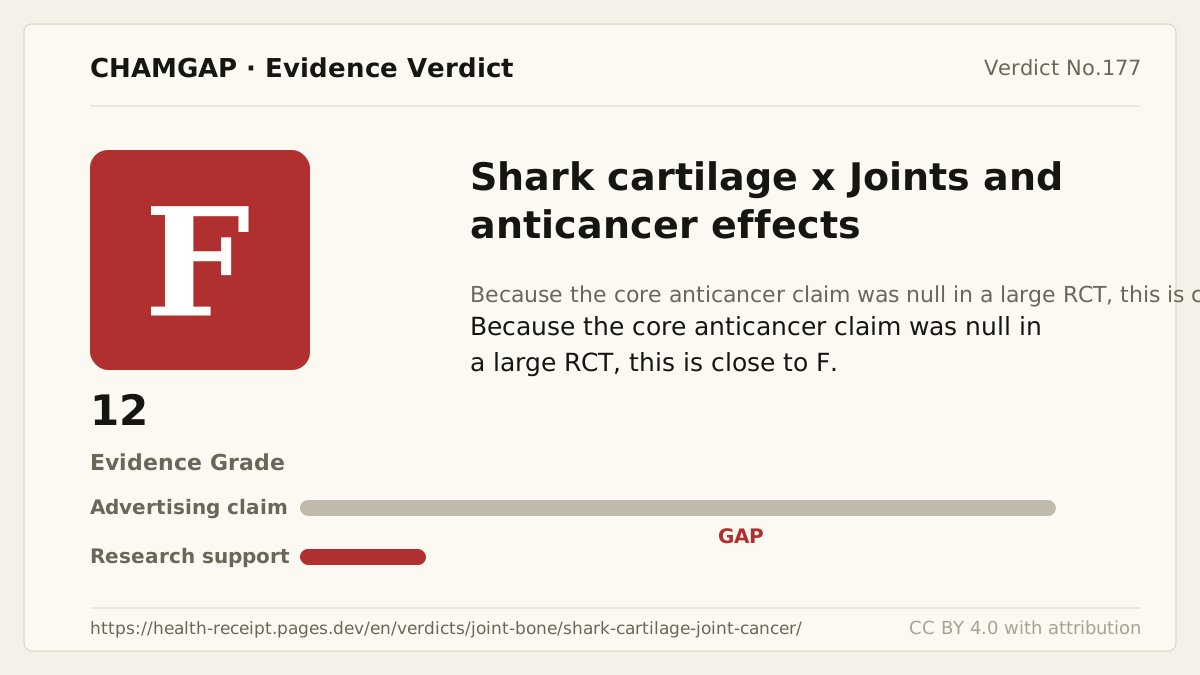
[Chamgap] Shark Cartilage × Joints and Anticancer Effects — Evidence Grade D·25. 4 cited sources checked. Source: https://chamgap.com/en/verdicts/joint-bone/shark-cartilage-joint-cancer/ · CC BY 4.0CC BY 4.0 — free to use with attribution; do not distort grades, numbers, or verdict meaning.
What this document does and does not do
Chamgap is an information source. It reports what research has and has not confirmed; it does not tell readers what to take or buy. That decision belongs to readers and, when needed, medical or legal professionals. This verdict reflects literature available up to the search date and may change as new research appears. Nothing here is medical advice.