
Boron,
does it really help with Bones, joints, and hormones?
research showsBoron has no RDA as an essential nutrient, and there is also limited consensus on a human clinical deficiency syndrome. There are small studies suggesting that it can change calcium/magnesium metabolism and sex-hormone markers, but evidence directly showing clinical effects on fractures, bone mineral density, joint pain, or hormones is weak.
ads claimAdvertisements mention 'bone mineral density,' 'joints,' 'testosterone,' and 'estrogen balance.' The verifiable evidence is mainly changes in blood and urine markers, and 'hormone enhancement' and 'bone strengthening' should be separated and viewed as closer to D.
Useful facts when choosing a product
- The U.S. adult UL is listed as 20 mg/day.
- Kidney disease, pregnancy/lactation, and long-term high-dose use require caution.
- A conservative approach is needed for hormone-sensitive conditions.
- This should not be interpreted as a clinical effect like osteoporosis drugs or testosterone therapy.
What the research actually shows
Boron has no RDA as an essential nutrient, and consensus on a human clinical deficiency syndrome is limited. Nielsen's metabolic studies reported that changes in boron intake may affect calcium/magnesium excretion and some steroid-hormone markers in postmenopausal women. Naghii 2011 administered 10 mg/day for 1 week to 8 healthy men and observed changes in free testosterone, estradiol, and inflammatory markers, but the sample was very small and the endpoints were short-term surrogate markers. Calcium fructoborate joint studies are small pilot signals, and evidence on direct endpoints for fractures or bone mineral density is weak.
Why this is classified as C (40)
There are human metabolic-marker and pilot signals, but because there is no RDA, consensus on a deficiency syndrome is limited, and direct clinical endpoints are lacking, the grade is C, 40 points.
Counterpoint. In special diets with low boron intake, separate nutritional assessment may be needed, but the evidence for general efficacy claims is at the lower end of C.
Rejudgment record. Draft — There are human metabolic-marker and pilot signals, but because there is no RDA, consensus on a deficiency syndrome is limited, and direct clinical endpoints are lacking, the grade is C, 40 points.
Cross-check — Codex and Claude
Evidence Table
| Study | Design | Sample | Funding | Endpoint | Result | Weight |
|---|---|---|---|---|---|---|
| Nielsen FH et al. 1987-1990s | Controlled-diet metabolic studies | Public/academic, including USDA | Calcium, magnesium, and hormone metabolic markers | Changes in boron intake affected some mineral and hormone markers. | Supporting | |
| Naghii MR et al. 2011 | Short-term human intervention study | 8 | Unknown | Steroid hormones and inflammatory markers | Changes in surrogate markers, including free testosterone, were reported. | Supporting |
| Scorei RI et al. 2011 | Small pilot study | Possible product involvement | Joint pain and CRP | Symptom and CRP signals were reported for calcium fructoborate, but size and independence were limited. | Supporting |
Receipt — 4 References
All 4 cited sources were verified for existence at the original page (as of 2026-07-10).
Reviewed and approved: Chamgap Editorial Team · Approval date: 2026-07-10 · Corrections: none
Cite this verdict
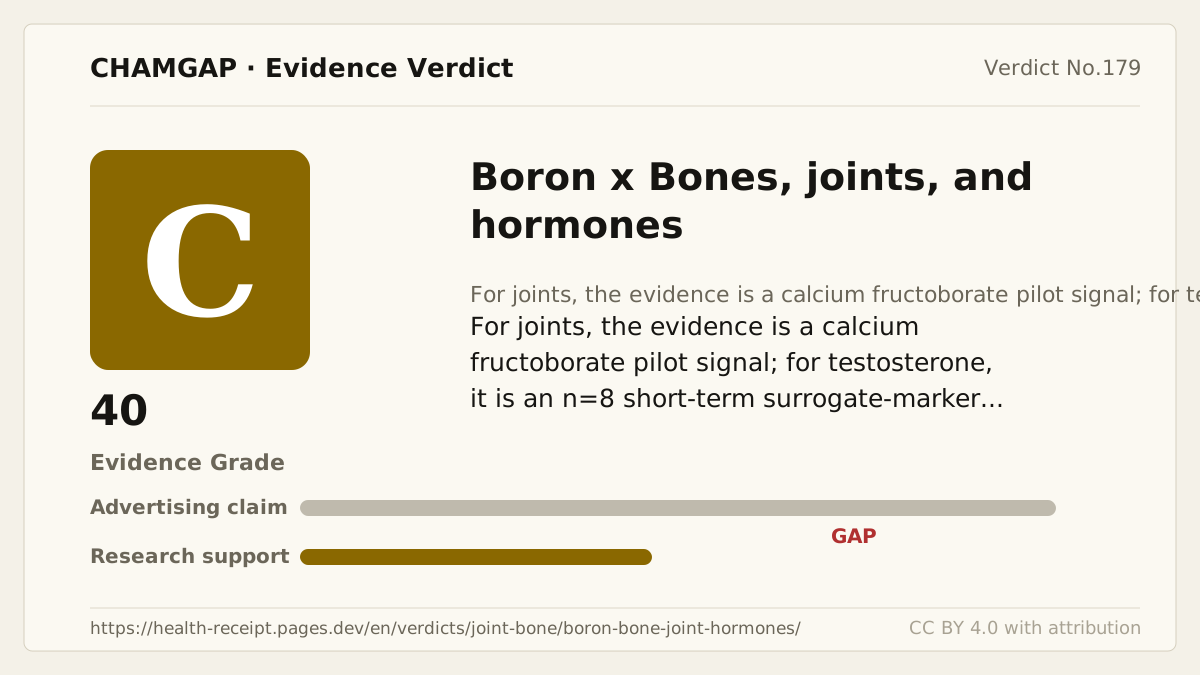
[Chamgap] Boron × Bones, Joints, and Hormones — Evidence Grade C·40. 4 cited sources checked. Source: https://chamgap.com/en/verdicts/joint-bone/boron-bone-joint-hormones/ · CC BY 4.0CC BY 4.0 — free to use with attribution; do not distort grades, numbers, or verdict meaning.
What this document does and does not do
Chamgap is an information source. It reports what research has and has not confirmed; it does not tell readers what to take or buy. That decision belongs to readers and, when needed, medical or legal professionals. This verdict reflects literature available up to the search date and may change as new research appears. Nothing here is medical advice.