
Hibiscus,
does it really help with Blood pressure?
research showsHibiscus tea and extracts have RCT and meta-analysis signals showing reductions in blood pressure by several mmHg. However, blood pressure is a surrogate marker for cardiovascular events, and the studies are small, short-term, and heterogeneous in formulation, so this cannot be expanded to disease-prevention effects.
ads claimAdvertising mentions 'blood pressure management,' 'vascular health,' 'swelling,' 'antioxidant,' and 'diet' together. The most direct evidence is blood-pressure values.
Useful facts when choosing a product
- Tea, extracts, and capsules differ in anthocyanin and organic-acid content and dose.
- When used with antihypertensive drugs or diuretics, the possibility of low blood pressure should be considered.
- High-dose intake during pregnancy is often advised against.
- A reduction in blood pressure does not directly prove a reduction in cardiovascular events.
What the research actually shows
The McKay 2010 RCT reported that, in 65 adults with prehypertension or mild hypertension, consuming 3 cups/day of hibiscus tea for 6 weeks lowered systolic blood pressure more than placebo. The Serban 2015 meta-analysis reported reductions of about -7.6 mmHg systolic and about -3.5 mmHg diastolic across 5 RCTs and 390 participants. Later meta-analyses are generally similar in direction, but heterogeneity, short-term studies, and formulation differences remain.
Why this is classified as C (58)
There is positive RCT and meta-analysis evidence for blood-pressure values, so this is upper-end C. However, the boundary rule that surrogate markers alone do not raise a claim to A/B is applied, so it is kept at 58 points.
Counterpoint. As an adjunctive lifestyle marker for prehypertension or mild hypertension, the research signal is relatively clear.
Rejudgment record. Draft — Positive blood-pressure RCTs and meta-analyses, but blood pressure is a surrogate marker and there is no long-term clinical-event evidence
Cross-check — Codex and Claude
Evidence Table
| Study | Design | Sample | Funding | Endpoint | Result | Weight |
|---|---|---|---|---|---|---|
| McKay DL et al. 2010 | Randomized placebo-controlled trial | 65 | USDA and other public/academic funding | Systolic and diastolic blood pressure | Hibiscus tea 3 cups/day lowered systolic blood pressure more than placebo. | Core |
| Serban C et al. 2015 | Systematic review and meta-analysis | 390 | Unknown/academic | Blood pressure | Reported reductions of -7.58 mmHg systolic and -3.53 mmHg diastolic. | Core |
Receipt — 3 References
All 3 cited sources were verified for existence at the original page (as of 2026-07-09).
Reviewed and approved: Chamgap Editorial Team · Approval date: 2026-07-09 · Corrections: none
Cite this verdict
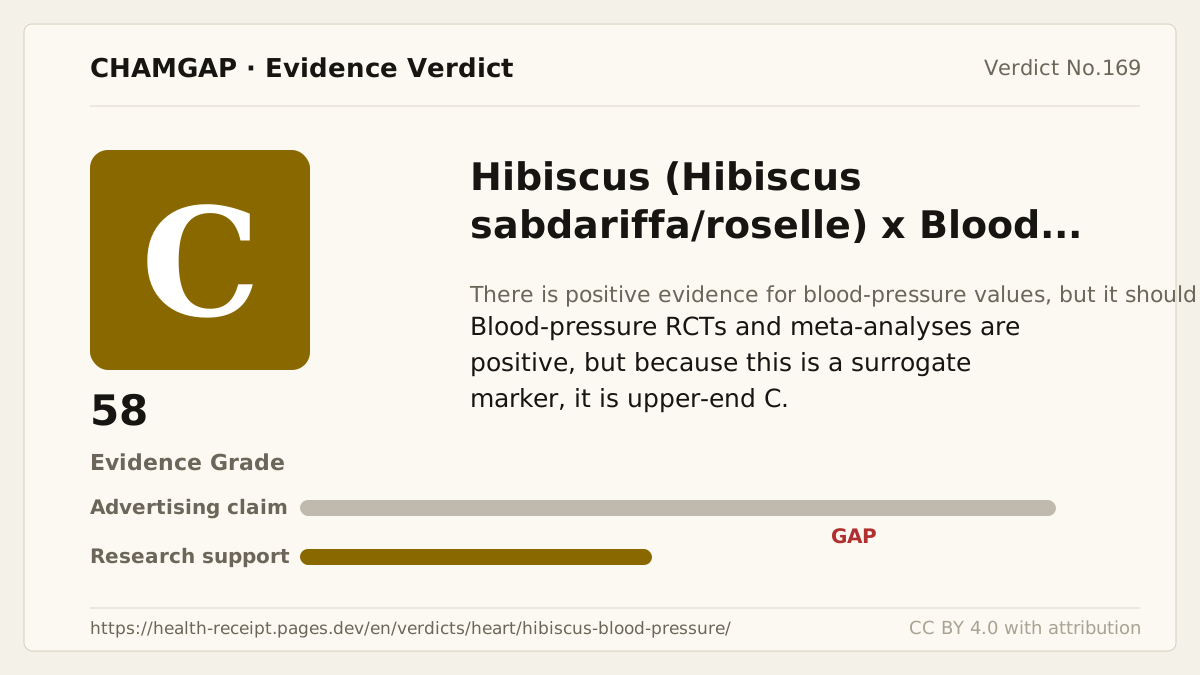
[Chamgap] Hibiscus (Hibiscus sabdariffa) × blood pressure — Evidence Grade C·58. 3 cited sources checked. Source: https://chamgap.com/en/verdicts/heart/hibiscus-blood-pressure/ · CC BY 4.0CC BY 4.0 — free to use with attribution; do not distort grades, numbers, or verdict meaning.
What this document does and does not do
Chamgap is an information source. It reports what research has and has not confirmed; it does not tell readers what to take or buy. That decision belongs to readers and, when needed, medical or legal professionals. This verdict reflects literature available up to the search date and may change as new research appears. Nothing here is medical advice.