
Celery seed extract,
does it really help with Blood pressure?
research showsCelery seed extract has only shown the possibility of lowering blood-pressure values in a single small trial in adults with hypertension. Blood pressure is a surrogate marker, so the maximum is C, and current human evidence is centered on a single small trial plus preclinical mechanisms for 3nB, with insufficient independent large-scale replication.
ads claimAdvertising mentions 'blood pressure management,' 'natural diuretic,' 'vascular relaxation,' '3nB,' and 'swelling.'
Useful facts when choosing a product
- Celery seed extract, celery powder, and celery juice cannot be viewed as having the same evidence.
- When combined with antihypertensive drugs or diuretics, low blood pressure or electrolyte problems should be considered.
- Caution is needed for celery allergy and Apiaceae-family allergy.
- Medicinal doses during pregnancy and lactation are generally advised against.
What the research actually shows
A double-blind placebo-controlled study cited as 2022 reported the possibility of reduced systolic and diastolic blood pressure after 4 weeks of celery seed capsule intake in about 52-54 adults with hypertension. However, this is only a single small study, and standardization of 3nB, product independence, long-term safety, and independent large-scale replication are limited. Blood-pressure-related mechanisms of 3-n-butylphthalide mainly come from animal and pharmacology data.
Why this is classified as C (40)
The possibility of lowering blood-pressure values is at the level of a single small study. Blood pressure is a surrogate marker, so the maximum is C, and because independent large replication and clinical-event evidence are absent, this is lower-end C, 40 points.
Counterpoint. The blood-pressure reduction signal from the early study cannot be ignored, but because it is a single small result, it should be viewed conservatively until replication is confirmed.
Rejudgment record. Final — Blood pressure is a surrogate marker, so the maximum is C; evidence centers on a single small human trial and preclinical 3nB mechanisms, with insufficient independent large-scale replication
Cross-check — Codex and Claude
Evidence Table
| Study | Design | Sample | Funding | Endpoint | Result | Weight |
|---|---|---|---|---|---|---|
| Celery seed capsule hypertension RCT. 2022 | Randomized double-blind placebo-controlled trial | 54 | Unknown | Systolic and diastolic blood pressure | After 4 weeks, reductions of about -11.08 mmHg systolic and about -6.54 mmHg diastolic were reported. | Core |
| Tsi D, Tan BKH. 1997 | Animal pharmacology study | spontaneously hypertensive rats | Unknown | Blood pressure and cardiovascular pharmacology | Suggested possible blood-pressure-related mechanisms of 3-n-butylphthalide. | Background |
Receipt — 3 References
All 3 cited sources were verified for existence at the original page (as of 2026-07-09).
Reviewed and approved: Chamgap Editorial Team · Approval date: 2026-07-09 · Corrections: none
Cite this verdict
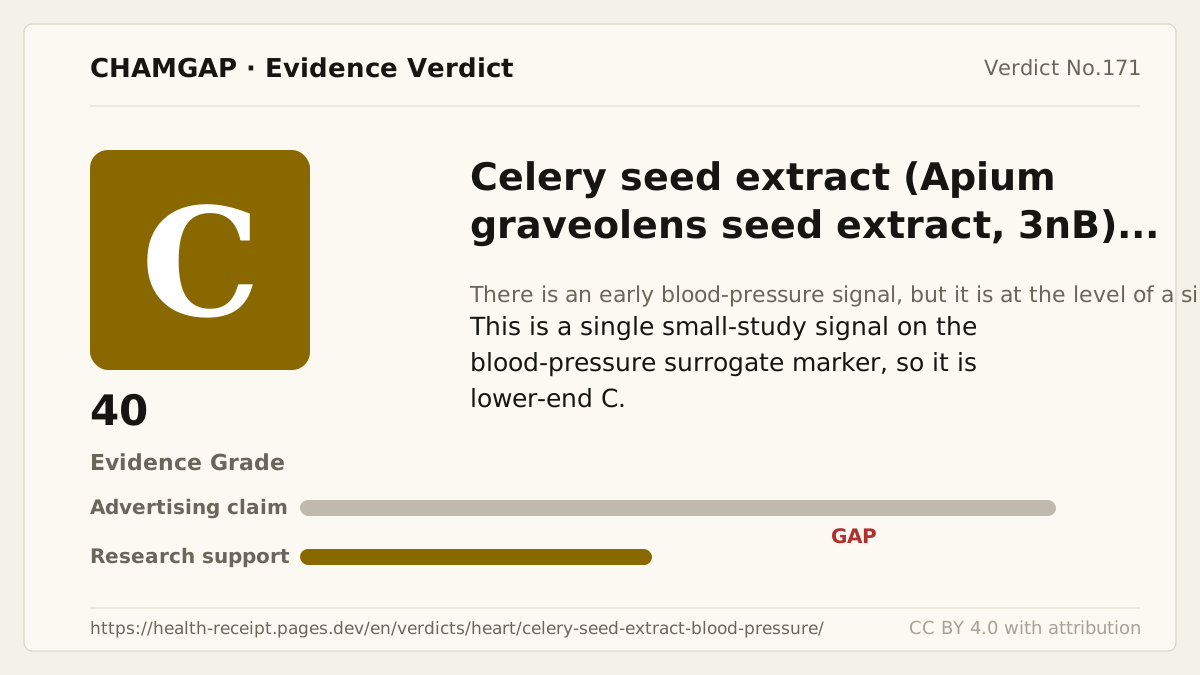
[Chamgap] Celery seed extract (3nB) × blood pressure — Evidence Grade C·40. 3 cited sources checked. Source: https://chamgap.com/en/verdicts/heart/celery-seed-extract-blood-pressure/ · CC BY 4.0CC BY 4.0 — free to use with attribution; do not distort grades, numbers, or verdict meaning.
What this document does and does not do
Chamgap is an information source. It reports what research has and has not confirmed; it does not tell readers what to take or buy. That decision belongs to readers and, when needed, medical or legal professionals. This verdict reflects literature available up to the search date and may change as new research appears. Nothing here is medical advice.