
Artichoke leaf extract,
does it really help with Cholesterol, digestion, and liver?
research showsArtichoke leaf extract has human-study signals for LDL and total cholesterol, functional dyspepsia symptoms, and liver enzymes in fatty liver. However, cholesterol and liver enzymes are surrogate markers, and digestion studies are also limited, so broad claims such as cardiovascular-event prevention or liver detox are C.
ads claimProducts in Korea and abroad combine 'cholesterol,' 'bile secretion,' 'digestion,' 'liver cleansing/detox,' and 'fatty liver.' Liver cleansing and detox are not clinically defined endpoints, so they should be distinguished from liver-enzyme studies.
Useful facts when choosing a product
- Research doses vary widely, from 250 to 2700 mg/day of extract.
- Caution is needed in people with Asteraceae-family plant allergy, gallstones, or bile-duct obstruction.
- Improvements in LDL and ALT/AST are surrogate markers and are not the same as improved cardiovascular events or liver-disease prognosis.
- Standardized constituents such as cynarin and chlorogenic acid can differ by product.
What the research actually shows
The Cochrane review of artichoke leaf extract for hypercholesterolemia considered the evidence uncertain because the number of studies was small and quality was limited. Lipid meta-analyses by Sahebkar and others reported signals for reductions in total cholesterol and LDL, but these are blood surrogate markers. The Holtmann 2003 RCT in 247 patients with functional dyspepsia reported improvements in symptoms and quality of life. Fatty-liver studies show signals for improvements in ALT/AST, ultrasound, and lipid measures, but they did not evaluate liver-related clinical events.
Why this is classified as C (55)
Cholesterol and liver enzymes are surrogate markers, so the maximum grade is C. The dyspepsia-symptom RCT uses a direct symptom endpoint, but the overall composite claim does not have enough large independent evidence to raise it to B. It is judged near the upper end of C, at 55 points.
Counterpoint. If a narrow symptom claim such as functional dyspepsia were evaluated separately, the score could be slightly higher. This file judges the composite claim for cholesterol, digestion, and liver.
Rejudgment record. Draft — Surrogate-marker centered, limited digestion-symptom RCT evidence, and composite claim.
Cross-check — Codex and Claude
Evidence Table
| Study | Design | Sample | Funding | Endpoint | Result | Weight |
|---|---|---|---|---|---|---|
| Cochrane 2013 | Cochrane review | 3 | Independent review | Blood cholesterol | Assessed that evidence for lipid improvement with artichoke leaf extract was limited by study number and quality. | Core |
| Sahebkar A et al. 2018 | Systematic review and meta-analysis | Mixed | Total cholesterol, LDL, and TG | Reported signals for improved blood lipids, but these are surrogate markers. | Core | |
| Holtmann G et al. 2003 | Randomized placebo-controlled trial | 247 | Possible industry ties | Functional dyspepsia symptoms | Reported improvements in symptom scores and quality of life. | Supporting |
| Study 4 | Randomized placebo-controlled trial | Mixed | ALT/AST, ultrasound, and lipids | Reported signals for improved liver enzymes and lipid measures, but not clinical prognosis endpoints. | Surrogate marker |
Receipt — 4 References
All 4 cited sources were verified for existence at the original page (as of 2026-07-09).
Reviewed and approved: Chamgap Editorial Team · Approval date: 2026-07-09 · Corrections: none
Cite this verdict
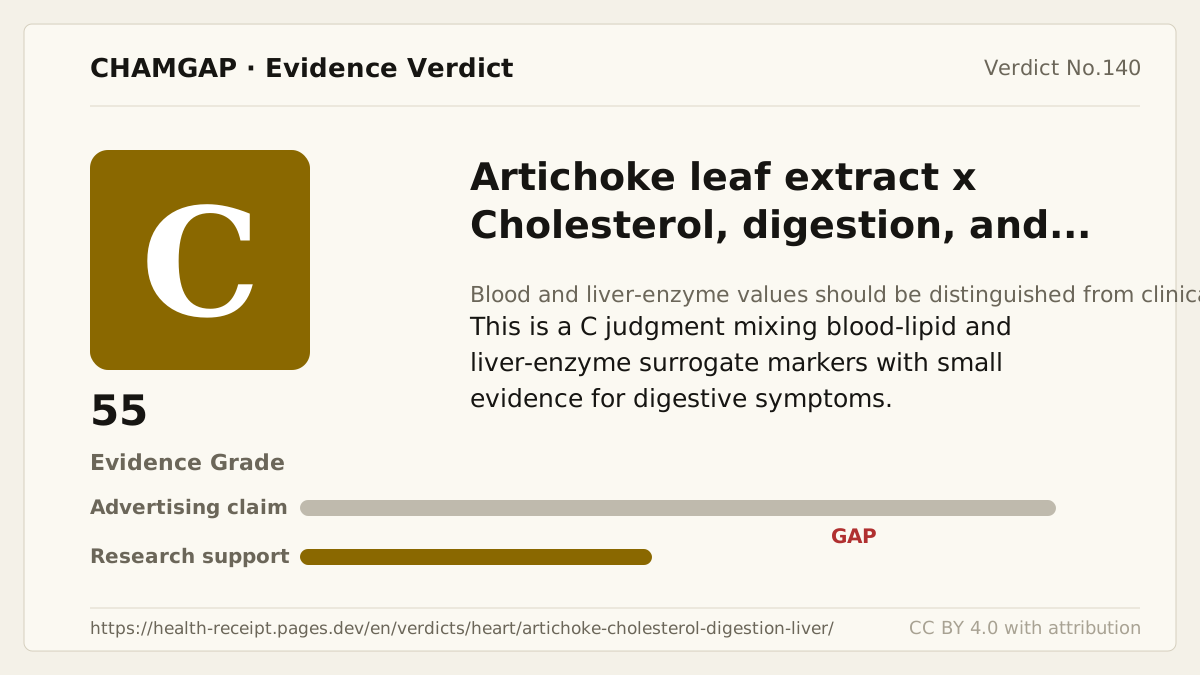
[Chamgap] Artichoke leaf extract x cholesterol, digestion, and liver — Evidence Grade C·55. 4 cited sources checked. Source: https://chamgap.com/en/verdicts/heart/artichoke-cholesterol-digestion-liver/ · CC BY 4.0CC BY 4.0 — free to use with attribution; do not distort grades, numbers, or verdict meaning.
What this document does and does not do
Chamgap is an information source. It reports what research has and has not confirmed; it does not tell readers what to take or buy. That decision belongs to readers and, when needed, medical or legal professionals. This verdict reflects literature available up to the search date and may change as new research appears. Nothing here is medical advice.