
D-mannose,
does it really help with Prevention of recurrent urinary tract infection?
research showsAn early randomized trial of 308 women reported fewer recurrences with D-mannose 2 g/day, but it was neither blinded nor placebo-controlled. A later Cochrane review rated certainty as very low, and a double-blind placebo-controlled trial of 598 women across 99 UK primary-care sites found no difference in medically attended UTI over six months, at 51.0% versus 55.7%. A 2025 meta-analysis of six RCTs and 1,167 participants also did not confirm a significant preventive effect, supporting D.
ads claimAdvertisements use phrases such as 'blocks E. coli adhesion,' 'prevents recurrence without antibiotics,' and 'bladder protection.' The adhesion mechanism is an experimental rationale, but clinically important recurrence and antibiotic use were not reduced in the large placebo-controlled trial.
Useful facts when choosing a product
- The main prevention trials used D-mannose powder 2 g/day for six months.
- The large trial's primary endpoint was clinically suspected UTI for which primary or ambulatory care was contacted within six months.
- Serious safety differences were not prominent in short trials, while gastrointestinal discomfort and diarrhea can occur.
- UTI treatment and recurrence prevention are separate claims; this judgment evaluates prevention.
What the research actually shows
Kranjčec 2014 reported fewer recurrences with D-mannose in an unblinded, non-placebo-controlled trial of 308 women. The Cooper 2022 Cochrane review rated certainty from seven studies and 719 participants as very low. Hayward 2024 assigned 598 women across 99 UK primary-care sites to 2 g/day or placebo for six months; recurrence was 51.0% versus 55.7% (p=.26). The Vargas 2025 meta-analysis reported RR 0.57 (95% CI 0.29-1.15) across six RCTs and 1,167 participants. Because the Vargas abstract contains internally inconsistent statistical reporting, this judgment uses only the RR and 95% CI from that meta-analysis.
Why this is classified as D (22)
The early unblinded study was positive, but the independent 598-person double-blind placebo-controlled trial was negative for its primary and secondary endpoints, and the six-RCT meta-analysis reported RR 0.57 (95% CI 0.29-1.15). Boundary rule ② supports D with 22 points. The early positive evidence means the grade is not F.
Counterpoint. Current confidence intervals do not completely exclude a small effect in selected subgroups or microbiologically confirmed recurrence. Such an effect was not established in the available large primary-care trial.
Rejudgment record. New judgment — The null primary and all secondary endpoints in an independent 598-person double-blind placebo-controlled trial and the subsequent null RCT meta-analysis outweigh the early unblinded positive study, invoking boundary rule ②
Cross-check — Codex and Claude
Evidence Table
| Study | Design | Sample | Funding | Endpoint | Result | Weight |
|---|---|---|---|---|---|---|
| Kranjčec B et al. 2014 | Randomized unblinded three-arm trial | 308 | Unknown | Recurrent UTI over six months | Recurrence was 14.6% with D-mannose, 20.4% with nitrofurantoin, and 60.8% with no prophylaxis, but there was no placebo or blinding. | Supportive |
| Cooper TE et al. 2022 | Cochrane systematic review | 719 | Independent academic review | UTI prevention, treatment, and adverse events | Data were sparse and at high risk of bias, yielding very-low-certainty evidence. | Key |
| Hayward G et al. 2024 | Multicenter double-blind randomized placebo-controlled trial | 99 | UK NIHR public funding | Medically attended suspected UTI within six months | Rates were 51.0% versus 55.7%, risk difference -5 percentage points (95% CI -13 to 3), p=0.26, with no significant primary or secondary endpoint differences. | Decisive |
| Vargas CEF et al. 2025 | Systematic review and meta-analysis of RCTs | 1,167 | Academic review; no conflicts reported | Recurrent UTI | There was no significant reduction versus control, RR 0.57 (95% CI 0.29-1.15). | Decisive |
Receipt — 4 References
All 4 cited sources were verified for existence at the original page (as of 2026-07-11).
Reviewed and approved: Chamgap Editorial Team · Approval date: 2026-07-11 · Corrections: none
Cite this verdict
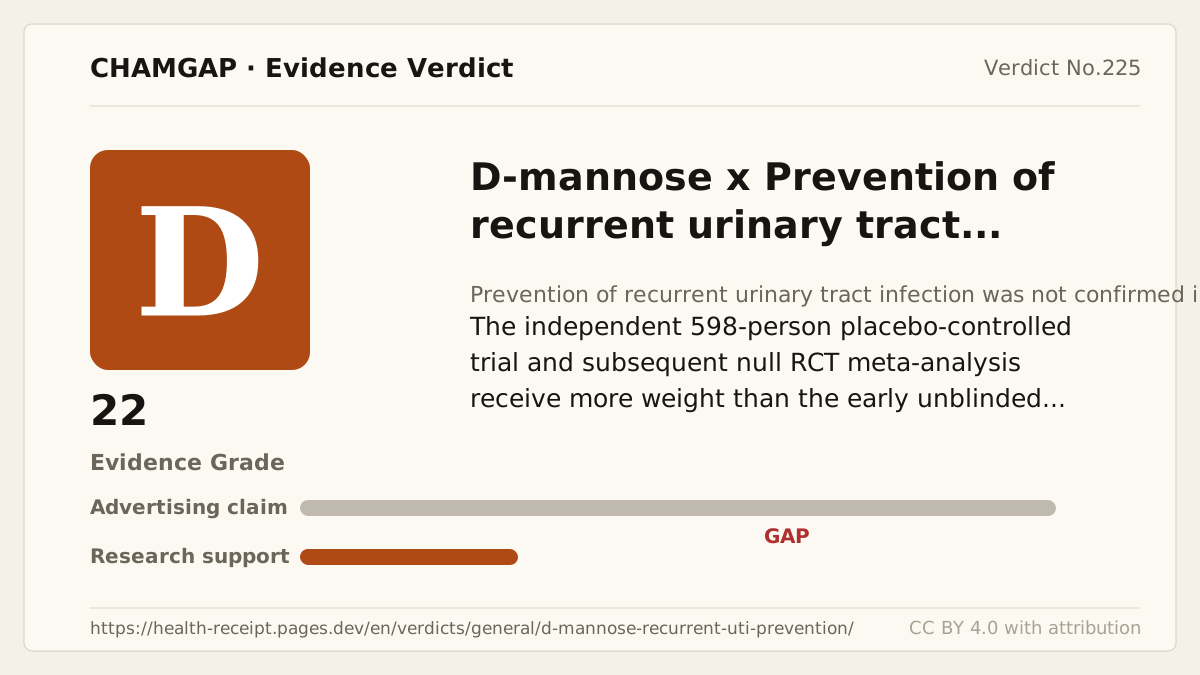
[Chamgap] D-mannose x prevention of recurrent urinary tract infection — Evidence Grade D·22. 4 cited sources checked. Source: https://chamgap.com/en/verdicts/general/d-mannose-recurrent-uti-prevention/ · CC BY 4.0CC BY 4.0 — free to use with attribution; do not distort grades, numbers, or verdict meaning.
What this document does and does not do
Chamgap is an information source. It reports what research has and has not confirmed; it does not tell readers what to take or buy. That decision belongs to readers and, when needed, medical or legal professionals. This verdict reflects literature available up to the search date and may change as new research appears. Nothing here is medical advice.