
Sea buckthorn oil,
does it really help with Dry-eye symptoms and tear-film improvement?
research showsIn one industry-linked RCT, only tear-film osmolarity was positive after covariate adjustment at p=0.04; the unadjusted analysis and TBUT, Schirmer, and mOSDI were null. The 2011 paper was a secondary analysis of the same sample, not an independent replication, so the grade is C.
ads claimMarketed omega-7 products use expressions such as 'replenishes the tear film,' 'moisture from within the eyes,' and 'improves dry eye.' Human evidence centers on one study of a specific oil at 2 g/day for three months and does not generalize to every seed- or pulp-oil formulation or to improved objective tear production.
Useful facts when choosing a product
- The pivotal RCT used sea buckthorn oil at 2 g/day for three months.
- Seed oil and pulp oil have different fatty-acid profiles, and marketed products may differ from the study product in blend ratio and extraction method.
- The pivotal trial received support from ingredient-related companies, and some authors were employees of related companies.
- No major safety signal was reported in the trial, but long-term use data are limited.
What the research actually shows
The industry-linked Larmo 2010 RCT assigned 100 people reporting dry-eye symptoms to sea buckthorn oil 2 g/day or placebo for three months. The between-group tear-film osmolarity result reached p=0.04 only after covariate adjustment; the unadjusted analysis was not significant. TBUT, Schirmer, and mOSDI were also null. Järvinen 2011 was not a separate trial but a secondary tear-film fatty-acid analysis of the same sample, found no between-group difference, and does not constitute independent replication.
Why this is classified as C (44)
In one industry-linked RCT, only adjusted osmolarity was marginally positive, while the unadjusted analysis and TBUT, Schirmer, and mOSDI were null. A secondary analysis of the same sample is not independent replication, supporting C with 44 points.
Counterpoint. The signal for some subjective symptoms and attenuation of seasonal osmolarity worsening in one trial remains. This assessment does not extend that signal to the entire tear film or to a confirmed clinical treatment effect.
Rejudgment record. Reassessment (cross-check reflected) — In one industry-linked RCT, only tear-film osmolarity was positive after covariate adjustment at p=0.04; the unadjusted analysis and TBUT, Schirmer, and mOSDI were null, and the 2011 paper was a secondary analysis of the same sample rather than an independent replication, supporting C
Sub-claim grades by effect
This ingredient is marketed for several effects. A single overall grade blends strong and weak claims together, so each effect is graded separately here. The overall grade reflects the strongest disconfirming or core claim.
| Effect (sub-claim) | Grade | Basis |
|---|---|---|
| Dry-eye symptoms | C | A 100-person RCT found signals for selected symptoms such as redness and burning, but most symptoms did not differ between groups |
| Tear-film improvement | C | Seasonal worsening of osmolarity was attenuated, but tear secretion, breakup time, and fatty-acid composition were null |
Cross-check — Codex and Claude
Evidence Table
| Study | Design | Sample | Funding | Endpoint | Result | Weight |
|---|---|---|---|---|---|---|
| Larmo PS et al. 2010 | Randomized double-blind placebo-controlled trial | 86 | Joint industry and public support including Aromtech and Finnsusp; authors included employees of related companies | Tear-film osmolarity, tear secretion, breakup time, and dry-eye symptoms | Seasonal increase in osmolarity and selected maximum-intensity symptoms were attenuated, but most symptoms and objective measures did not differ between groups. | Key |
| Järvinen RL et al. 2011 | Secondary analysis of the same RCT sample | 86 | Same industry-linked trial | Tear-film fatty-acid composition | There were no between-group differences in changes in saturated, monounsaturated, or polyunsaturated fatty acids. | Supportive |
Receipt — 2 References
All 2 cited sources were verified for existence at the original page (as of 2026-07-13).
Reviewed and approved: Chamgap Editorial Team · Approval date: 2026-07-13 · Corrections: none
Cite this verdict
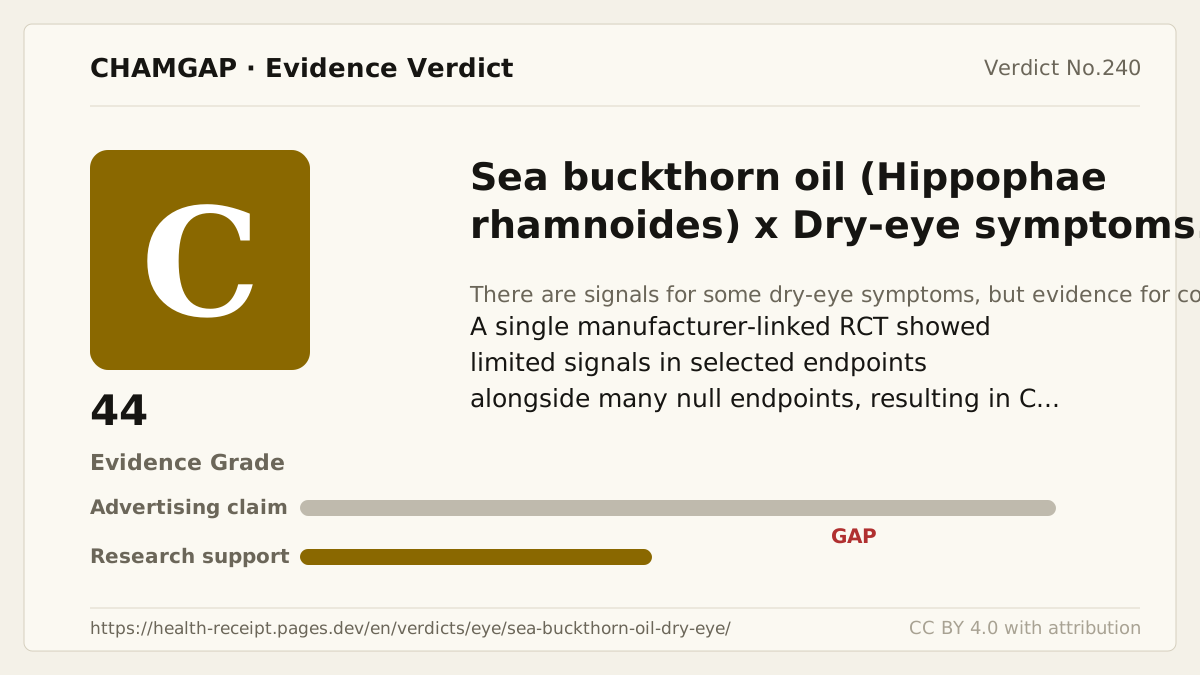
[Chamgap] Sea buckthorn oil (Hippophae rhamnoides) x dry-eye symptoms and tear-film improvement — Evidence Grade C·44. 2 cited sources checked. Source: https://chamgap.com/en/verdicts/eye/sea-buckthorn-oil-dry-eye/ · CC BY 4.0CC BY 4.0 — free to use with attribution; do not distort grades, numbers, or verdict meaning.
What this document does and does not do
Chamgap is an information source. It reports what research has and has not confirmed; it does not tell readers what to take or buy. That decision belongs to readers and, when needed, medical or legal professionals. This verdict reflects literature available up to the search date and may change as new research appears. Nothing here is medical advice.