
Persimmon-leaf ethanolic extract,
does it really help with Improvement of dry eye?
research showsA randomized trial of persimmon-leaf ethanolic extract at 600 mg/day for 12 weeks in 100 participants reported improvements in tear break-up time, corneal staining, and the Schirmer test. The grade is C because the evidence currently depends on one company-funded preprint that has not undergone peer review.
ads claimAdvertisements may describe persimmon-leaf extract as a treatment for dry eye or a way to manage intraocular pressure. Direct evidence concerns one 12-week trial of the exact EEDK formulation and does not evaluate replacement of standard care or long-term disease course.
Useful facts when choosing a product
- The trial used EEDK, an ethanolic persimmon-leaf extract, at 600 mg/day.
- Its extraction process and content differ from persimmon-leaf tea or water extracts.
- The main analysis covered 89 completers from 100 randomized participants.
- No serious adverse event was reported during the 12-week trial.
What the research actually shows
The 2025 preprint by Hwang and colleagues randomized 100 adults with mild dry eye and asymptomatic elevated intraocular pressure to EEDK 600 mg/day or placebo for 12 weeks. Among 89 completers, tear break-up time at week 12 increased by 1.76 seconds in the test group and 0.22 seconds with placebo, while corneal staining and the Schirmer test also showed between-group differences. KIST and Whanin Pharm supported the work, company researchers were coauthors, and the manuscript has not yet been peer reviewed.
Why this is classified as C (49)
The RCT signal spans several subjective and objective measures, but the public evidence is one company-funded preprint relying on completer analysis, so the grade is C. The consistent positive measures and verification limitations together support 54 points.
Counterpoint. A short-term signal for improved dry-eye measures remains for the exact EEDK formulation at 600 mg/day.
Rejudgment record. New verdict — A 100-person RCT was positive for tear break-up time, corneal staining, and Schirmer testing, but it is one company-funded preprint based on 89 completers with no independent replication
Cross-check — Codex and Claude
Evidence Table
| Study | Design | Sample | Funding | Endpoint | Result | Weight |
|---|---|---|---|---|---|---|
| Hwang HB et al. 2025 | Preprint of a randomized double-blind placebo-controlled trial | 12 | Supported by KIST and Whanin Pharm; company researchers were coauthors | Tear break-up time, corneal staining, Schirmer testing, and intraocular pressure | Reported improvement versus placebo in tear break-up time, corneal staining, and Schirmer testing at 12 weeks. | Key |
| KCT0010532 | Registered clinical trial | 100 | KIST and Whanin Pharm | Dry-eye and intraocular-pressure measures with persimmon-leaf EEDK | Corroborates the registration number and design reported in the preprint. | Supportive |
Receipt — 2 References
All 2 cited sources were verified for existence at the original page (as of 2026-07-11).
Reviewed and approved: Chamgap Editorial Team · Approval date: 2026-07-11 · Corrections: none
Cite this verdict
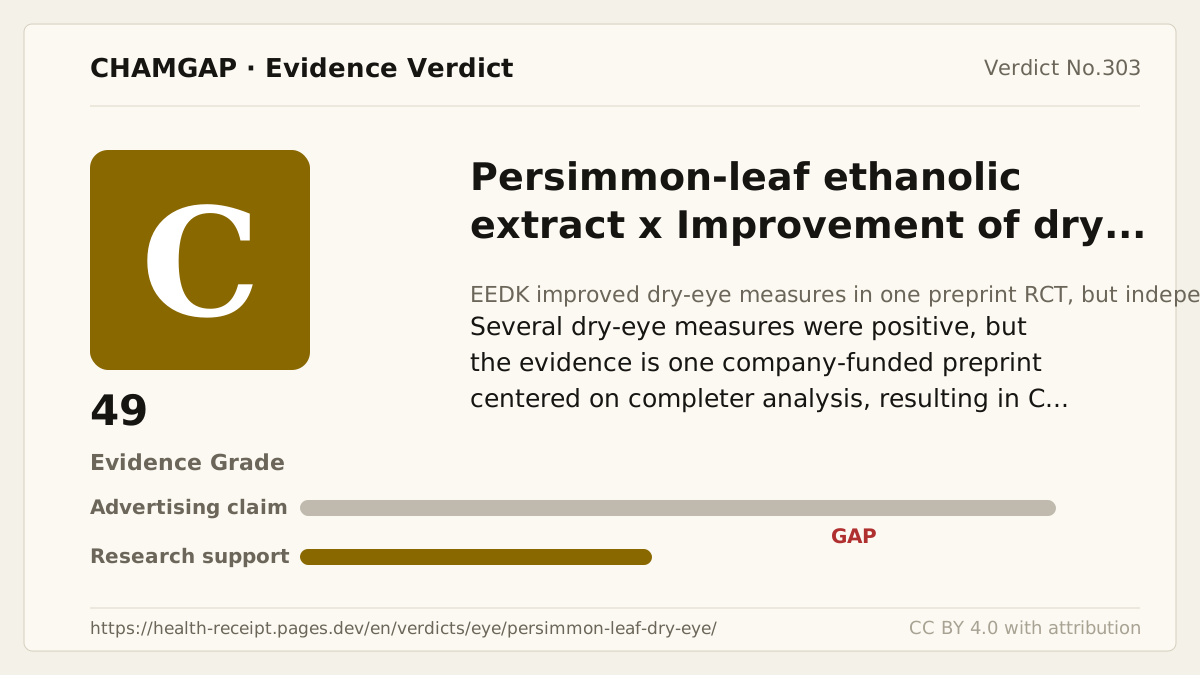
[Chamgap] Persimmon-leaf ethanolic extract × Improvement of dry eye — Evidence Grade C·49. 2 cited sources checked. Source: https://chamgap.com/en/verdicts/eye/persimmon-leaf-dry-eye/ · CC BY 4.0CC BY 4.0 — free to use with attribution; do not distort grades, numbers, or verdict meaning.
What this document does and does not do
Chamgap is an information source. It reports what research has and has not confirmed; it does not tell readers what to take or buy. That decision belongs to readers and, when needed, medical or legal professionals. This verdict reflects literature available up to the search date and may change as new research appears. Nothing here is medical advice.