
Eyebright,
does it really help with Eye-fatigue relief and vision protection?
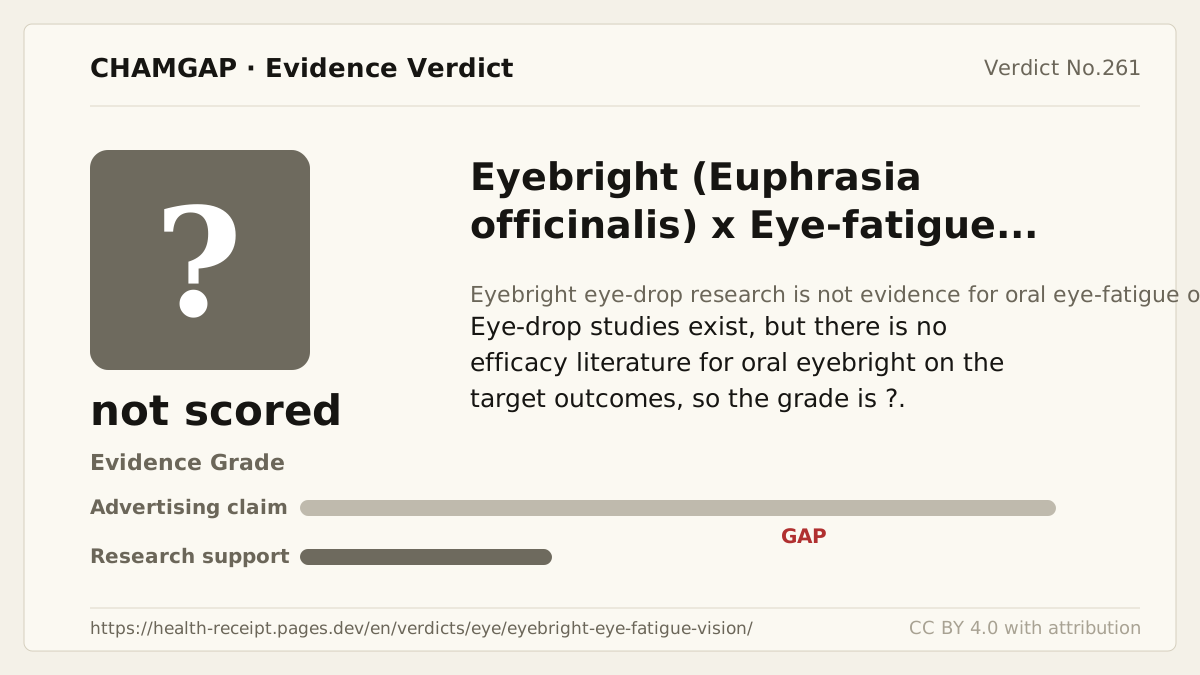
research showsNo human efficacy trial was identified that evaluated oral eyebright for eye fatigue or vision. Human studies mainly concern eyebright eye drops for conjunctivitis or ocular discharge in neonates and cannot be reinterpreted as evidence for an oral supplement.
ads claimOral capsule advertising uses the plant's name and traditional ocular use to support phrases such as 'clear eyes,' 'vision support,' and 'eye-fatigue relief.' The identified clinical data are limited to a topical formulation and different conditions or symptoms.
Useful facts when choosing a product
- Marketed oral capsules and the eye drops used in clinical studies have different administration routes.
- The eye-drop evidence concerns conjunctivitis and ocular discharge, not vision protection.
- Several related species may be sold under the commercial name Euphrasia officinalis, making botanical identification a variable.
- A standardized oral dose and long-term safety profile have not been established.
What the research actually shows
The Stoss 2000 study was an uncontrolled open cohort of 65 patients with conjunctivitis treated with eyebright eye drops. The Meier-Girard 2020 RCT gave eyebright eye drops or placebo for 96 hours to 84 preterm neonates with ocular discharge and found no significant difference in the primary outcome of discharge resolution without antibiotics. Neither study directly addresses oral efficacy for eye fatigue or vision.
Why this is classified as ?
Topical studies exist, but no human efficacy literature was identified for the oral ingredient-outcome pair of eye fatigue and vision protection; the grade is ? with no score.
Counterpoint. Traditional use and topical research provide a hypothesis. Absorption and ocular clinical effects from an oral supplement require separate testing.
Rejudgment record. New assessment — No oral monotherapy trial of eyebright for eye fatigue or vision protection; eye-drop studies mismatch the route and endpoints
Cross-check — Codex and Claude
Evidence Table
| Study | Design | Sample | Funding | Endpoint | Result | Weight |
|---|---|---|---|---|---|---|
| Stoss M et al. 2000 | Multicenter prospective open-label single-arm cohort | 65 | Unknown | Redness, swelling, discharge, burning, and foreign-body sensation | Most participants improved after eye drops, but there was no control group and the route and target outcomes do not match the claim. | Indirect |
| Meier-Girard D et al. 2020 | Randomized double-blind placebo-controlled trial | 84 | Swiss public and academic institutional support | Resolution of ocular discharge by 96 hours without topical antibiotics | Eyebright eye drops did not significantly improve the primary treatment-success outcome versus placebo. | Indirect |
Receipt — 2 References
All 2 cited sources were verified for existence at the original page (as of 2026-07-11).
Reviewed and approved: Chamgap Editorial Team · Approval date: 2026-07-11 · Corrections: none
Cite this verdict
[Chamgap] Eyebright (Euphrasia officinalis) x eye-fatigue relief and vision protection — Evidence Grade ?. 2 cited sources checked. Source: https://chamgap.com/en/verdicts/eye/eyebright-eye-fatigue-vision/ · CC BY 4.0CC BY 4.0 — free to use with attribution; do not distort grades, numbers, or verdict meaning.
What this document does and does not do
Chamgap is an information source. It reports what research has and has not confirmed; it does not tell readers what to take or buy. That decision belongs to readers and, when needed, medical or legal professionals. This verdict reflects literature available up to the search date and may change as new research appears. Nothing here is medical advice.