
PQQ,
does it really help with Energy and cognition?
research showsFor cognition, three manufacturer-linked randomized double-blind placebo-controlled trials reported limited positive findings. For energy, evidence of improvement in objective aerobic performance is insufficient.
ads claimAdvertising emphasizes 'mitochondrial booster,' 'cellular energy,' 'antioxidant,' 'brain energy,' and 'synergy with CoQ10.' A substantial part of these expressions is closer to mechanistic or surrogate-marker evidence.
Useful facts when choosing a product
- Commercial doses of 10-20 mg/day are common, and many studies are also in this range.
- Safety data should be distinguished by ingredient form, such as PQQ disodium salt.
- Mitochondrial biogenesis and inflammation markers are not the same as clinical fatigue or cognitive improvement.
- Long-term high-dose safety data are limited.
What the research actually shows
Itoh 2016 (PMID 26782228) was a randomized double-blind placebo-controlled trial in healthy older adults that administered BioPQQ 20 mg/day for 12 weeks. It reported limited positive findings for selective attention and working memory on tests including Stroop/reverse-Stroop and visuospatial tests, and was linked to Mitsubishi Gas Chemical, the manufacturer of BioPQQ. Shiojima 2022 (PMID 34415830) was a parallel-group trial with N=64 enrolled/58 completed that administered mnemoPQQ 21.5 mg/day for 12 weeks. It reported positive findings on Cognitrax measures including memory, attention, and reaction time and on MMSE-J; many authors were employees of the sponsor Ryusendo, the seller of mnemoPQQ. Tamakoshi 2023 (PMID 36807425) was an N=70/62 trial that administered BioPQQ 20 mg/day for 12 weeks and reported positive composite and verbal memory findings. The younger subgroup analysis carries multiplicity risk, and Mitsubishi Gas Chemical fully funded the trial. In the energy evidence, Hwang 2020 (PMID 31860387) assigned N=23 to PQQ 20 mg plus six weeks of endurance training; VO2peak and time to exhaustion did not differ from placebo, while only the PGC-1α surrogate marker increased. Nascent Health, the manufacturer and supplier of PureQQ, supported the study. Nakano 2012 was an uncontrolled, open-label, single-arm trial with N=17 that reported improvements in subjective POMS fatigue, vigor, and sleep questionnaires and was linked to BioPQQ. Harris 2013 (PMID 24231099) was a small N=10 crossover study of surrogate markers including CRP, IL-6, and mitochondrial metabolites, not clinical energy endpoints. The EFSA novel food review (DOI 10.2903/j.efsa.2017.5058) is safety material, not efficacy evidence.
Why this is classified as C (47)
Methodology boundary rule ②-b was applied. Cognition is not ungraded because three double-blind placebo-controlled RCTs using objective cognitive tests reported positive findings, but all were manufacturer-linked, small, and lacked non-manufacturer independent replication; cognition is therefore capped at C, yielding C (58). Energy is D (33) because the RCT was null for objective aerobic performance and the remaining evidence consists of subjective questionnaires or surrogate markers. The combined judgment is C (47).
Counterpoint. The EFSA novel food safety review concerns conditions of use for a specific ingredient and is not included as efficacy evidence. Positive findings from the cognition trials are also distinct from replication in manufacturer-independent studies of PQQ alone.
Rejudgment record. Reassessment (?→C) — Positive cognition DBPC RCTs exist, but all are manufacturer-linked and lack independent replication, so rule ②-b caps cognition at C; energy is D because the objective performance RCT was null; combined grade C.
Sub-claim grades by effect
This ingredient is marketed for several effects. A single overall grade blends strong and weak claims together, so each effect is graded separately here. The overall grade reflects the strongest disconfirming or core claim.
| Effect (sub-claim) | Grade | Basis |
|---|---|---|
| Cognition | C · 58 | Three positive double-blind RCTs on objective cognition, but all manufacturer-linked, small, and without independent replication (rule 2-b) |
| Energy | D · 33 | The objective aerobic-performance RCT was null (Hwang 2020); the rest is subjective questionnaires and surrogate markers |
Cross-check — Codex and Claude
Evidence Table
| Study | Design | Sample | Funding | Endpoint | Result | Weight |
|---|---|---|---|---|---|---|
| Itoh et al. 2016 (PMID 26782228) | Randomized double-blind placebo-controlled trial, 12 weeks | Linked to Mitsubishi Gas Chemical, the manufacturer of BioPQQ | Objective cognitive tests including Stroop/reverse-Stroop and visuospatial tests | Limited positive findings for selective attention and working memory with BioPQQ 20 mg/day | Cognition grade C evidence; manufacturer-linked with no independent replication | |
| Shiojima et al. 2022 (PMID 34415830) | Randomized double-blind placebo-controlled parallel-group trial, 12 weeks | 58 | Many authors were employees of the sponsor Ryusendo, the seller of mnemoPQQ | Cognitrax memory, attention, reaction time, and other measures, plus MMSE-J | Positive cognitive-test findings with mnemoPQQ 21.5 mg/day | Cognition grade C evidence; clear manufacturer conflict of interest and no independent replication |
| Tamakoshi et al. 2023 (PMID 36807425) | Randomized double-blind placebo-controlled trial, 12 weeks | 62 | Fully funded by Mitsubishi Gas Chemical, the manufacturer of BioPQQ | Composite and verbal memory; younger subgroup analysis | Positive findings with BioPQQ 20 mg/day; the younger subgroup analysis carries multiplicity risk | Cognition grade C evidence; manufacturer-linked with no independent replication |
| Hwang et al. 2020 (PMID 31860387) | Randomized double-blind placebo-controlled trial with six weeks of endurance training | 23 | Supported by Nascent Health, the manufacturer and supplier of PureQQ | VO2peak, time to exhaustion, and PGC-1α | With PQQ 20 mg/day, objective aerobic performance did not differ from placebo; only the PGC-1α surrogate marker increased | Energy grade D evidence; null objective performance, positive surrogate marker, and manufacturer support |
| Nakano et al. 2012 (DOI 10.31989/ffhd.v2i8.81) | Open-label single-arm trial without placebo control | 17 | Linked to BioPQQ | Subjective POMS fatigue, vigor, and sleep questionnaires | Reported questionnaire improvements; not an objective energy endpoint | Supporting energy grade D evidence; subjective questionnaires, uncontrolled, and manufacturer-linked |
| Harris et al. 2013 (PMID 24231099) | Small crossover study | 10 | The reported funding source was not separately verified in the materials used for this judgment | Surrogate markers including CRP, IL-6, and mitochondrial metabolites | Evaluated changes in surrogate markers, not clinical energy endpoints | Supporting energy grade D evidence; surrogate markers and small sample |
| EFSA NDA Panel 2017 (DOI 10.2903/j.efsa.2017.5058) | Novel food regulatory safety review | Regulatory assessment material | Safety of PQQ disodium salt under specified conditions of use | A safety review that did not evaluate efficacy | Rule ④ regulatory neutrality; not efficacy evidence |
Receipt — 7 References
All 7 cited sources were verified for existence at the original page (as of 2026-07-09).
Reviewed and approved: Chamgap Editorial Team · Approval date: 2026-07-09 · Corrections: 1
Correction log — 1
Corrections applied to this verdict, in chronological order. Changes are logged, not erased.
- 2026-07-11 · Re-adjudication (grade changed) — The previous 'judgment deferred (?)' cited a lack of confirmatory RCTs with objective endpoints for energy/cognition, but three double-blind placebo-controlled RCTs using objective cognitive tests exist (Itoh 2016 PMID 26782228, Shiojima 2022 PMID 34415830, Tamakoshi 2023 PMID 36807425), all positive. Because human RCTs exist, this is C, not '?'. However, all positive cognition trials are manufacturer-linked (BioPQQ/mnemoPQQ), small, and lack independent replication, so cognition is capped at C by rule 2-b; the objective aerobic-performance RCT for energy was null (Hwang 2020), making energy D. The three cognition RCTs are now cited explicitly and the EFSA search link was replaced with the actual reference. 2026-07-11 internal audit. (grade ?→C)
Cite this verdict
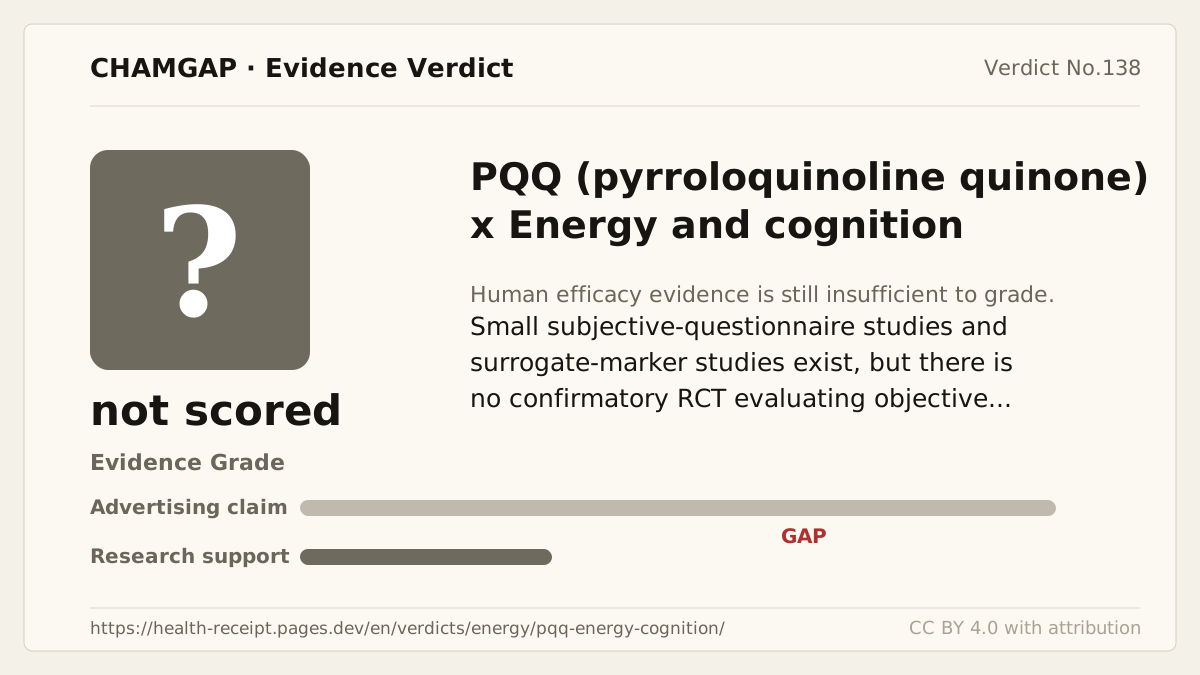
[Chamgap] PQQ x energy and cognition — Evidence Grade C·47. 7 cited sources checked. Source: https://chamgap.com/en/verdicts/energy/pqq-energy-cognition/ · CC BY 4.0CC BY 4.0 — free to use with attribution; do not distort grades, numbers, or verdict meaning.
What this document does and does not do
Chamgap is an information source. It reports what research has and has not confirmed; it does not tell readers what to take or buy. That decision belongs to readers and, when needed, medical or legal professionals. This verdict reflects literature available up to the search date and may change as new research appears. Nothing here is medical advice.