
Eleuthero/Siberian ginseng,
does it really help with Fatigue, stress, and exercise?
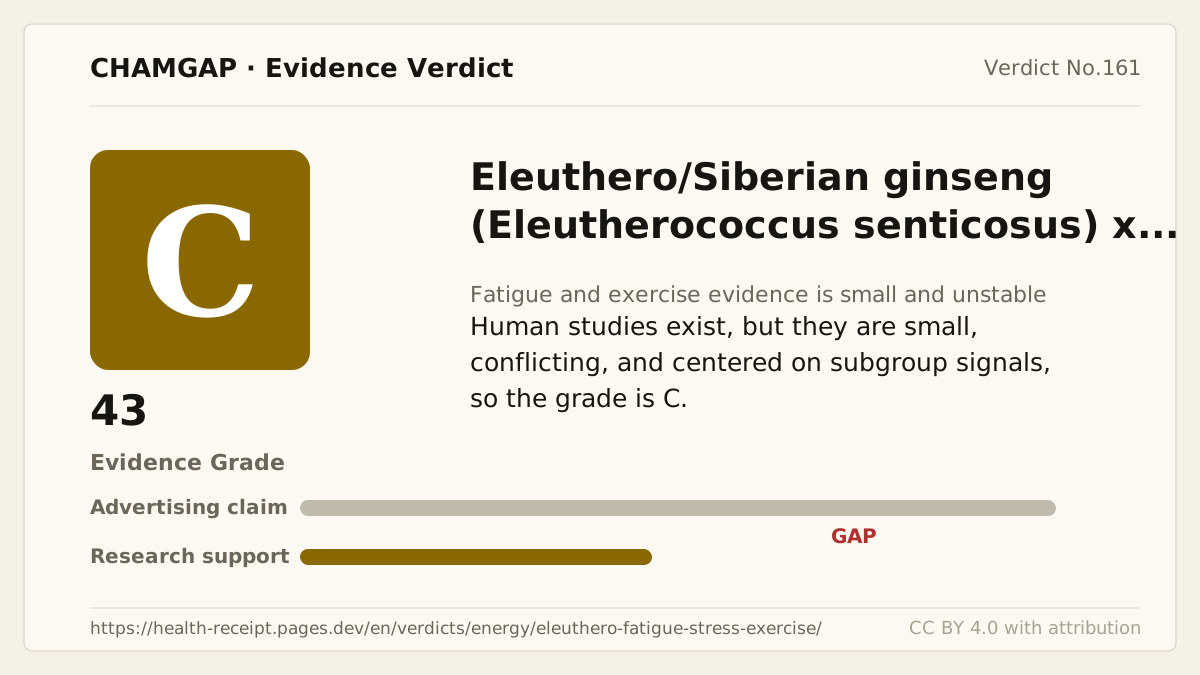
research showsEleuthero is advertised as an "adaptogen," but human RCTs supporting chronic fatigue, stress, and exercise performance are small and mixed. A relatively large chronic fatigue RCT did not show a clear effect in the whole group, and the exercise studies have very small samples.
ads claimAdvertisements broadly claim 'natural vitality,' 'adrenal fatigue,' 'stress resistance,' 'exercise endurance,' and 'immunity.' Actual evidence consists of small fatigue questionnaire and exercise-test studies.
Useful facts when choosing a product
- It is a different plant from Panax ginseng, and the name "Siberian ginseng" causes confusion.
- Whether eleutherosides are standardized and differences between root and stem extracts are important.
- Caution is needed for insomnia, palpitations, blood pressure, blood glucose, and possible concomitant use with anticoagulants, sedatives, and diabetes medications.
- Safety data during pregnancy and lactation are insufficient.
What the research actually shows
The Hartz 2004 randomized trial evaluated Siberian ginseng in 96 patients with chronic fatigue, but the whole-group effect was not clear and a signal appeared only in the subgroup with less severe fatigue. The Kuo 2010 study reported improvement in endurance markers after 8 weeks of intake in a very small exercise study of around 9 participants, but the sample is too small. Other stress/exercise studies also use different formulations and endpoints, so the conclusion is not stable.
Why this is classified as C (43)
Human studies exist, but the overall effect is weak and depends on subgroup and small-sample signals. Traditional use is neutral, so the rating is C with 43 points.
Counterpoint. There may be small signals in specific fatigue states or exercise conditions. However, evidence is insufficient to broaden this to general vitality, stress resistance, or improved exercise ability.
Rejudgment record. Draft — Centered on small RCTs and subgroup signals, with insufficient whole-group/large independent replication
Cross-check — Codex and Claude
Evidence Table
| Study | Design | Sample | Funding | Endpoint | Result | Weight |
|---|---|---|---|---|---|---|
| Hartz AJ et al. 2004 | Randomized placebo-controlled trial | 96 | Unknown | Chronic fatigue symptoms | Whole-group effect was not clear, with a signal in the less-severe fatigue subgroup. | Key |
| Kuo J et al. 2010 | Small exercise RCT | 9 | Unknown | Endurance exercise performance and metabolic markers | Signal of improved endurance markers after 8 weeks of intake. | Supportive |
| EMA/HMPC Eleutherococcus monograph | Traditional-use regulatory document | Regulatory agency | Traditional use for asthenia and fatigue | Summarizes traditional use, but does not add to the clinical-evidence grade. | Supportive |
Receipt — 3 References
All 3 cited sources were verified for existence at the original page (as of 2026-07-09).
Reviewed and approved: Chamgap Editorial Team · Approval date: 2026-07-09 · Corrections: none
Cite this verdict
[Chamgap] Eleuthero/Siberian ginseng x fatigue, stress, and exercise — Evidence Grade C·43. 3 cited sources checked. Source: https://chamgap.com/en/verdicts/energy/eleuthero-fatigue-stress-exercise/ · CC BY 4.0CC BY 4.0 — free to use with attribution; do not distort grades, numbers, or verdict meaning.
What this document does and does not do
Chamgap is an information source. It reports what research has and has not confirmed; it does not tell readers what to take or buy. That decision belongs to readers and, when needed, medical or legal professionals. This verdict reflects literature available up to the search date and may change as new research appears. Nothing here is medical advice.