
D-ribose,
does it really help with Improved fatigue in chronic fatigue syndrome and fibromyalgia?
research showsCFS and fibromyalgia fatigue has only open-label, uncontrolled self-reported improvement signals, placing it in the lower C range. Mental fatigue was not improved in a placebo-controlled crossover trial of 17 healthy adults, so that subclaim is D.
ads claimAdvertisements describe ATP replenishment and recovery from chronic fatigue as established, while the disease-specific evidence consists of self-reported open-label studies.
Useful facts when choosing a product
- Disease studies generally used 5 g three times daily.
- Main outcomes were self-reported energy, sleep, cognition, pain, and well-being.
- Transient blood-glucose reductions may occur at doses of 5 g or more.
What the research actually shows
Teitelbaum 2006 gave 5 g three times daily to 41 patients and reported improvement in energy and other visual-analogue measures. Teitelbaum 2012 reported improvements among 203 completers from 257 patients, but it was also unblinded and uncontrolled and included authors employed by the product company. In Ataka 2008, D-ribose at 2 g/day did not improve mental fatigue in a double-blind, placebo-controlled, three-way crossover trial of 17 healthy adults.
Why this is classified as C (40)
The human signal for CFS and fibromyalgia is concentrated in uncontrolled self-report data, while the placebo-controlled healthy-adult fatigue trial was null, resulting in lower-C with 40 points.
Counterpoint. Similar self-reported signals were observed in both chronic fatigue syndrome and fibromyalgia.
Rejudgment record. Reassessment (cross-check reflected) — CFS and fibromyalgia evidence is limited to open-label, uncontrolled self-report, and the 17-person placebo-controlled crossover trial in healthy adults was null
Sub-claim grades by effect
This ingredient is marketed for several effects. A single overall grade blends strong and weak claims together, so each effect is graded separately here. The overall grade reflects the strongest disconfirming or core claim.
| Effect (sub-claim) | Grade | Basis |
|---|---|---|
| CFS and fibromyalgia fatigue | C | Lower-C signal from open-label, uncontrolled self-report |
| Fatigue in healthy adults | D | Null 17-person crossover trial |
Cross-check — Codex and Claude
Evidence Table
| Study | Design | Sample | Funding | Endpoint | Result | Weight |
|---|---|---|---|---|---|---|
| Teitelbaum JE et al. 2006 | Open-label uncontrolled pilot | 41 | Possible product-related interests; details unknown | Visual-analogue ratings of energy, sleep, cognition, pain, and well-being | All visual-analogue categories improved from baseline with 15 g/day. | Limited |
| Teitelbaum J et al. 2012 | Multicenter open-label uncontrolled trial | 203 | Corvalen supplied free; product-company authors | Energy, sleep, cognition, pain, and well-being | All self-reported measures improved among completers after three weeks. | Limited, industry-linked |
| Ataka S et al. 2008 | Double-blind placebo-controlled three-way crossover trial | 17 | Details unknown | Mental fatigue and cognitive-task performance | D-ribose at 2 g/day did not improve mental fatigue versus placebo. | Direct, negative |
Receipt — 4 References
All 4 cited sources were verified for existence at the original page (as of 2026-07-11).
Reviewed and approved: Chamgap Editorial Team · Approval date: 2026-07-11 · Corrections: none
Cite this verdict
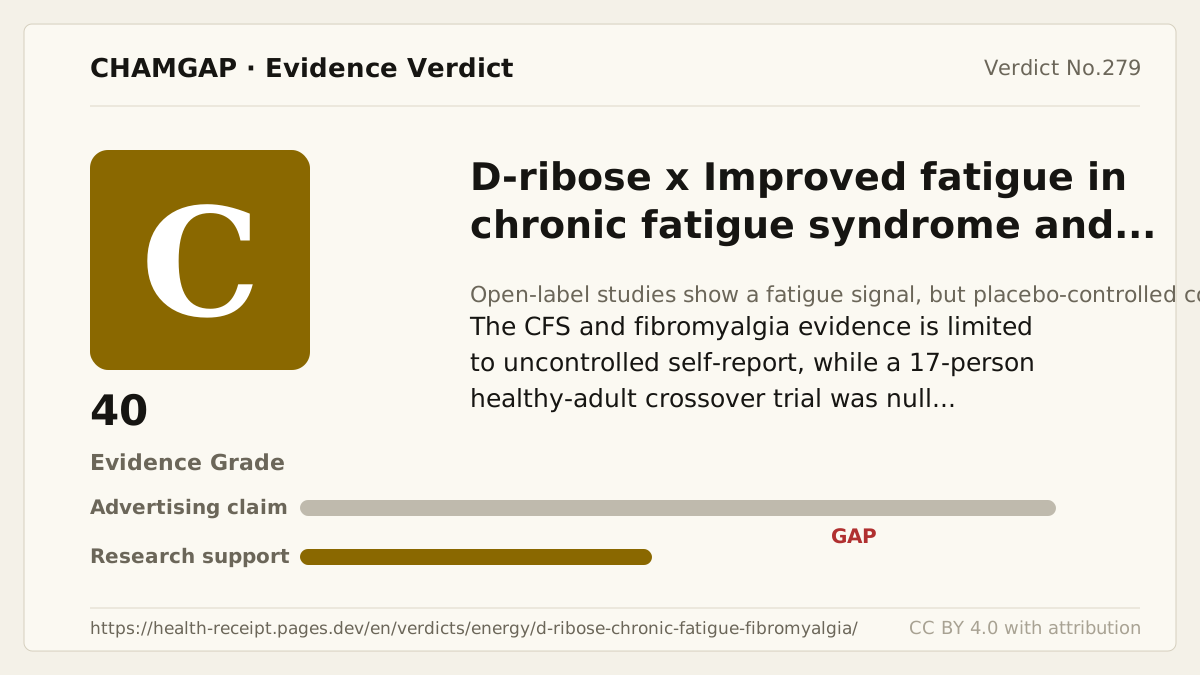
[Chamgap] D-ribose x improved fatigue in chronic fatigue syndrome and fibromyalgia — Evidence Grade C·40. 4 cited sources checked. Source: https://chamgap.com/en/verdicts/energy/d-ribose-chronic-fatigue-fibromyalgia/ · CC BY 4.0CC BY 4.0 — free to use with attribution; do not distort grades, numbers, or verdict meaning.
What this document does and does not do
Chamgap is an information source. It reports what research has and has not confirmed; it does not tell readers what to take or buy. That decision belongs to readers and, when needed, medical or legal professionals. This verdict reflects literature available up to the search date and may change as new research appears. Nothing here is medical advice.