
DMAE,
does it really help with Improvement in memory and focus?
research showsMemory evidence for DMAE is D: a double-blind trial in 27 people with Alzheimer's disease was negative, and an open trial found no memory improvement. Focus, however, showed positive signals in a double-blind trial of 35 general volunteers and a placebo-controlled trial of 75 children with behavioral disorders, so the compound claim cannot be grouped entirely as D. The overall grade is low C.
ads claimAdvertising calls DMAE an 'acetylcholine precursor' and a 'memory and focus enhancer,' but modern clinical evidence does not show cognitive enhancement from the precursor hypothesis.
Useful facts when choosing a product
- DMAE is also labeled deanol or dimethylethanolamine.
- DMAE pyroglutamate and centrophenoxine are not the same test substance as ordinary DMAE.
- Drowsiness, retardation, increased confusion, and mild blood-pressure elevation were reported in the Alzheimer's trial.
What the research actually shows
Murphree 1960 compared deanol with placebo in 35 general volunteers and reported a subjective focus signal. Geller 1960 assigned 75 children with behavioral disorders to deanol, trimeglamide, or placebo and reported improved concentration and puzzle-based integrative tasks with deanol. The Ferris 1977 open trial in 14 people with dementia found no memory improvement, and the Fisman 1981 placebo-controlled trial in 27 people with Alzheimer's disease found no significant cognitive benefit. Blin 2009 tested DMAE pyroglutamate, a reaction product distinct from ordinary DMAE.
Why this is classified as C (40)
Memory is D because the direct double-blind trial was negative and the open trial found no improvement. Focus is C because positive signals appeared in a 35-person volunteer trial and a 75-child placebo-controlled trial, so the compound claim cannot remain D. The old, small samples and subjective or behavioral outcomes yield low C with 40 points.
Counterpoint. Two old positive focus signals remain. DMAE pyroglutamate was not counted toward the upgrade because it is a different test substance from ordinary DMAE.
Rejudgment record. Reassessment (cross-check reflected) — Memory was negative in a 27-person Alzheimer's trial, while focus was positive in trials of 35 general volunteers and 75 children; old small samples and subjective or behavioral outcomes cap the result at low C
Sub-claim grades by effect
This ingredient is marketed for several effects. A single overall grade blends strong and weak claims together, so each effect is graded separately here. The overall grade reflects the strongest disconfirming or core claim.
| Effect (sub-claim) | Grade | Basis |
|---|---|---|
| Memory improvement | D | Memory improvement was not established in the placebo-controlled Alzheimer's trial or the open dementia trial. |
| Focus improvement | C | Small double-blind samples with subjective and behavioral outcomes |
Cross-check — Codex and Claude
Evidence Table
| Study | Design | Sample | Funding | Endpoint | Result | Weight |
|---|---|---|---|---|---|---|
| Murphree HB Jr et al. 1960 | Double-blind placebo-controlled trial | 35 | Unknown | Subjective focus and stimulant effects | Reported a subjective focus signal with deanol, but did not use modern objective cognitive testing. | Positive for focus, limited |
| Geller SJ 1960 | Deanol-, active-drug-, and placebo-controlled trial | 25 | Unknown | Focus, puzzle-based integrative tasks, and behavior | Reported improved focus and integrative-task performance with deanol, but relied on a small sample and behavioral outcomes. | Positive for focus, limited |
| Fisman M et al. 1981 | Double-blind placebo-controlled trial | 27 | Unknown | Cognitive change and tolerability | No significant benefit; six of 13 DMAE participants withdrew for adverse effects within five weeks. | Key |
| Ferris SH et al. 1977 | Open pre-post clinical trial | 14 | Unknown | Memory, cognition, and behavior | Some behavior changed, but memory and other cognitive functions did not improve. | Supportive |
| Blin O et al. 2009 | Drug-induced memory-deficit study in healthy volunteers | Unknown | Scopolamine-induced memory deficit and reaction time | DMAE pyroglutamate reduced some deficits, but it is a different compound. | Limited |
Receipt — 5 References
All 5 cited sources were verified for existence at the original page (as of 2026-07-11).
Reviewed and approved: Chamgap Editorial Team · Approval date: 2026-07-11 · Corrections: none
Cite this verdict
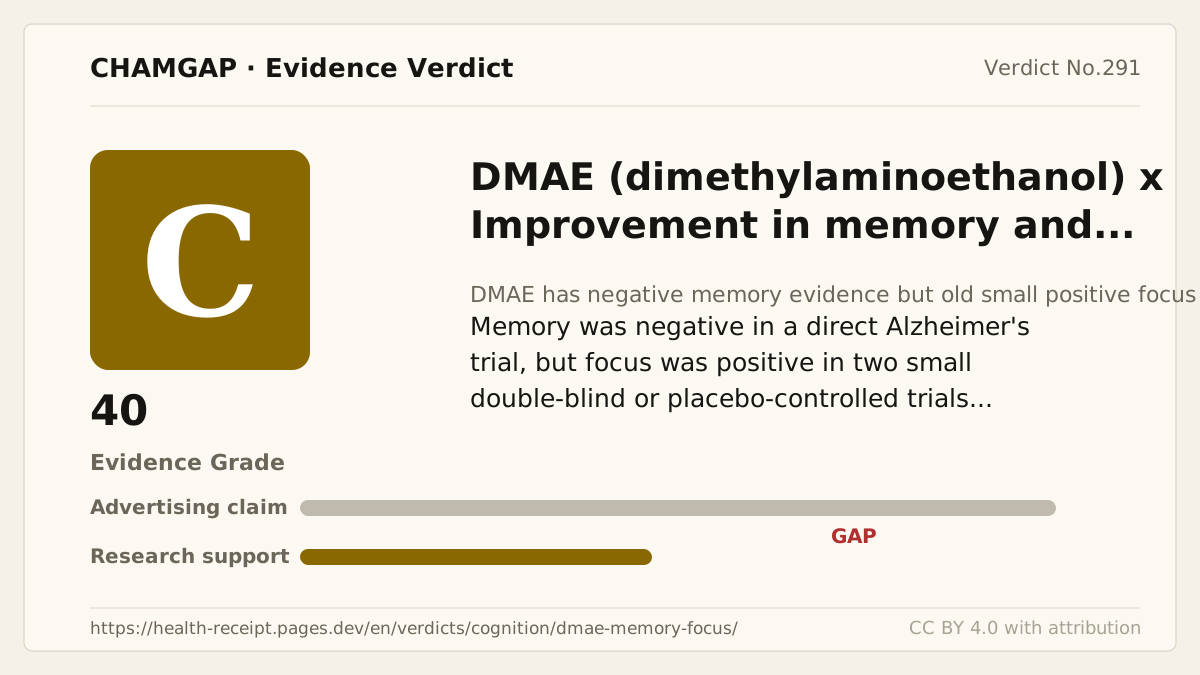
[Chamgap] DMAE (dimethylaminoethanol) x improvement in memory and focus — Evidence Grade C·40. 5 cited sources checked. Source: https://chamgap.com/en/verdicts/cognition/dmae-memory-focus/ · CC BY 4.0CC BY 4.0 — free to use with attribution; do not distort grades, numbers, or verdict meaning.
What this document does and does not do
Chamgap is an information source. It reports what research has and has not confirmed; it does not tell readers what to take or buy. That decision belongs to readers and, when needed, medical or legal professionals. This verdict reflects literature available up to the search date and may change as new research appears. Nothing here is medical advice.