
Siberian rhubarb extract,
does it really help with Relief of menopausal hot flashes and symptoms?
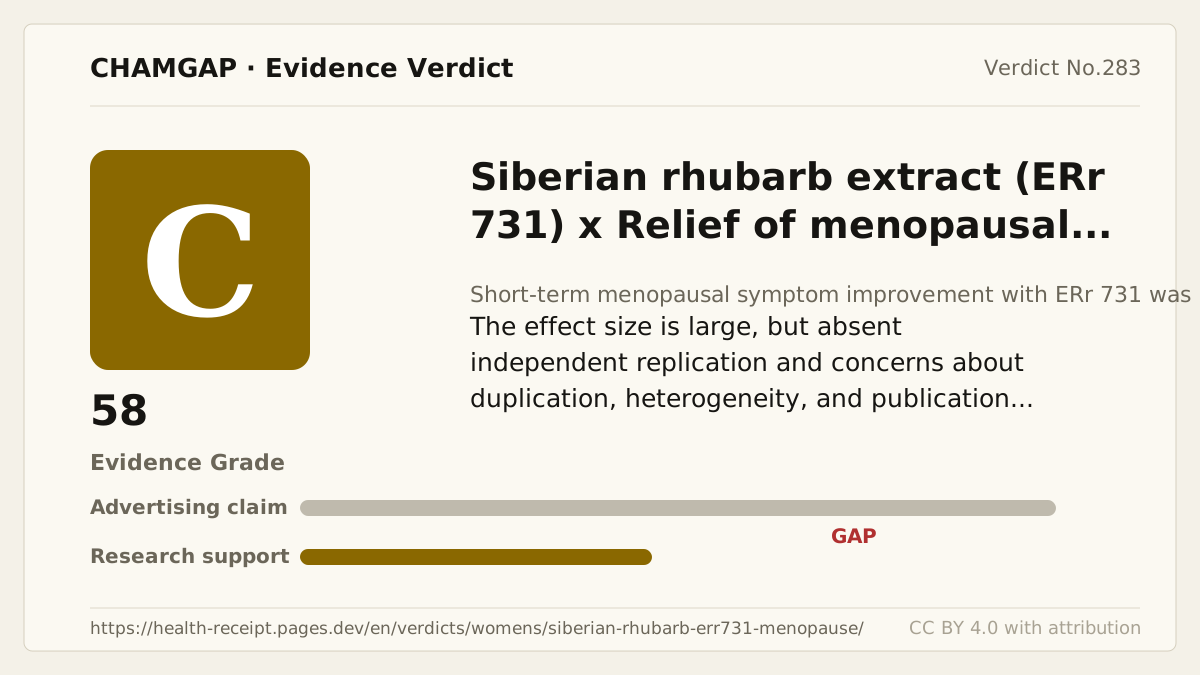
research showsRCTs of 109 and 112 participants showed strong improvements in Menopause Rating Scale scores and hot flashes with ERr 731, but all evidence is tied to the specific ERr 731 formulation and a linked research network without confirmed independent replication. The 390-person meta-analysis also had I-squared of 93%, supporting upper C.
ads claimAdvertisements present it as a nonhormonal menopause solution with broad symptom relief. The evidence concerns a specific standardized extract at 4 mg/day, not rhubarb in general.
Useful facts when choosing a product
- Key trials used 4 mg/day of ERr 731 in enteric-coated tablets.
- Results cannot be directly applied to ordinary rhubarb, rhubarb tea, or other extracts.
- Short-term tolerability was acceptable, while product labeling includes caution related to estrogen-dependent conditions.
What the research actually shows
Heger 2006 reported greater improvement in Menopause Rating Scale II scores and hot flashes versus placebo after 12 weeks in 109 women. A 112-person confirmation trial by Kaszkin-Bettag 2009 replicated the scale reduction. The Dubey 2024 meta-analysis pooled four studies and 390 participants and reported a mean scale difference of -15.12, but heterogeneity was 93%. Heger 2026 was not a new independent RCT; it was an additional reanalysis of the existing 112-person RCT and its subsequent observational data.
Why this is classified as C (58)
The strong Menopause Rating Scale and hot-flash effects in the 109- and 112-person RCTs are recognized, but all evidence is tied to the specific ERr 731 formulation and linked research network without independent replication, while meta-analytic heterogeneity was 93%; this supports upper C with 58 points.
Counterpoint. Short-term hot-flash and scale benefits were repeated when the product was specifically ERr 731.
Rejudgment record. Reassessment (cross-check reflected) — The 109- and 112-person RCTs were strongly positive, but evidence is tied to the specific ERr 731 formulation and linked research network without independent replication; the 390-person meta-analysis had 93% heterogeneity, and the 2026 paper reanalyzed the existing 112-person RCT
Sub-claim grades by effect
This ingredient is marketed for several effects. A single overall grade blends strong and weak claims together, so each effect is graded separately here. The overall grade reflects the strongest disconfirming or core claim.
| Effect (sub-claim) | Grade | Basis |
|---|---|---|
| Relief of hot flashes | C | Two short-term RCTs were positive, but evidence is concentrated in the ERr 731 formulation and linked research network |
| Relief of overall menopausal symptoms | C | Repeated improvement in Menopause Rating Scale scores; lack of independent replication and non-independent data limit it to upper C |
Cross-check — Codex and Claude
Evidence Table
| Study | Design | Sample | Funding | Endpoint | Result | Weight |
|---|---|---|---|---|---|---|
| Heger M et al. 2006 | Multicenter randomized double-blind placebo-controlled trial | 109 | Linked to the ERr 731 and Health Research Services research network | Menopause Rating Scale II, hot flashes, and quality of life | Total scale score, individual symptoms, and hot flashes improved versus placebo after 12 weeks. | Key, linked research network |
| Kaszkin-Bettag M et al. 2009 | Multicenter randomized placebo-controlled confirmation trial | 112 | Linked to the ERr 731 product and research network | Total Menopause Rating Scale score and hot flashes | Twelve weeks of ERr 731 improved scale scores and hot flashes versus placebo. | Key, linked research network |
| Dubey VP et al. 2024 | Systematic review and meta-analysis | 390 | Authors linked to the ERr 731 product and research network | Total Menopause Rating Scale score | The mean difference was -15.12, but heterogeneity was 93% and publication-bias and non-independence concerns remain. | Synthesis, linked research network |
| Heger PW et al. 2026 | Reanalysis of the existing 112-person RCT and follow-up observational data | 89 | Linked to the ERr 731 and Health Research Services research network | Headache, migraine, dizziness, paresthesia, and well-being | It additionally analyzed selected symptoms from the existing RCT and its follow-up; it was not a new independent RCT. | Supportive, non-independent |
Receipt — 4 References
All 4 cited sources were verified for existence at the original page (as of 2026-07-11).
Reviewed and approved: Chamgap Editorial Team · Approval date: 2026-07-11 · Corrections: none
Cite this verdict
[Chamgap] Siberian rhubarb extract (ERr 731) x relief of menopausal hot flashes and symptoms — Evidence Grade C·58. 4 cited sources checked. Source: https://chamgap.com/en/verdicts/womens/siberian-rhubarb-err731-menopause/ · CC BY 4.0CC BY 4.0 — free to use with attribution; do not distort grades, numbers, or verdict meaning.
What this document does and does not do
Chamgap is an information source. It reports what research has and has not confirmed; it does not tell readers what to take or buy. That decision belongs to readers and, when needed, medical or legal professionals. This verdict reflects literature available up to the search date and may change as new research appears. Nothing here is medical advice.