
Black cohosh,
does it really help with Menopausal symptoms (hot flashes)?
research showsBlack cohosh has long been used for menopausal hot flashes, but Cochrane review and a large independent RCT did not confirm clear improvement over placebo. Because liver-injury reports exist, safety is closer to a stronger warning than simple 'caution.'
ads claimProducts use wording such as 'women's menopause,' 'hot flashes,' 'not a phytoestrogen,' and 'without hormone worries.' The actual evidence splits by extract type, and liver-safety wording is sometimes omitted.
Useful facts when choosing a product
- Because cases of liver injury such as hepatitis, jaundice, and elevated liver enzymes have been reported, people with liver disease and people who drink heavily need particular caution.
- Pregnant or breastfeeding people and people with hormone-sensitive conditions such as breast cancer are difficult to interpret without clinician consultation.
- Verification of the original plant and issues of contamination or substitution differ by product and are important.
- This should not be viewed as evidence for hot-flash improvement at the level of hormone therapy.
What the research actually shows
The Leach 2012 Cochrane review concluded from 16 RCTs and data on 2027 people that it was difficult to say black cohosh consistently improved hot-flash frequency or menopausal symptoms more than placebo. The Newton 2006 Ann Intern Med HALT study (n=351) found that black cohosh alone or in combined herbs did not reduce vasomotor symptoms more than placebo. Some commercial-extract studies such as Wuttke 2003 reported improvements in symptom scales, but they have manufacturer and formulation relevance.
Why this is classified as D (33)
Large independent RCT and Cochrane conclusions lean toward null or uncertainty, while positive evidence is strongly tied to formulation and industry. I judge it as the upper part of D, 33 points.
Counterpoint. A positive interpretation is possible when limited to some standardized extracts. However, once independent replication and safety are combined, it is appropriate to read the general claim low.
Rejudgment record. Draft — Large independent RCT and Cochrane found improvement in main symptoms uncertain; safety warning
Cross-check — Codex and Claude
Evidence Table
| Study | Design | Sample | Funding | Endpoint | Result | Weight |
|---|---|---|---|---|---|---|
| Leach MJ, Moore V. 2012 | Cochrane systematic review | 2027 | Non-profit review; original studies mixed | Hot-flash frequency and menopausal symptom scales | Concluded that consistent improvement versus placebo was difficult to confirm. | Core |
| Newton KM et al. 2006 | Randomized placebo-controlled trial (HALT) | 351 | NCCAM/public funding | Frequency and intensity of vasomotor symptoms | Black cohosh alone and combined herbal products did not significantly reduce symptoms compared with placebo. | Core counterexample |
| Naser B et al. 2011 | Safety review | Possible links to commercial extracts | Liver adverse events | Summarized liver-injury case reports and debates over causality. | Safety |
Receipt — 4 References
All 4 cited sources were verified for existence at the original page (as of 2026-07-09).
Reviewed and approved: Chamgap Editorial Team · Approval date: 2026-07-09 · Corrections: none
Cite this verdict
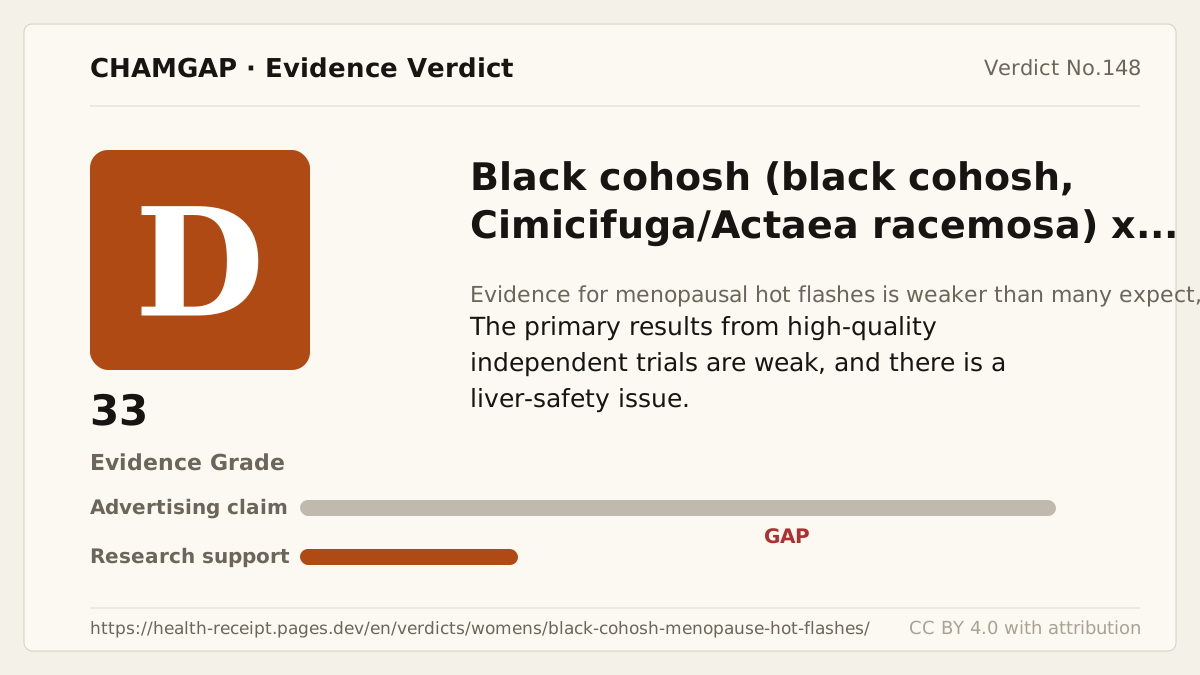
[Chamgap] Black cohosh x menopausal symptoms (hot flashes) — Evidence Grade D·33. 4 cited sources checked. Source: https://chamgap.com/en/verdicts/womens/black-cohosh-menopause-hot-flashes/ · CC BY 4.0CC BY 4.0 — free to use with attribution; do not distort grades, numbers, or verdict meaning.
What this document does and does not do
Chamgap is an information source. It reports what research has and has not confirmed; it does not tell readers what to take or buy. That decision belongs to readers and, when needed, medical or legal professionals. This verdict reflects literature available up to the search date and may change as new research appears. Nothing here is medical advice.