
Fucoxanthin,
does it really help with Reduction in body weight and abdominal fat?
research showsHuman evidence for fucoxanthin reducing body weight and abdominal fat is mixed across a small number of trials. Xanthigen combines fucoxanthin with pomegranate seed oil, so its results cannot be attributed to fucoxanthin alone as weight-loss evidence. Among direct fucoxanthin trials, positive findings are concentrated in a 33-participant ingredient-company study, the 28-participant trial mainly reported within-group pre-post changes, and the 37-participant trial was negative for additional reductions in body weight or body fat beyond diet and exercise. The overall rating is at the bottom of C.
ads claimMarketed claims may present brown-algae origin, thermogenesis, fat burning, and abdominal-fat reduction as one package. Human trials used different extracts and combinations at 1-12 mg/day and produced inconsistent results, so they do not establish a definitive weight-loss effect across products.
Useful facts when choosing a product
- Fucoxanthin is a carotenoid in brown algae such as wakame and kelp, and products contain it as brown-algae or microalgae extracts.
- Human trial doses range widely from 1 to 12 mg/day, and fucoxanthin content and extraction source differ among products.
- One of the prominent positive weight trials used a combination of fucoxanthin and pomegranate seed oil, so it cannot isolate the single-ingredient effect.
- Short-term trials have not shown a clear serious-adverse-event signal, but long-term, large-scale safety data are limited.
What the research actually shows
The Abidov 2010 RCT reported reductions in body weight and body fat over 16 weeks with Xanthigen, which combined fucoxanthin with pomegranate seed oil, so the isolated contribution of fucoxanthin cannot be separated. The Hitoe 2017 trial administered 1 or 3 mg/day for four weeks to 33 Japanese adults with BMI 25-30 and found that some weight and abdominal-fat measures improved versus placebo, but both authors and all study funding were linked to the ingredient company. The López-Ramos 2023 RCT reported within-group reductions in body weight and waist circumference after 12 mg/day in 28 patients with metabolic syndrome, but between-group effect reporting was insufficient. The Dickerson 2024 RCT administered 4.4 mg/day for 12 weeks to 37 women with overweight during a diet and exercise program and found no added reduction in body weight or body fat versus placebo.
Why this is classified as C (40)
Direct human RCTs exist, so this is not ?, which denotes an absence of human efficacy literature. However, Xanthigen results cannot be attributed to fucoxanthin alone, and positive single-ingredient findings are concentrated in a 33-participant ingredient-company trial. The within-group comparison problem in the 28-participant trial and the negative added reductions in body weight and body fat in the 37-participant direct trial result in 38 points at the bottom of C.
Counterpoint. Signals of reduced body weight and waist circumference remain for specific standardized extracts and metabolically at-risk populations. This assessment does not evaluate brown-algae consumption in general or other metabolic effects of fucoxanthin.
Rejudgment record. Reassessment (cross-validation incorporated) — Xanthigen combination results cannot be attributed to fucoxanthin alone; positive single-ingredient findings are concentrated in a 33-participant company-linked trial, the 28-participant trial mainly reports within-group change, and the 37-participant direct trial was negative for added body-weight and body-fat reduction
Cross-check — Codex and Claude
Evidence Table
| Study | Design | Sample | Funding | Endpoint | Result | Weight |
|---|---|---|---|---|---|---|
| Abidov M et al. 2010 | Randomized double-blind placebo-controlled trial | 151 | Product and author conflicts were insufficiently reported | Body weight, waist circumference, body fat, liver fat, and resting energy expenditure | Some dose groups receiving Xanthigen, a fucoxanthin-pomegranate seed oil combination, had reductions in body weight and body fat; the isolated effect of fucoxanthin cannot be separated. | Supportive |
| Hitoe S, Shimoda H. 2017 | Randomized double-blind placebo-controlled trial | 33 | Fully funded by Oryza Oil & Fat Chemical; both authors were employees | Body weight, BMI, CT abdominal visceral fat, and subcutaneous fat | At four weeks, 3 mg/day improved relative body weight, BMI, and visceral fat, while 1 mg/day improved some fat measures, but the dose-response pattern was inconsistent. | Key |
| López-Ramos A et al. 2023 | Randomized double-blind placebo-controlled trial | 28 | Unknown | Body weight, BMI, waist circumference, blood pressure, triglycerides, and insulin measures | Reported within-group reductions in body weight, BMI, and waist circumference after 12 mg/day for 12 weeks, but the abstract did not clearly present between-group effects. | Supportive |
| Dickerson B et al. 2024 | Randomized double-blind placebo-controlled trial | 37 | Funded by Microphyt; company employees were coauthors | Body weight, body fat, fat-free mass, and resting energy expenditure | Adding 4.4 mg/day for 12 weeks to a diet and exercise program produced no additional reduction in body weight or body fat versus placebo. | Key |
Receipt — 4 References
All 4 cited sources were verified for existence at the original page (as of 2026-07-11).
Reviewed and approved: Chamgap Editorial Team · Approval date: 2026-07-11 · Corrections: none
Cite this verdict
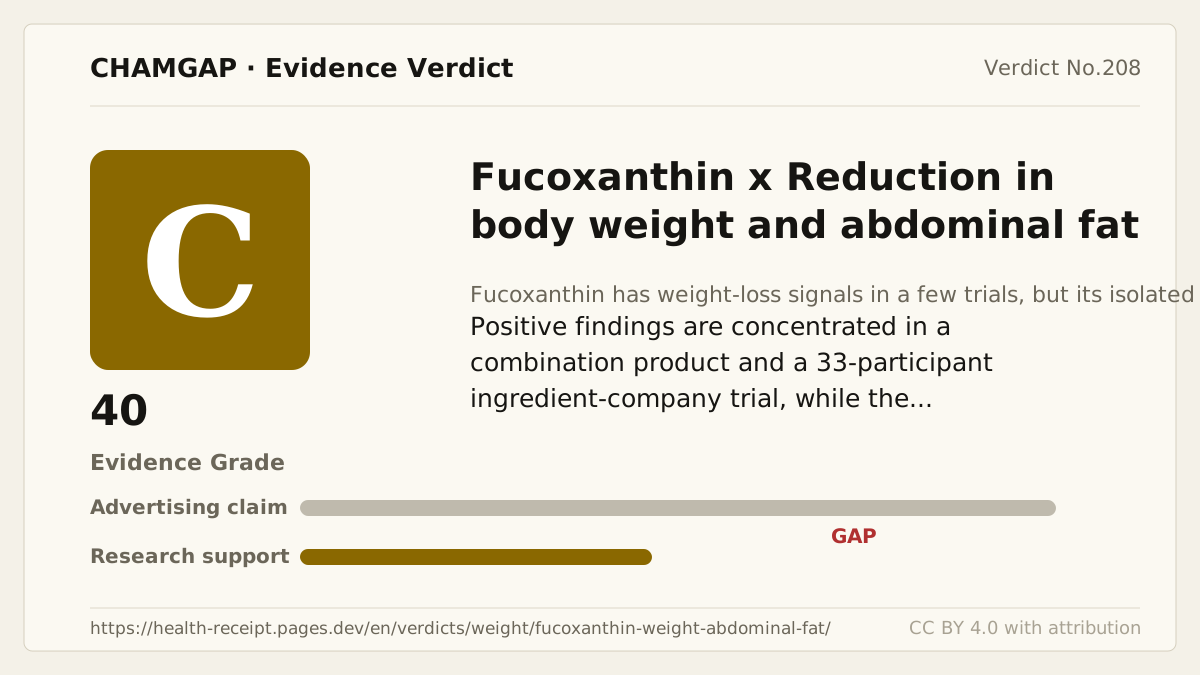
[Chamgap] Fucoxanthin x reduction in body weight and abdominal fat — Evidence Grade C·40. 4 cited sources checked. Source: https://chamgap.com/en/verdicts/weight/fucoxanthin-weight-abdominal-fat/ · CC BY 4.0CC BY 4.0 — free to use with attribution; do not distort grades, numbers, or verdict meaning.
What this document does and does not do
Chamgap is an information source. It reports what research has and has not confirmed; it does not tell readers what to take or buy. That decision belongs to readers and, when needed, medical or legal professionals. This verdict reflects literature available up to the search date and may change as new research appears. Nothing here is medical advice.