
Capsinoids,
does it really help with Thermogenesis and body-fat reduction?
research showsCapsinoids show a signal of slightly increasing energy expenditure and fat oxidation in single-dose trials, but these are mainly short-term metabolic markers. The roughly 34 kcal/day estimate in the 2021 meta-analysis pooled capsinoids with capsaicinoids, so it cannot be presented as an isolated capsiate effect. In an 80-participant, 12-week RCT, body weight (P=0.86) and total body fat did not differ between groups, and only abdominal fat reached P=0.049. The overall rating is at the lower end of C.
ads claimAdvertising may present a nonpungent pepper ingredient, brown-fat activation, thermogenesis, and body-fat reduction as a continuous chain of established effects. The changes documented in research are mainly small shifts in energy expenditure and respiratory quotient, while the amount of weight loss is not established.
Useful facts when choosing a product
- Capsinoids are minimally pungent capsaicin analogues including capsiate, dihydrocapsiate, and nordihydrocapsiate.
- The main human trials used 6-9 mg/day or a single 9 mg dose.
- In the representative 12-week trial, body weight and total fat mass did not differ, while only an abdominal-fat measure differed at a borderline level.
- Short-term trials generally found good tolerability, but data on long-term weight-management efficacy and safety are limited.
What the research actually shows
The Snitker 2009 RCT randomized 80 adults with BMI 25-35 and evaluated 6 mg/day for 12 weeks. Weight change was 0.9±3.1 kg in the capsinoid group and 0.5±2.4 kg in the placebo group, with no difference (P=0.86); total adiposity also did not differ, while only abdominal-fat reduction reached P=0.049. The Yoneshiro 2012 crossover trial reported that in 18 healthy men, energy expenditure in the brown-fat-positive group increased by 15.2±2.6 kJ/h over one hour after a single 9 mg dose. The Ludy 2012 critical meta-analysis concluded that increases in thermogenesis and fat oxidation were small. The Irandoost 2021 meta-analysis of 13 studies reported an increase in resting metabolic rate of about 33.99 kcal/day, but it pooled capsinoids with capsaicinoids and did not assess a weight-loss clinical endpoint.
Why this is classified as C (42)
Thermogenic surrogate markers are repeated but small, and the roughly 34 kcal/day estimate in the 2021 meta-analysis pooled capsinoids with capsaicinoids. In the representative 12-week RCT, body weight was negative at P=0.86, total fat mass was negative, and only abdominal fat reached P=0.049; manufacturer-linked studies also make up a substantial share. The result is 42 points at the lower end of C.
Counterpoint. An acute energy-expenditure response has been replicated in some adults with active brown fat. The overall assessment does not deny that physiological response; it limits the link to long-term body-fat reduction.
Rejudgment record. Reassessment (cross-validation incorporated) — The roughly 34 kcal/day result in the 2021 meta-analysis is a surrogate estimate pooled across capsinoids and capsaicinoids; the representative 12-week RCT was negative for body weight at P=0.86 and total fat, with only abdominal fat at P=0.049
Sub-claim grades by effect
This ingredient is marketed for several effects. A single overall grade blends strong and weak claims together, so each effect is graded separately here. The overall grade reflects the strongest disconfirming or core claim.
| Effect (sub-claim) | Grade | Basis |
|---|---|---|
| Increased thermogenesis and energy expenditure | C | Small increases recur in single-dose and short-term trials and meta-analyses, but they are surrogate markers. |
| Reduction in body fat | C | In the 12-week RCT, total fat mass was negative and only abdominal fat showed a borderline difference. |
Cross-check — Codex and Claude
Evidence Table
| Study | Design | Sample | Funding | Endpoint | Result | Weight |
|---|---|---|---|---|---|---|
| Snitker S et al. 2009 | Randomized double-blind placebo-controlled trial | 12 | Funded by Ajinomoto Co., Inc.; company employees were coauthors | Body weight, total adiposity, abdominal fat, and energy expenditure | No between-group difference in body weight (P=0.86) or total adiposity; only abdominal-fat reduction favored capsinoids at P=0.049. | Key |
| Yoneshiro T et al. 2012 | Single-blind randomized placebo-controlled crossover trial | 18 | Public research funding and industry links reported | FDG-PET brown-fat activity and two-hour energy expenditure after a single dose | After a single 9 mg dose, one-hour energy expenditure increased by 15.2±2.6 kJ/h in the brown-fat-positive group; change was small in the brown-fat-negative group. | Key |
| Ludy MJ et al. 2012 | Critical systematic review and meta-analysis | Unknown | Energy expenditure, fat oxidation, and appetite | Pooled increased thermogenesis and fat oxidation with capsiate, but judged the magnitude small. | Key | |
| Irandoost P et al. 2021 | Systematic review and meta-analysis | 13 | Unknown | Resting metabolic rate, energy expenditure, respiratory quotient, and fat oxidation | Capsaicinoids and capsinoids increased resting metabolic rate by 33.99 kcal/day, but this was not a weight-loss endpoint. | Supportive |
Receipt — 4 References
All 4 cited sources were verified for existence at the original page (as of 2026-07-11).
Reviewed and approved: Chamgap Editorial Team · Approval date: 2026-07-11 · Corrections: none
Cite this verdict
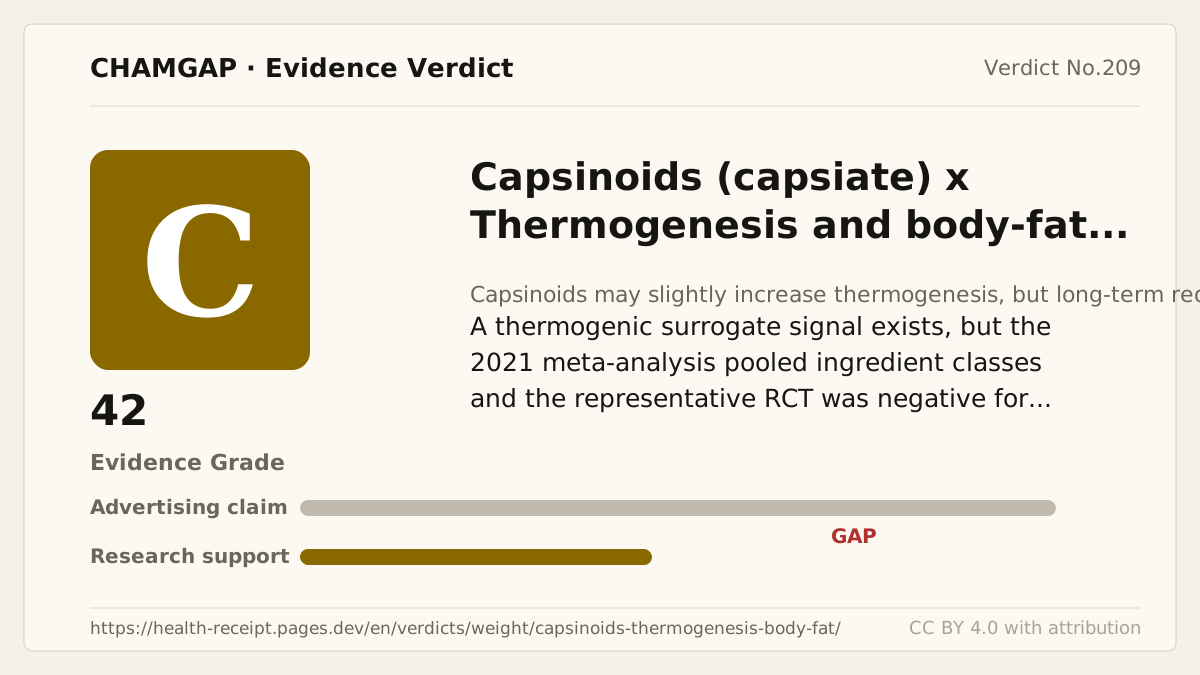
[Chamgap] Capsinoids (capsiate) x thermogenesis and body-fat reduction — Evidence Grade C·42. 4 cited sources checked. Source: https://chamgap.com/en/verdicts/weight/capsinoids-thermogenesis-body-fat/ · CC BY 4.0CC BY 4.0 — free to use with attribution; do not distort grades, numbers, or verdict meaning.
What this document does and does not do
Chamgap is an information source. It reports what research has and has not confirmed; it does not tell readers what to take or buy. That decision belongs to readers and, when needed, medical or legal professionals. This verdict reflects literature available up to the search date and may change as new research appears. Nothing here is medical advice.