
Workplace problem-solving intervention,
does it really help with Reduced registered sickness-absence days among workers with occupational stress or common mental disorders?
research showsThe grade is C with 56 points. In a Swedish cluster-randomized trial of 100 employees, summing the monthly means in the 12-month table gives about 65.6 registered days in the problem-solving group and 96.5 in active usual care. The model found an approximately 15-day advantage across four middle months, but no annual between-group confidence interval was reported. The small sample and unclear handling of consultant-level clustering prevent a firm conclusion.
ads claimThe tested package combined separate employee and manager interviews, a joint problem-solving meeting, work adjustment, stress-management advice, and at least three follow-ups over three months. Korean employee-assistance marketing should not reduce this to a generic counseling session.
Useful facts when choosing a product
- Occupational-health consultants received one day of training and were advised to conduct separate interviews, a joint meeting, and at least three follow-ups.
- Administrative records reduce recall error but did not capture the first 14 days of a Swedish sickness-absence spell.
- Partial absence was converted to net days, while informal or unregistered short absence could still be missed.
What the research actually shows
In the original September 28, 2015 entry for `NCT02563743`, the first two primary outcomes were (1) ‘Change from Baseline in Return to Work (RTW) at 12 months,’ defined as 0 to 365 total sick-leave days in registry data, and (2) ‘Change from Baseline in Return to Work (RTW) during a follow-up period of 12 months,’ defined by monthly self-report as time to any increase in work level at 25%, 50%, 75%, or 100%. On December 2, 2016, registered sickness-absence days became the single primary outcome, while self-reported absence and partial or full return-to-work outcomes moved to secondary status. The paper matched the amended single primary outcome. An independent statistician used computer-generated numbers stratified by occupational-health unit. Employees were blinded to the possibility of another trial intervention, and statisticians and researchers were blinded only at the initial primary analysis. Separate outcome-assessor blinding was not reported. Registry outcomes were available for all 41 and 59 assigned employees, but the public paper and registration did not establish explicit handling of consultant-level intracluster correlation.
Why this is classified as C (56)
A publicly funded trial found fewer registered absence days, but one 100-person cluster trial with unclear consultant-level clustering supports only C with 56 points.
Counterpoint. Delivery may differ under Korean workplace authority, privacy protections, and sickness-absence systems.
Rejudgment record. Cross-check applied — Positive registered primary outcome tempered by small size and unclear consultant-level cluster handling
| Endpoint | H | Hard endpoint - actual events such as death |
| Replication | R1 | Single confirmatory trial |
| Independence | I2 | Decisive evidence is publicly or non-profit funded |
| Effect size | E+ | Meets the clinically important threshold |
The scoring table and the verdict agree (C).
Sub-claim grades by effect
This ingredient is marketed for several effects. A single overall grade blends strong and weak claims together, so each effect is graded separately here. The overall grade reflects the strongest disconfirming or core claim.
| Effect (sub-claim) | Grade | Basis |
|---|---|---|
| Reduction in registered sickness-absence days over 12 months | C | One small cluster trial was positive, but no annual between-group confidence interval was reported. |
Cross-check — Codex and Claude
Evidence Table
| Study | Design | Sample | Funding | Endpoint | Result | Weight |
|---|---|---|---|---|---|---|
| Study 1 | Cluster-randomized trial at occupational-health consultant level | 59 | Original wording: “Primary sponsor: The Swedish Research Council for Health, Working Life and Welfare (registration number 2014-0742). Secondary sponsor: The Swedish Social Insurance Agency (registration number 027552-2015).” | Registered net sickness-absence days over 12 months | Summed monthly raw means about 65.6 versus 96.5 days; group-by-time P=0.033; modeled months 5-8 differed by about 15 days; no annual between-group CI reported | Pivotal single trial |
Receipt — 2 References
All 2 cited sources were verified for existence at the original page (as of 2026-08-08).
Reviewed and approved: Chamgap Editorial Team · Approval date: 2026-08-08 · Corrections: none
Cite this verdict
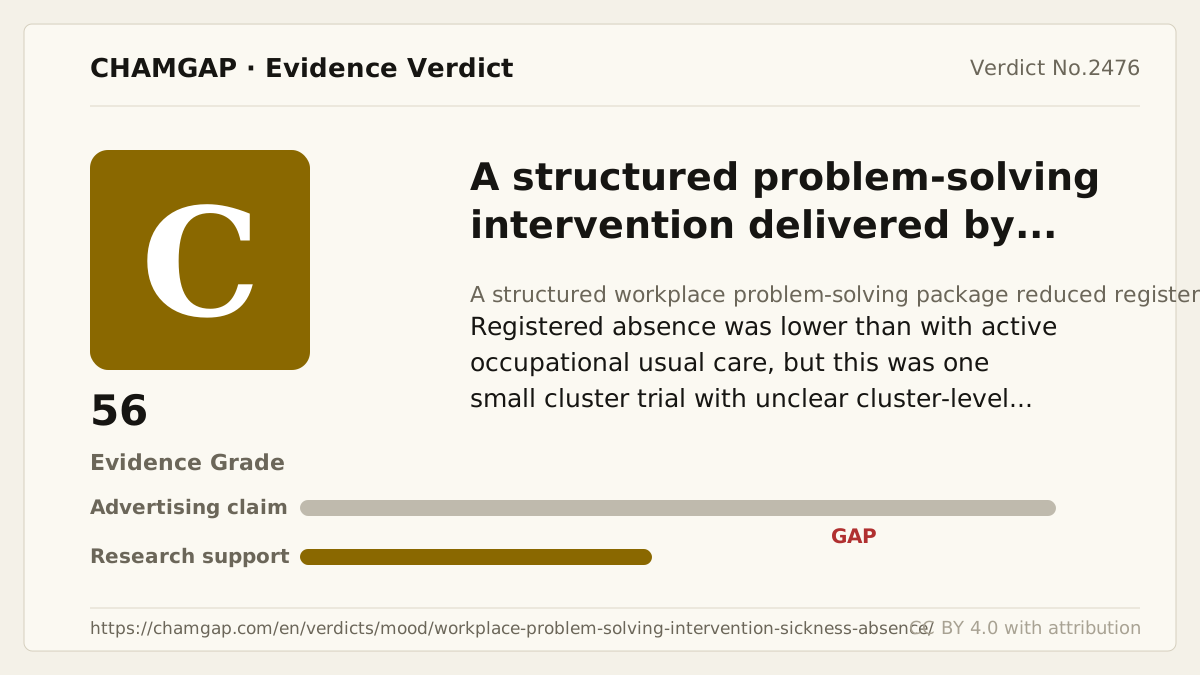
[Chamgap] Workplace problem-solving intervention x reduced registered sickness absence — Evidence Grade C·56. 2 cited sources checked. Source: https://chamgap.com/en/verdicts/mood/workplace-problem-solving-intervention-sickness-absence/ · CC BY 4.0CC BY 4.0 — free to use with attribution; do not distort grades, numbers, or verdict meaning.
What this document does and does not do
Chamgap is an information source. It reports what research has and has not confirmed; it does not tell readers what to take or buy. That decision belongs to readers and, when needed, medical or legal professionals. This verdict reflects literature available up to the search date and may change as new research appears. Nothing here is medical advice.