
Systematic family-presence offer during CPR,
does it really help with Reduction in relatives' PTSD-related symptoms at 90 days?
research showsThe grade is B with 70 points. In a cluster-randomized French trial of 570 relatives, PTSD-related symptoms at 90 days occurred in 64/233 (27.5%) observed relatives in the offer group and 90/242 (37.2%) in usual practice. The adjusted odds ratio for control versus offer was 1.7 (95% CI 1.2-2.5), but 95/570 (16.7%) lacked the 90-day assessment and there is no independent replication.
ads claimOffering the option and actually witnessing CPR are different exposures. Seventy-nine percent of the offer group and 43% of controls witnessed CPR, so this verdict concerns a systematic offer with support, not mandatory presence.
Useful facts when choosing a product
- The intervention offers one relative a choice to witness CPR and provides a dedicated support person.
- Actual witnessing occurred in 211/266 (79%) versus 131/304 (43%).
- No significant effect on resuscitation procedures, 28-day survival, or medical-team stress was reported.
What the research actually shows
Jabre 2013 assigned 15 emergency medical service units, offering the option systematically to 266 relatives while 304 received usual practice. Jabre 2014 is a longer follow-up of the same trial. Funding came from the French Ministry of Health's Programme Hospitalier de Recherche Clinique 2008.
Why this is classified as B (70)
One publicly funded cluster-randomized trial found fewer patient-centered PTSD-related symptoms, but the single-trial evidence and 16.7% missing outcome data give B with 70 points.
Counterpoint. Implementation must consider the relative's choice, patient safety, space, and staff roles; in-hospital CPR requires separate evidence.
Rejudgment record. Cross-check applied — Cross-checked the prespecified day-90 primary outcome, observed denominators, missingness, public funding, and the status of the one-year paper as follow-up of the same trial
| Endpoint | P | Patient-reported treatment goal - the symptom is the goal |
| Replication | R1 | Single confirmatory trial |
| Independence | I2 | Decisive evidence is publicly or non-profit funded |
| Effect size | E+ | Meets the clinically important threshold |
The scoring table and the verdict agree (B).
Sub-claim grades by effect
This ingredient is marketed for several effects. A single overall grade blends strong and weak claims together, so each effect is graded separately here. The overall grade reflects the strongest disconfirming or core claim.
| Effect (sub-claim) | Grade | Basis |
|---|---|---|
| A systematic offer of family presence reduces relatives' PTSD-related symptoms at 90 days | B | Observed rates were 27.5% versus 37.2%. |
| Family presence improves patient survival | D | No difference in 28-day survival was found. |
Cross-check — Codex and Claude
Evidence Table
| Study | Design | Sample | Funding | Endpoint | Result | Weight |
|---|---|---|---|---|---|---|
| Study 1 | Cluster-randomized trial across 15 prehospital emergency medical service units | 242 | Programme Hospitalier de Recherche Clinique 2008 of the French Ministry of Health | Proportion with PTSD-related symptoms at day 90 | Observed cases 64/233 (27.5%) versus 90/242 (37.2%); adjusted OR for control versus offer 1.7 (95% CI 1.2-2.5), P=.004 | Pivotal publicly funded trial of the prespecified primary outcome |
| Study 2 | Follow-up report of the same PRESENCE trial | 1 | Same publicly funded trial | PTSD-related symptoms at one year | Adjusted OR for control versus offer 1.8 (95% CI 1.1-3.0) | Supports durability but is not counted as independent replication |
Receipt — 2 References
All 2 cited sources were verified for existence at the original page (as of 2026-08-14).
Reviewed and approved: Chamgap Editorial Team · Approval date: 2026-08-14 · Corrections: none
Cite this verdict
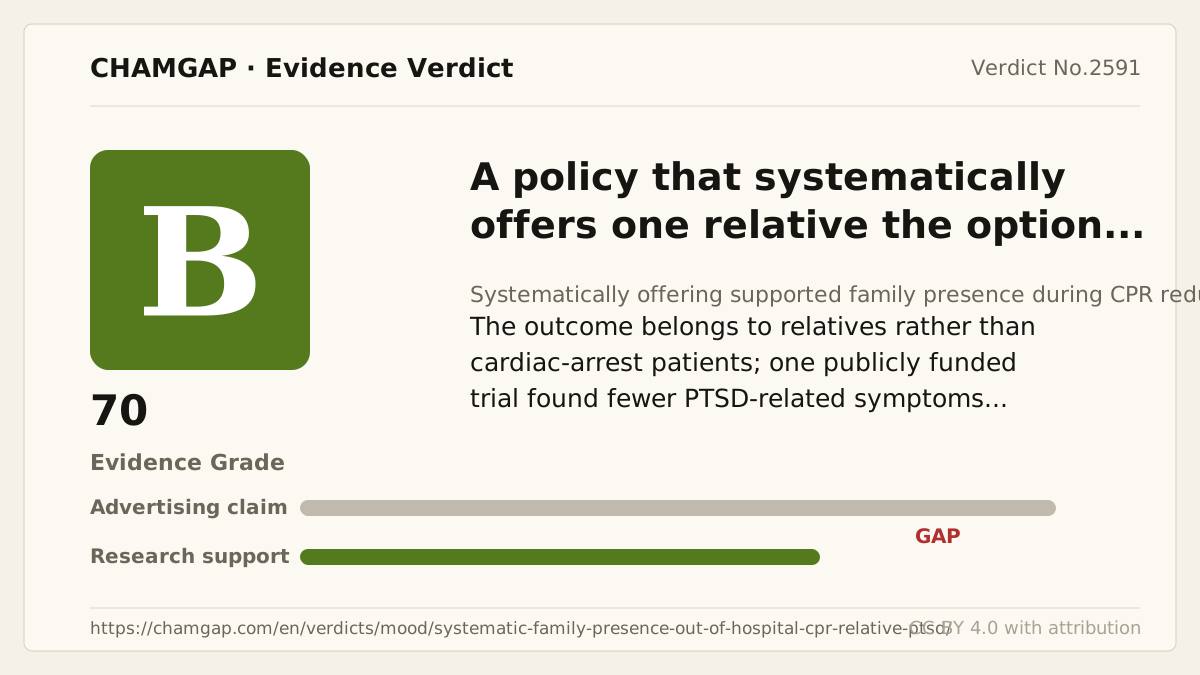
[Chamgap] Systematic family-presence offer during CPR x relatives' PTSD-related symptoms — Evidence Grade B·70. 2 cited sources checked. Source: https://chamgap.com/en/verdicts/mood/systematic-family-presence-out-of-hospital-cpr-relative-ptsd/ · CC BY 4.0CC BY 4.0 — free to use with attribution; do not distort grades, numbers, or verdict meaning.
What this document does and does not do
Chamgap is an information source. It reports what research has and has not confirmed; it does not tell readers what to take or buy. That decision belongs to readers and, when needed, medical or legal professionals. This verdict reflects literature available up to the search date and may change as new research appears. Nothing here is medical advice.