
L-lysine,
does it really help with Relief of stress and anxiety?
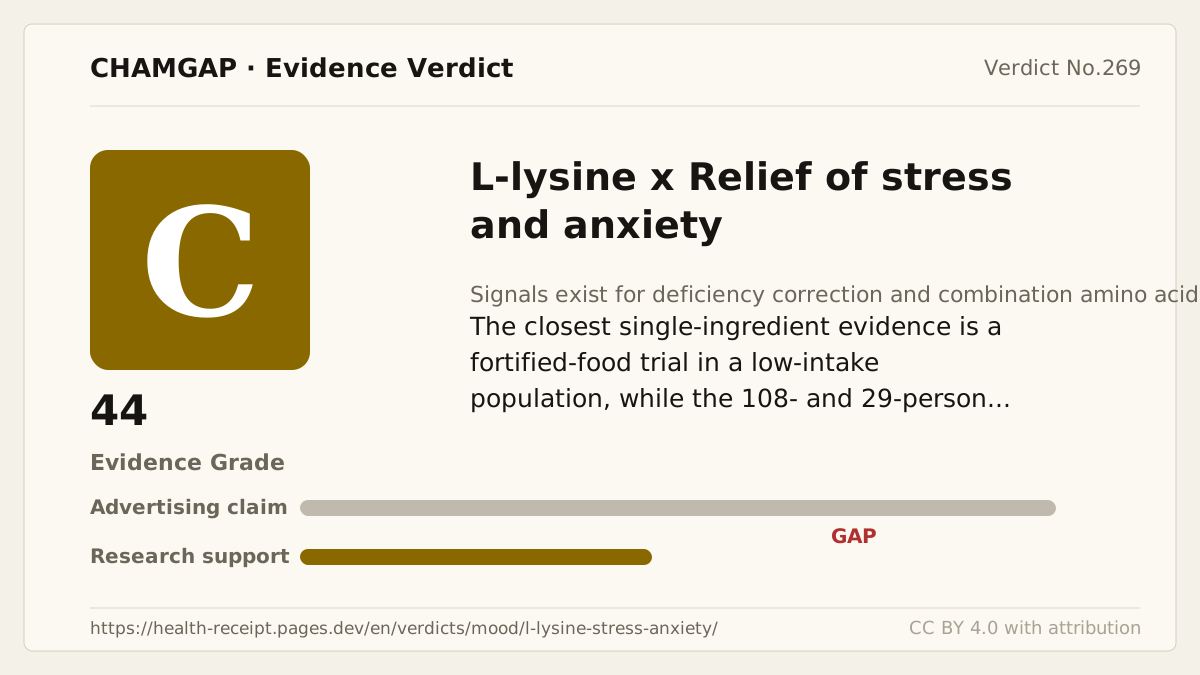
research showsThe closest evidence for L-lysine alone is a fortified-food trial in a Syrian community with low lysine intake, with positive findings limited to selected sex-specific outcomes. The 108-person and 29-person trials both used lysine plus arginine, so their effects cannot be attributed to L-lysine alone. Deficiency correction, combination ingredients, and manufacturer concentration support C with 44 points.
ads claimMarketing states that one amino acid regulates serotonin receptors and cortisol to reduce ordinary stress. Human evidence centers on deficiency correction and a lysine-arginine combination, which is not equivalent to a single-ingredient L-lysine product.
Useful facts when choosing a product
- The Syrian study used lysine-fortified flour, not a supplement capsule.
- The Japanese trial combined lysine 2.64 g/day with arginine 2.64 g/day.
- Main outcomes were short-term measures such as anxiety questionnaires, salivary cortisol, and skin conductance.
- Key human studies had funding or author links to Ajinomoto.
What the research actually shows
The Smriga 2004 study provided lysine-fortified flour for three months in a low-intake Syrian community and found improvements in selected sex-specific outcomes, including trait anxiety in men, the cortisol response to blood drawing in women, and skin conductance in men. This is the closest evidence for L-lysine alone, but it is a deficiency-correction food-fortification study. The 108-person Smriga 2007 and 29-person Jezova 2005 trials both used lysine plus arginine, so they cannot establish efficacy of L-lysine alone.
Why this is classified as C (44)
Signals in two randomized human studies mean the evidence is not ungradable, but a deficiency-risk population, combination ingredients, sex-specific results, short-term surrogates, and manufacturer concentration limit it to C with 44 points.
Counterpoint. A nutritional-correction effect remains possible in diets with low lysine intake, which is distinct from additional supplementation in people with adequate intake.
Rejudgment record. Reassessment (cross-check reflected) — Randomized human signals exist, but they involve a lysine-deficiency-risk population or lysine-arginine combinations, sex-specific outcomes, short-term surrogates, and concentration of evidence around Ajinomoto
Cross-check — Codex and Claude
Evidence Table
| Study | Design | Sample | Funding | Endpoint | Result | Weight |
|---|---|---|---|---|---|---|
| Smriga M et al. 2004 | Three-month randomized double-blind food-fortification trial | Ajinomoto Co., Inc. | Trait anxiety, cortisol response, and skin conductance | Selected sex-specific outcomes improved, but this was a fortified-food study in a population with low lysine intake. | Key | |
| Smriga M et al. 2007 | Randomized double-blind placebo-controlled trial | 108 | Authors affiliated with Ajinomoto | Trait and state anxiety, salivary cortisol, and chromogranin A | The lysine-arginine combination reduced anxiety scores and selected basal hormonal markers in men. | Key |
| Smriga M et al. 2005 | Randomized double-blind placebo-controlled stress-challenge trial | 29 | Ajinomoto-linked | Hormonal, cardiovascular, and skin-conductance responses to public-speaking stress | The lysine-arginine combination altered hormonal and skin-conductance responses, while heart rate and blood pressure did not differ. | Supportive |
Receipt — 3 References
All 3 cited sources were verified for existence at the original page (as of 2026-07-11).
Reviewed and approved: Chamgap Editorial Team · Approval date: 2026-07-11 · Corrections: none
Cite this verdict
[Chamgap] L-lysine x Relief of stress and anxiety — Evidence Grade C·44. 3 cited sources checked. Source: https://chamgap.com/en/verdicts/mood/l-lysine-stress-anxiety/ · CC BY 4.0CC BY 4.0 — free to use with attribution; do not distort grades, numbers, or verdict meaning.
What this document does and does not do
Chamgap is an information source. It reports what research has and has not confirmed; it does not tell readers what to take or buy. That decision belongs to readers and, when needed, medical or legal professionals. This verdict reflects literature available up to the search date and may change as new research appears. Nothing here is medical advice.