
Stinging nettle root extract,
does it really help with Improvement of urinary symptoms from benign prostatic hyperplasia?
research showsThe IPSS effect of SMD -2.06 in the 2025 meta-analysis appears large, but it pooled different Urtica formulations and comparators, heterogeneity and certainty were very low, and quality of life was null. The large effect in the 620-person trial has not been independently replicated. Consistency with pygeum, rated C in verdict 227, supports the top of C with 57 points; B would overstate the evidence.
ads claimAdvertisements combine 'shrinks the prostate,' 'resolves nocturia,' 'restores urine flow,' and 'balances male hormones.' Human evidence mainly concerns IPSS over a limited period; long-term progression and avoidance of surgery have not been established.
Useful facts when choosing a product
- Trials studied root extract, which is not interchangeable with nettle leaf or tea.
- Trial doses and standardization vary, often within approximately 300 to 600 mg/day.
- The main clinical endpoint is IPSS; Qmax, residual urine, and prostate-size results are less consistent.
- Serious adverse events were uncommon in trials, but concentrated extracts differ in composition.
What the research actually shows
The Safarinejad 2005 RCT followed 620 men for six months and reported a large IPSS improvement, but that magnitude has not been independently replicated. The Karami 2020 RCT gave 60 men root extract 450 mg/day for 12 weeks and reported an IPSS signal, while most other measures were not significant. The Posadzki 2025 review pooled six RCTs and 1,210 participants across different Urtica formulations and comparators, producing an IPSS SMD of -2.06, but rated heterogeneity and certainty as very low and found no significant quality-of-life benefit.
Why this is classified as C (57)
The IPSS SMD of -2.06 and the 620-person signal are acknowledged, but heterogeneity across Urtica formulations and comparators, very low certainty, null quality of life, and lack of independent replication of the large effect support the top of C with 57 points. Consistency with pygeum in verdict 227 makes B an overrating.
Counterpoint. IPSS improvement remains possible in men with mild to moderate BPH symptoms. This judgment does not extend to preventing long-term progression, acute urinary retention, or surgery.
Rejudgment record. Reassessment (cross-check reflected) — IPSS SMD -2.06 pooled heterogeneous Urtica formulations and comparators under very low certainty; quality of life was null, the 620-person large effect lacks independent replication, and calibration to pygeum applies
Cross-check — Codex and Claude
Evidence Table
| Study | Design | Sample | Funding | Endpoint | Result | Weight |
|---|---|---|---|---|---|---|
| Posadzki P et al. 2025 | Systematic review and meta-analysis | 6 RCTs; n=1,210 | No funding | IPSS, quality of life, and PSA | The IPSS SMD of -2.06 across heterogeneous Urtica formulations and comparators had very low certainty; quality of life was not significantly improved. | Key |
| Safarinejad MR 2005 | Randomized double-blind placebo-controlled partial-crossover trial | n=620; completers n=558 | Unknown | IPSS, Qmax, residual urine, and prostate size | Six-month improvements in IPSS and Qmax were reported, but effect sizes were large and independent confirmation is limited. | Key |
| Karami AA et al. 2020 | Randomized double-blind placebo-controlled trial | n=60 | Unknown | IPSS, inflammation, and oxidative-stress markers | An intermediate IPSS effect was reported after 450 mg/day for 12 weeks, while most other measures were nonsignificant. | Supportive |
Receipt — 3 References
All 3 cited sources were verified for existence at the original page (as of 2026-07-11).
Reviewed and approved: Chamgap Editorial Team · Approval date: 2026-07-11 · Corrections: none
Cite this verdict
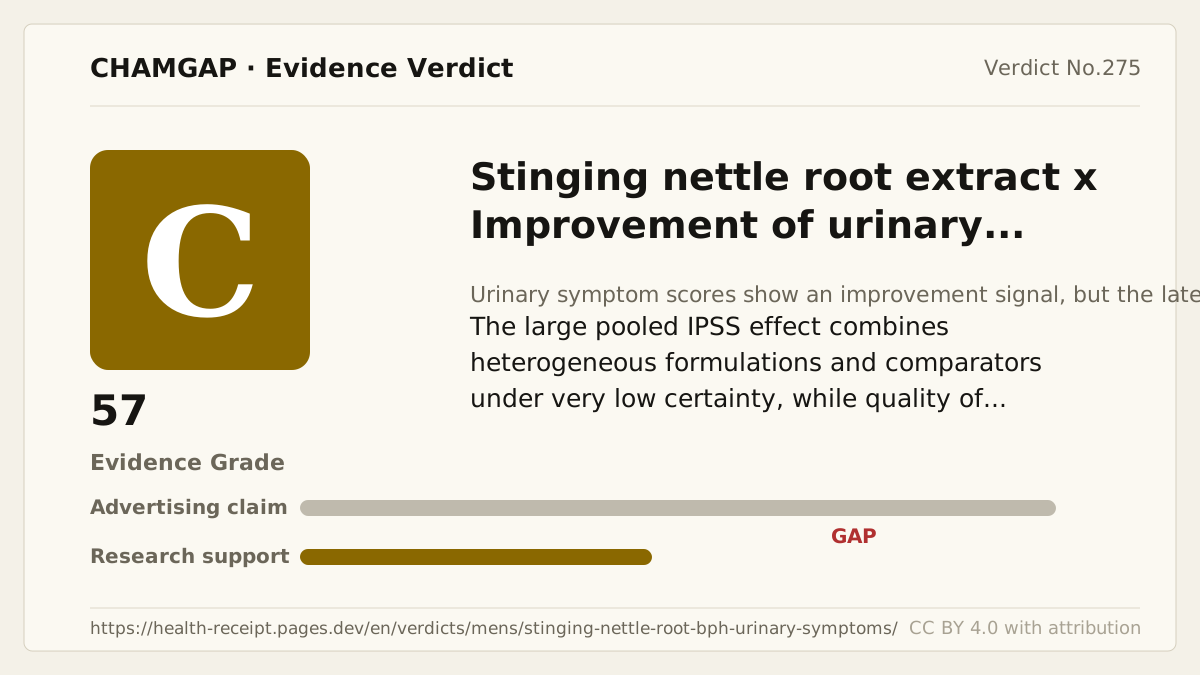
[Chamgap] Stinging nettle root extract x improvement of urinary symptoms from benign prostatic hyperplasia — Evidence Grade C·57. 3 cited sources checked. Source: https://chamgap.com/en/verdicts/mens/stinging-nettle-root-bph-urinary-symptoms/ · CC BY 4.0CC BY 4.0 — free to use with attribution; do not distort grades, numbers, or verdict meaning.
What this document does and does not do
Chamgap is an information source. It reports what research has and has not confirmed; it does not tell readers what to take or buy. That decision belongs to readers and, when needed, medical or legal professionals. This verdict reflects literature available up to the search date and may change as new research appears. Nothing here is medical advice.