
Rye grass pollen extract,
does it really help with Improvement of urinary symptoms from benign prostatic hyperplasia?
research showsPositive evidence applies to the specific Cernilton preparation, not arbitrary rye-pollen products. Old trials found improvements in self-rated symptoms and nocturia, while urinary flow and residual volume were null, and the updated Cochrane record has been withdrawn. The evidence is therefore limited to the 2000 BJU review and original trials, supporting C with 55 points; modern pollen products cannot be assumed equivalent.
ads claimAdvertisements combine 'normalizes prostate function,' 'strengthens urine flow,' 'reduces prostate size,' and 'resolves nocturia.' Evidence supports only a signal for short-term self-rated symptoms and nocturia in some men.
Useful facts when choosing a product
- Cernilton is a specific standardized water- and lipid-soluble fraction of flower pollen that includes rye grass pollen.
- Cernilton cannot automatically be treated as equivalent to arbitrary modern pollen or Graminex-type products.
- Key trials lasted 12 to 24 weeks and provide no outcome data on long-term progression, acute urinary retention, or avoidance of surgery.
- Pollen hypersensitivity is possible; adverse events in trials were generally rare and mild.
What the research actually shows
The Buck 1990 Cernilton RCT followed 60 men for six months and reported subjective improvement of 69% versus 30%, but between-group differences in urinary flow and voided volume were null. The MacDonald 2000 BJU review pooled four controlled Cernilton trials with 444 men and found self-rated improvement and less nocturia, but direct placebo evidence involved only two trials with 163 men, allocation concealment was unclear, and pooled urinary flow and residual volume were null. Because the updated Cochrane record is withdrawn, this judgment is limited to the BJU review and original trials.
Why this is classified as C (55)
Self-rated symptom and nocturia signals for the specific Cernilton preparation are acknowledged, but urinary flow and residual volume were null, evidence is limited to the 2000 BJU review and old original trials, the updated Cochrane record is withdrawn, and equivalence to arbitrary modern pollen products is unestablished. This supports C with 55 points.
Counterpoint. Improvement in nocturia and self-rated symptoms remains possible in mild to moderate disease. This judgment does not include prostate shrinkage or prevention of long-term progression.
Rejudgment record. Reassessment (cross-check reflected) — Old self-rated symptom and nocturia signals apply to the specific Cernilton preparation, while urinary flow and residual volume were null, the updated Cochrane record is withdrawn, and equivalence to modern pollen products is absent
Cross-check — Codex and Claude
Evidence Table
| Study | Design | Sample | Funding | Endpoint | Result | Weight |
|---|---|---|---|---|---|---|
| MacDonald R et al. 2000 | Systematic review | 4 controlled trials; n=444 | Unknown; trialists and manufacturers were contacted to identify studies | Self-rated symptoms, nocturia, urinary flow, residual volume, and prostate size | Self-rated symptoms and nocturia improved, while urinary flow, residual volume, and prostate size did not. | Key |
| Buck AC et al. 1990 | Randomized double-blind placebo-controlled trial | n=60 | Unknown | Subjective improvement, residual urine, flow rate, and voided volume | Subjective improvement was 69% versus 30%, but flow-rate and voided-volume differences were not significant. | Key |
Receipt — 3 References
All 3 cited sources were verified for existence at the original page (as of 2026-07-11).
Reviewed and approved: Chamgap Editorial Team · Approval date: 2026-07-11 · Corrections: none
Cite this verdict
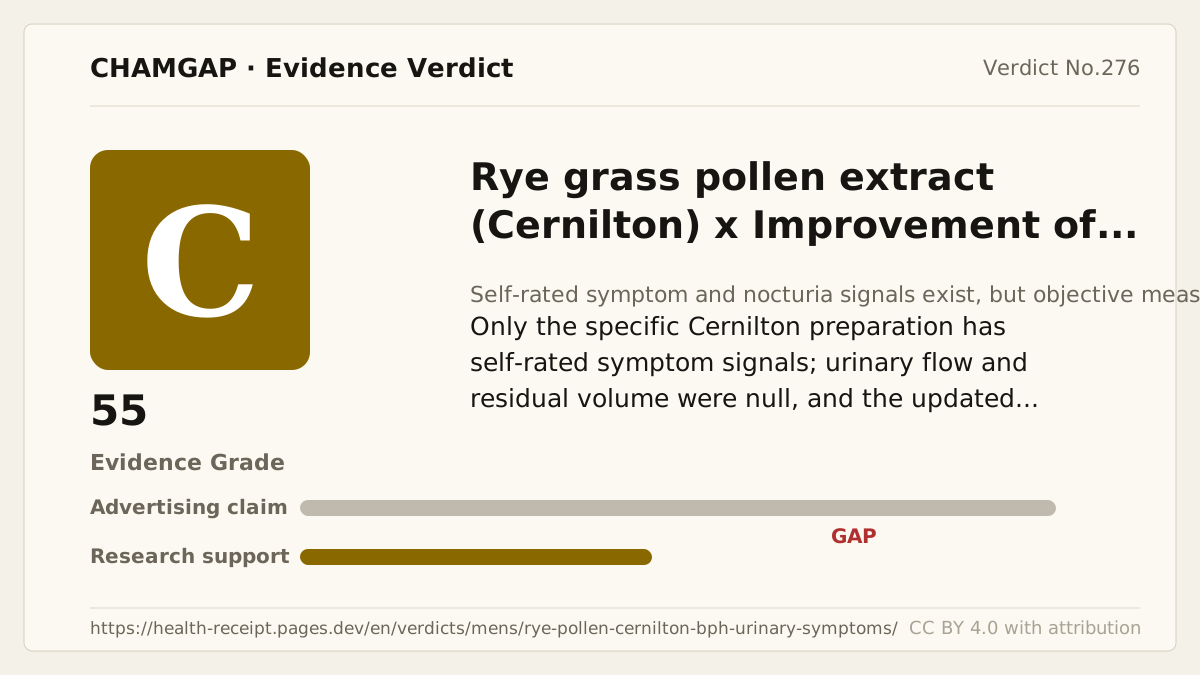
[Chamgap] Rye grass pollen extract (Cernilton) x improvement of urinary symptoms from benign prostatic hyperplasia — Evidence Grade C·55. 3 cited sources checked. Source: https://chamgap.com/en/verdicts/mens/rye-pollen-cernilton-bph-urinary-symptoms/ · CC BY 4.0CC BY 4.0 — free to use with attribution; do not distort grades, numbers, or verdict meaning.
What this document does and does not do
Chamgap is an information source. It reports what research has and has not confirmed; it does not tell readers what to take or buy. That decision belongs to readers and, when needed, medical or legal professionals. This verdict reflects literature available up to the search date and may change as new research appears. Nothing here is medical advice.