
Pumpkin seed oil,
does it really help with Improvement of urinary symptoms from benign prostatic hyperplasia and male androgenetic alopecia?
research showsSmall pumpkin-seed-oil trials produced IPSS signals for BPH urinary symptoms. However, the 1,431-person GRANU trial studied whole seed and extract, not pumpkin seed oil, and the encapsulated extract did not differ from placebo. GRANU therefore cannot be attributed as oil evidence. Alopecia evidence is one industry-supported trial of the specific Octa Sabal Plus® brand, limiting extension to general pumpkin seed oil.
ads claimAdvertisements use phrases such as '5α-reductase inhibition,' 'reduced prostate size,' 'resolved nocturia,' and 'DHT blocking and hair growth.' Clinical data mainly concern IPSS and hair count, while evidence for reduced prostate size, prevention of retention or surgery, and long-term suppression of hair-loss progression is limited.
Useful facts when choosing a product
- BPH oil trials used 320-720 mg/day, while GRANU tested whole seed 10 g/day and extract 1 g/day, so formulations differed.
- The alopecia RCT used Dreamplus-supplied Octa Sabal Plus® 400 mg/day for 24 weeks in men with mild-to-moderate androgenetic alopecia.
- Pumpkin seed oil, whole-seed powder, and oil-based or oil-free extracts are not the same preparation and may have different phytosterol content.
- Trials generally reported favorable tolerability, but data on pumpkin-seed allergy and long-term or drug-combination safety are limited.
What the research actually shows
Hong 2009 assigned 47 men with BPH to four arms and reported improved IPSS and quality of life with pumpkin seed oil, but PSA and prostate volume did not change significantly. Zerafatjou 2021 compared pumpkin seed oil with tamsulosin in 73 men and reported lower IPSS in both groups, but there was no placebo. The 1,431-person GRANU trial was not an oil study: it compared whole pumpkin seed, pumpkin seed extract, and placebo. Whole seed produced a signal, but encapsulated extract did not differ from placebo, so the trial cannot be attributed to oil. Cho 2014 reported increased hair count in 76 men using the specific industry-supported Octa Sabal Plus® brand; this single product trial does not establish a general-oil effect.
Why this is classified as C (43)
Oil evidence for BPH consists of two small trials; GRANU studied whole seed and extract and cannot be attributed to oil. Alopecia evidence is one 76-person industry-supported trial of the specific Octa Sabal Plus® brand, limiting extension to general oil. Combining the subclaims supports C with 43 points.
Counterpoint. IPSS in mild-to-moderate BPH and hair count in male androgenetic alopecia may improve with specific formulations. This judgment does not extend to prevention of prostate progression, urinary retention, or surgery, or to equivalence with standard hair-loss treatments.
Rejudgment record. New judgment — For BPH, small positive oil signals coexist with a negative primary endpoint for extract in a large trial, while alopecia evidence consists of one 76-person specific-product RCT; limited independent replication and formulation consistency support C
Sub-claim grades by effect
This ingredient is marketed for several effects. A single overall grade blends strong and weak claims together, so each effect is graded separately here. The overall grade reflects the strongest disconfirming or core claim.
| Effect (sub-claim) | Grade | Basis |
|---|---|---|
| Improvement of urinary symptoms from benign prostatic hyperplasia | C | Small oil trials produced signals, but GRANU studied whole seed and extract; encapsulated extract did not differ from placebo and cannot be attributed as oil evidence |
| Improvement of male androgenetic alopecia | C | Evidence comes from one 76-person industry-supported trial of the specific Octa Sabal Plus® brand, limiting extension to general pumpkin seed oil |
Cross-check — Codex and Claude
Evidence Table
| Study | Design | Sample | Funding | Endpoint | Result | Weight |
|---|---|---|---|---|---|---|
| Hong H et al. 2009 | Double-blind randomized placebo-controlled four-arm trial | 47 | Korean academic study; product-provision details unclear | IPSS, quality of life, PSA, prostate volume, and Qmax | IPSS and quality of life improved in the pumpkin-seed-oil group, but PSA and prostate volume did not change significantly and each arm was small. | Key |
| Vahlensieck W et al. 2015 | Partially blinded randomized placebo-controlled three-arm trial | 1,431 | Detailed product-related industry involvement unclear | Response of at least a five-point IPSS decrease at 12 months | Response was 58.5% with whole pumpkin seed versus 47.3% with placebo, but pumpkin seed extract did not differ from placebo. | Key |
| Zerafatjou N et al. 2021 | Single-blind randomized active-controlled trial | 73 | Hamadan University of Medical Sciences; no conflicts reported | IPSS, quality of life, PSA, prostate and residual volume, and Qmax | IPSS decreased with both pumpkin seed oil and tamsulosin, but the decrease was greater with tamsulosin and there was no placebo group. | Supportive |
| Cho YH et al. 2014 | Double-blind randomized placebo-controlled trial | 76 | Funded by Dreamplus Co., Ltd., which supplied the study capsules | Blinded photographic assessment, self-assessment, hair thickness, and hair count | Hair count increased 40% with pumpkin seed oil versus 10% with placebo over 24 weeks, with no adverse-event difference. | Key |
Receipt — 4 References
All 4 cited sources were verified for existence at the original page (as of 2026-07-11).
Reviewed and approved: Chamgap Editorial Team · Approval date: 2026-07-11 · Corrections: none
Cite this verdict
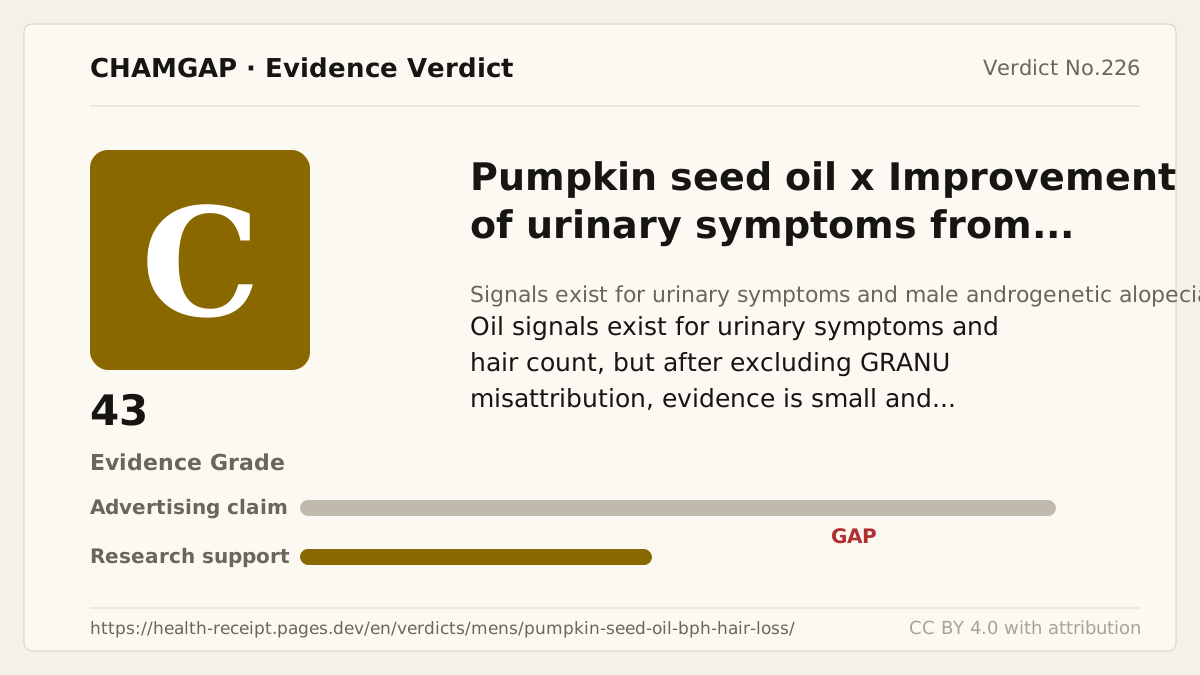
[Chamgap] Pumpkin seed oil x improvement of urinary symptoms from benign prostatic hyperplasia and male androgenetic alopecia — Evidence Grade C·43. 4 cited sources checked. Source: https://chamgap.com/en/verdicts/mens/pumpkin-seed-oil-bph-hair-loss/ · CC BY 4.0CC BY 4.0 — free to use with attribution; do not distort grades, numbers, or verdict meaning.
What this document does and does not do
Chamgap is an information source. It reports what research has and has not confirmed; it does not tell readers what to take or buy. That decision belongs to readers and, when needed, medical or legal professionals. This verdict reflects literature available up to the search date and may change as new research appears. Nothing here is medical advice.