
Total hip arthroplasty,
does it really help with Reduced reoperation within two years versus hemiarthroplasty for displaced femoral-neck fracture?
research showsThe grade is D with 34 points. Unplanned secondary hip procedures occurred in 57/718 (7.9%) after total hip arthroplasty and 60/723 (8.3%) after hemiarthroplasty; absolute difference -0.4 percentage points, HR 0.95 (95% CI 0.64 to 1.40), P=0.79.
ads claimThis is a direct choice in older patients with displaced femoral-neck fracture. Similar reoperation, small functional differences, and possible excess dislocation should all be discussed.
Useful facts when choosing a product
- Total arthroplasty replaces both acetabular and femoral sides; hemiarthroplasty replaces the femoral side.
- Mortality was 14.3% versus 13.1%, an absolute +1.2 points.
- Serious adverse events were 41.8% versus 36.7%, an absolute +5.1 points.
What the research actually shows
HEALTH randomized 1,495 patients at 80 centers; the primary analysis included 718 versus 723. The axis 6 B0 basis has four parts. ① Allocation concealment: the article named "concealed randomization" as a strength, and the Methods Center at McMaster University was responsible for randomization. ② Blinding: limitation name: lack of participant and surgeon blinding. Avoidability: impossible - this was a surgical comparison. Primary endpoint events were nevertheless assessed through "independent adjudication of primary end-point events". ③ Analysis population and missingness: primary-endpoint loss to follow-up was 14.9%, below the 15% threshold, and sensitivity analyses agreed. ④ Prespecified primary endpoint: "any unplanned secondary hip procedure" matched NCT00556842. There were therefore no avoidable design limitations. CIHR, NIH, ZonMw, Sophies Minde Foundation, McMaster Surgical Associates, and Stryker Orthopaedics jointly supported the trial.
Why this is classified as D (34)
A large hard-outcome RCT is a strength, but one mixed-funded null trial that did not exclude benefit gives D with 34 points.
Counterpoint. A null primary endpoint does not erase secondary function, quality-of-life, or dislocation findings.
Rejudgment record. Cross-check applied — Cross-checked HEALTH and registration for endpoint definition, HR and CI, secondary function and dislocation, analysis denominators, and mixed public/Stryker support
| Endpoint | H | Hard endpoint - actual events such as death |
| Replication | R1 | Single confirmatory trial |
| Independence | I1 | Mixed funding sources |
| Effect size | E0 | Null |
| Precision | C0 | The confidence interval leaves room for benefit |
The scoring table and the verdict agree (D).
Sub-claim grades by effect
This ingredient is marketed for several effects. A single overall grade blends strong and weak claims together, so each effect is graded separately here. The overall grade reflects the strongest disconfirming or core claim.
| Effect (sub-claim) | Grade | Basis |
|---|---|---|
| Reduced reoperation within two years | D | HR 0.95 (95% CI 0.64 to 1.40) was null. |
Cross-check — Codex and Claude
Evidence Table
| Study | Design | Sample | Funding | Endpoint | Result | Weight |
|---|---|---|---|---|---|---|
| Study 1 | 80-center randomized surgical trial with blinded event adjudication | 723 | CIHR, NIH, ZonMw and other nonprofit support plus Stryker Orthopaedics | Any unplanned secondary hip procedure within 24 months | 57/718 (7.9%) versus 60/723 (8.3%); HR 0.95 (95% CI 0.64 to 1.40); absolute -0.4 points | Pivotal large mixed-funded RCT |
Receipt — 1 References
All 1 cited sources were verified for existence at the original page (as of 2026-08-18).
Reviewed and approved: Chamgap Editorial Team · Approval date: 2026-08-18 · Corrections: none
Cite this verdict
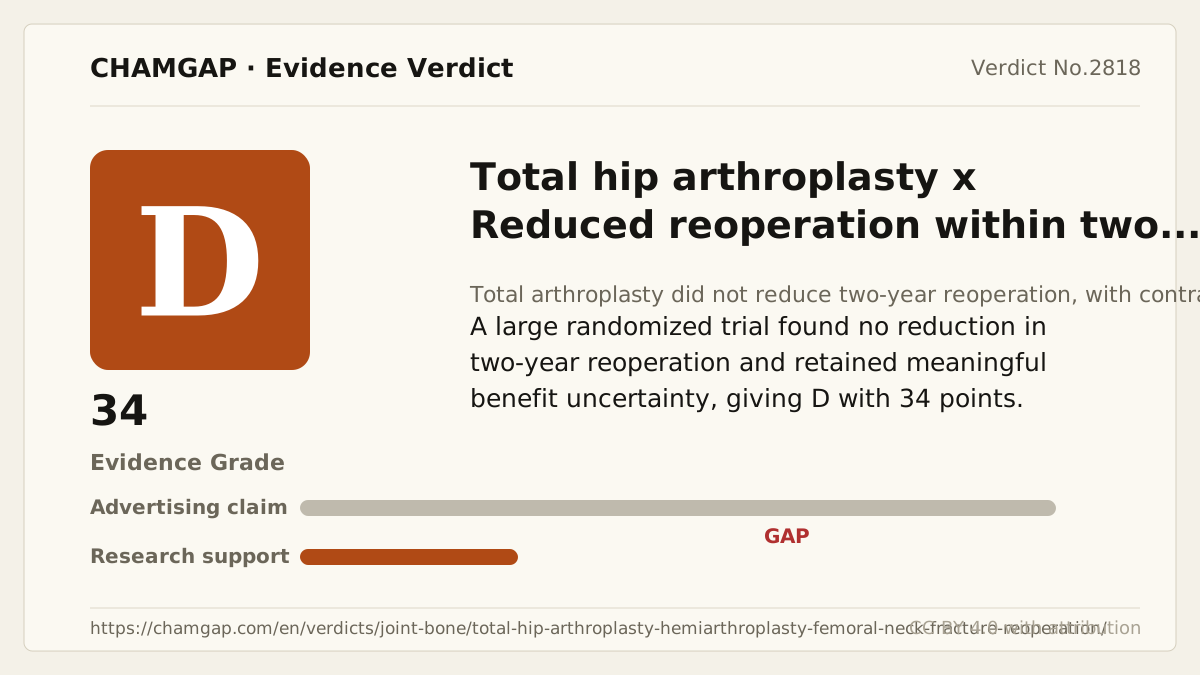
[Chamgap] Total Hip Arthroplasty or Hemiarthroplasty for Hip Fracture - Null — Evidence Grade D·34. 1 cited sources checked. Source: https://chamgap.com/en/verdicts/joint-bone/total-hip-arthroplasty-hemiarthroplasty-femoral-neck-fracture-reoperation/ · CC BY 4.0CC BY 4.0 — free to use with attribution; do not distort grades, numbers, or verdict meaning.
What this document does and does not do
Chamgap is an information source. It reports what research has and has not confirmed; it does not tell readers what to take or buy. That decision belongs to readers and, when needed, medical or legal professionals. This verdict reflects literature available up to the search date and may change as new research appears. Nothing here is medical advice.