
Camphor, menthol, and eucalyptus vapor rub,
does it really help with Relief of nocturnal cold symptoms in children?
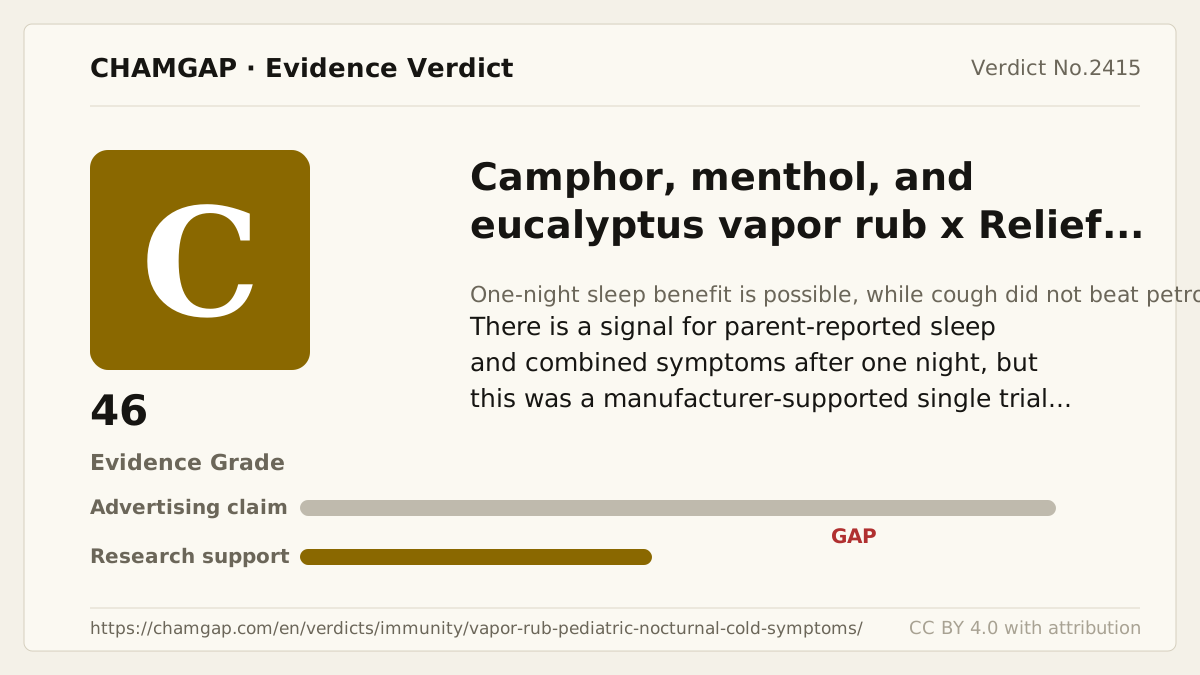
research showsThe grade is C with 46 points. In a three-arm trial, 144 children aged 2-11 were randomized and 138 completed one-night assessment. Parent-rated sleep and the combined score favored vapor rub over petrolatum, while cough frequency and severity did not reach significance versus petrolatum (P=.07 and P=.06).
ads claimThe trial did not study infants under two, adults, repeated multi-night use, under-nose or intranasal application, or heated inhalation. Korean products may differ in composition and age labeling.
Useful facts when choosing a product
- Participants were children aged 2-11, not adults.
- The three arms were vapor rub, petrolatum, and no treatment; 138/144 completed follow-up.
- The formulation contained camphor 4.8%, menthol 2.6%, and eucalyptus oil 1.2% and was applied once before bed.
- Odor made parent masking ineffective, and petrolatum could not fully match expectation.
- Heating or microwaving is not the studied use and has caused severe thermal and chemical burns.
What the research actually shows
Paul 2010 enrolled children aged 2-11 with cough, congestion, and rhinorrhea from an upper respiratory infection lasting seven days or less. Vapor rub, petrolatum, or no treatment was assigned; 138/144 completed follow-up. Children aged 2-5 received 5 mL and those aged 6-11 received 10 mL, massaged on the chest and neck one minute, 30 minutes before bed. The formulation contained camphor 4.8%, menthol 2.6%, and eucalyptus oil 1.2%. Parents rated cough frequency and severity, congestion, rhinorrhea, child sleep, and parent sleep on 1-to-7 scales. The paper did not clearly name a single prespecified primary endpoint. Baseline combined scores were 29.1 (SD 6.4), 28.5 (SD 5.9), and 28.8 (SD 5.7). Baseline means and standard deviations and P values were available, but the standard error and confidence interval for the adjusted between-group contrast were not, so the effect size could not be reconstructed. Funding was stated as “an unrestricted research grant from Procter and Gamble to Penn State University,” plus NIH GCRC grant M01RR10732 and construction grant C06RR016499. Provision of the trial ointments was not stated.
Why this is classified as C (46)
Positive sleep and combined-score signals come from one small, one-night manufacturer-supported trial. Baseline means and standard deviations and P values were available, but the standard error and confidence interval for the adjusted between-group contrast were not, so the effect size could not be reconstructed, limiting the grade to C.
Counterpoint. Cough outcomes were not significant versus petrolatum. The clearest petrolatum comparisons were parent-rated child sleep, parent sleep, and the combined score, all vulnerable to odor-driven unmasking.
Rejudgment record. Cross-check applied — Arm values, variance reporting, P values, adverse events, and exact funding were checked in the original article.
| Endpoint | P | Patient-reported treatment goal - the symptom is the goal |
| Replication | R1 | Single confirmatory trial |
| Independence | I0 | Evidence comes only from manufacturer studies |
| Effect size | EX | The clinical size of the effect could not be judged |
The scoring table and the verdict agree (C).
Sub-claim grades by effect
This ingredient is marketed for several effects. A single overall grade blends strong and weak claims together, so each effect is graded separately here. The overall grade reflects the strongest disconfirming or core claim.
| Effect (sub-claim) | Grade | Basis |
|---|---|---|
| Vapor chest rub relieves nocturnal cold symptoms in children | C | Sleep and combined-score signals were positive after one night, but cough did not beat petrolatum and adjusted effect size could not be reconstructed. |
Cross-check — Codex and Claude
Evidence Table
| Study | Design | Sample | Funding | Endpoint | Result | Weight |
|---|---|---|---|---|---|---|
| Study 1 | Partially double-blind three-arm randomized one-night trial | 47 | an unrestricted research grant from Procter and Gamble to Penn State University; NIH GCRC grant M01RR10732; GCRC construction grant C06RR016499 | Next-morning parent ratings of cough, congestion, rhinorrhea, and child and parent sleep | Versus petrolatum: child sleep P=.006, parent sleep P=.008, combined score P=.03; cough frequency P=.07 and severity P=.06; adjusted CIs not reported | Pivotal evidence |
Receipt — 4 References
All 4 cited sources were verified for existence at the original page (as of 2026-08-07).
Reviewed and approved: Chamgap Editorial Team · Approval date: 2026-08-07 · Corrections: none
Cite this verdict
[Chamgap] Vapor chest rub × nocturnal cold symptoms in children — Evidence Grade C·46. 4 cited sources checked. Source: https://chamgap.com/en/verdicts/immunity/vapor-rub-pediatric-nocturnal-cold-symptoms/ · CC BY 4.0CC BY 4.0 — free to use with attribution; do not distort grades, numbers, or verdict meaning.
What this document does and does not do
Chamgap is an information source. It reports what research has and has not confirmed; it does not tell readers what to take or buy. That decision belongs to readers and, when needed, medical or legal professionals. This verdict reflects literature available up to the search date and may change as new research appears. Nothing here is medical advice.