
Preoperative chlorhexidine whole-body washing,
does it really help with Prevention of surgical-site infection?
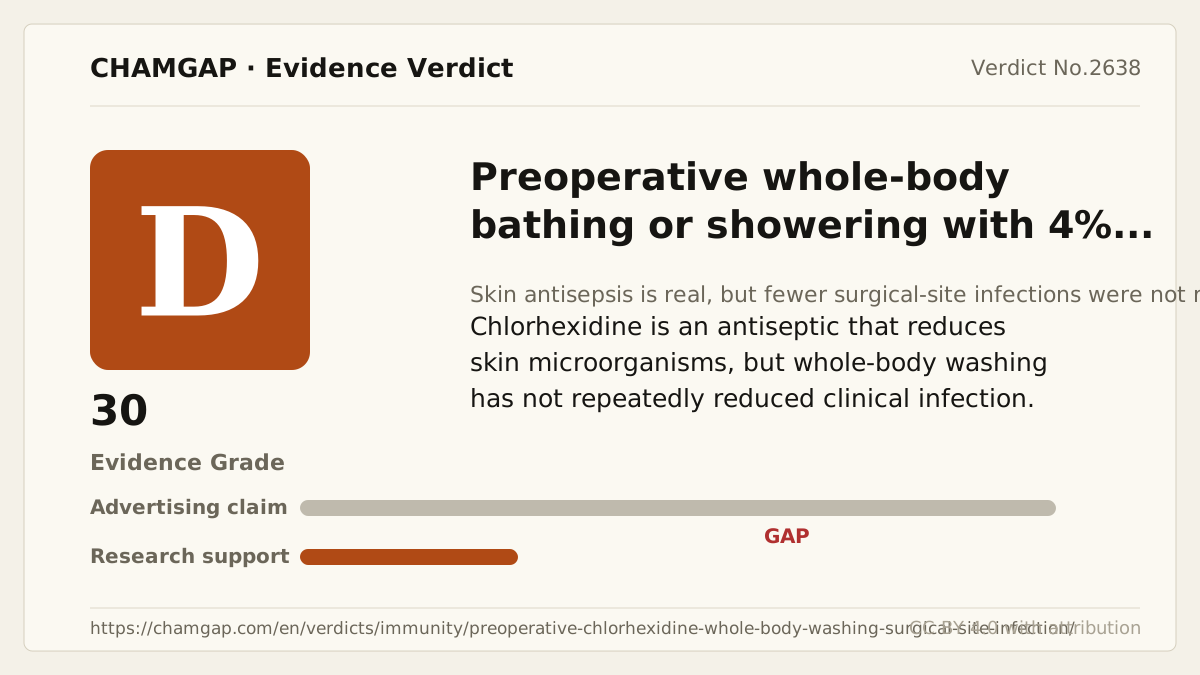
research showsThe grade is D with 30 points. Four trials comparing chlorhexidine with an identical nonantimicrobial cleanser included 7,791 participants and gave RR 0.91 (95% CI 0.80 to 1.04). Independent trials did not reproduce fewer infections, but the interval still permits a reduction as large as 20%, so prevention has not been fully excluded.
ads claimLower skin microbial counts are not the same endpoint as fewer surgical-site infections. Patients should not alter a surgical team's protocol or ignore chlorhexidine allergy.
Useful facts when choosing a product
- Chlorhexidine reduces skin microorganisms, whereas this verdict concerns clinical surgical-site infection.
- Rotter reported 37 of 1,413 versus 33 of 1,400 infections after two washes.
- The seven-trial Cochrane review summarizes included trials and is not an additional replication.
What the research actually shows
Webster and Osborne's 2015 Cochrane review included seven randomized trials and 10,157 participants. Four trials of 4% chlorhexidine versus placebo gave RR 0.91 (0.80-1.04), with no measured heterogeneity. The two stricter large trials by Byrne and Rotter included 6,302 participants and gave RR 0.95 (0.82-1.10), again with no measured heterogeneity. Rotter randomized 2,953 and analyzed 2,813, 1,413 versus 1,400, after 140 exclusions; infections were 37 versus 33, RR 1.11 (0.70-1.77). Coded identical containers masked patients and investigators and computer numbers with mixed packs implemented assignment, but postrandomization exclusions and no registration remain. ICI supplied bathing materials; separate trial funding was not identified. The review disclosed university and UK NIHR support.
Why this is classified as D (30)
Several independent placebo-controlled trials did not reproduce fewer infections, but their precision and clinical boundaries did not exclude meaningful benefit, giving D with 30 points.
Counterpoint. These data cannot negate every distinct operation, concentration, or adherence protocol.
Rejudgment record. Cross-check applied — Verified included trials, pooled estimates, heterogeneity, and bias in the Cochrane text and cross-checked assignment, analysis counts, masking, and supplied materials in Rotter
| Endpoint | H | Hard endpoint - actual events such as death |
| Replication | RX | Repeatedly refuted in the same indication |
| Independence | I1 | Mixed funding sources |
| Effect size | E0 | Null |
| Precision | C0 | The confidence interval leaves room for benefit |
The scoring table and the verdict agree (D).
Sub-claim grades by effect
This ingredient is marketed for several effects. A single overall grade blends strong and weak claims together, so each effect is graded separately here. The overall grade reflects the strongest disconfirming or core claim.
| Effect (sub-claim) | Grade | Basis |
|---|---|---|
| Prevention of surgical-site infection | D | Results were repeatedly null but still allowed up to a 20% reduction. |
| Reduction in skin microorganisms | ? | This is an established antiseptic action, not the clinical endpoint graded here. |
Cross-check — Codex and Claude
Evidence Table
| Study | Design | Sample | Funding | Endpoint | Result | Weight |
|---|---|---|---|---|---|---|
| Webster J, Osborne S. Cochrane review 2015 | Systematic review of randomized trials | 7,791 | Internal QUT and Griffith support and external NIHR support; no conflicts declared | Surgical-site infection | Chlorhexidine versus placebo RR 0.91 (0.80-1.04), with measured heterogeneity of 0% | Pivotal pooled evidence |
| Study 2 | Multinational double-masked placebo-controlled randomized trial | 1,400 | ICI supplied bathing materials; separate funding not reported | Postoperative wound infection | 37/1,413 versus 33/1,400, RR 1.11 (0.70-1.77) | Large direct placebo-controlled trial |
Receipt — 2 References
All 2 cited sources were verified for existence at the original page (as of 2026-08-15).
Reviewed and approved: Chamgap Editorial Team · Approval date: 2026-08-15 · Corrections: none
Cite this verdict
[Chamgap] Preoperative chlorhexidine whole-body washing x surgical-site infection — Evidence Grade D·30. 2 cited sources checked. Source: https://chamgap.com/en/verdicts/immunity/preoperative-chlorhexidine-whole-body-washing-surgical-site-infection/ · CC BY 4.0CC BY 4.0 — free to use with attribution; do not distort grades, numbers, or verdict meaning.
What this document does and does not do
Chamgap is an information source. It reports what research has and has not confirmed; it does not tell readers what to take or buy. That decision belongs to readers and, when needed, medical or legal professionals. This verdict reflects literature available up to the search date and may change as new research appears. Nothing here is medical advice.