
Adjunctive azithromycin,
does it really help with Fewer maternal postoperative infections within six weeks after nonelective cesarean delivery during labor or after membrane rupture?
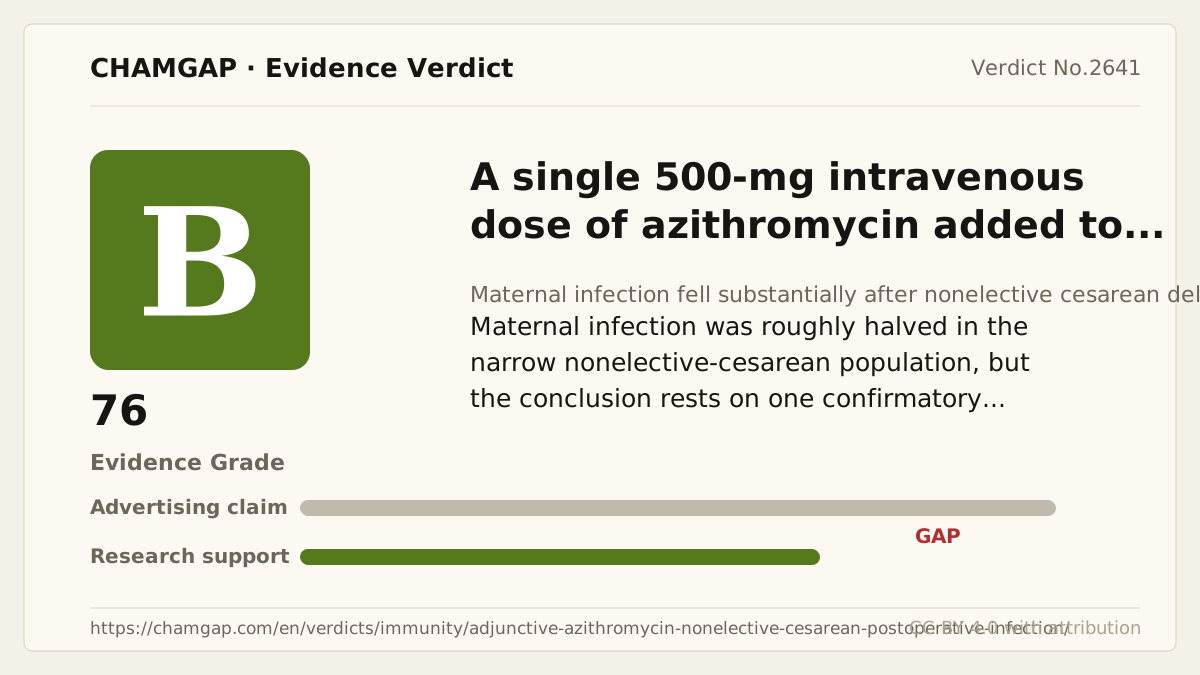
research showsThe grade is B with 76 points. In a 2,013-participant multicenter placebo-controlled trial, the six-week composite of endometritis, wound infection, or other infection occurred in 62/1,019 (6.1%) versus 119/994 (12.0%), RR 0.51 (95% CI 0.38 to 0.68). The effect corresponds to about one composite infection prevented per 17 treated women, but there is no independent second confirmatory trial.
ads claimThis is not a blanket claim for adding antibiotics to every cesarean. Marketing must retain the conditions of labor or ruptured membranes, nonelective surgery, standard prophylaxis, and one 500-mg intravenous azithromycin dose.
Useful facts when choosing a product
- The tested intervention was one 500-mg intravenous azithromycin dose added to standard prophylaxis.
- The primary outcome was a six-week composite of maternal endometritis, wound infection, and other infections.
- The absolute difference was 5.9 percentage points and the number needed to treat was 17 (95% CI 12 to 30).
What the research actually shows
C/SOAP randomized 2,013 women at 14 US hospitals to groups of 1,019 and 994. Allocation concealment was stated as: “Only the investigational pharmacists who prepared the study drug had access to the randomization algorithm through a dedicated password-protected website.” Masking was described as: “Clinical and research staff members other than the investigational pharmacist were unaware of treatment assignments.” The analysis population was stated as: “All analyses were performed according to the intention-to-treat principle.” Follow-up was “1961 of the 2013 women (97.4%)”. The prespecified primary endpoint was: “The primary outcome was a composite of endometritis, wound infection, or other infection occurring within 6 weeks.” This matched NCT01235546. The paper did not state how missing data from the 2.6% not followed up were handled. The primary infection composite was 6.1% versus 12.0%, RR 0.51 (95% CI 0.38 to 0.68; P<0.001).
Why this is classified as B (76)
A large publicly funded double-blind trial found a large reduction in direct infection events without a major design defect, but lack of independent replication gives B with 76 points.
Counterpoint. The neonatal composite did not improve, and scheduled cesareans or mothers with active infection fall outside this verdict.
Rejudgment record. Evidence aligned — Allocation concealment, masking, ITT analysis, and the prespecified primary endpoint were met, but the paper did not state how missing data from the 2.6% not followed up were handled
| Endpoint | H | Hard endpoint - actual events such as death |
| Replication | R1 | Single confirmatory trial |
| Independence | I2 | Decisive evidence is publicly or non-profit funded |
| Effect size | E+ | Meets the clinically important threshold |
The scoring table and the verdict agree (B).
Sub-claim grades by effect
This ingredient is marketed for several effects. A single overall grade blends strong and weak claims together, so each effect is graded separately here. The overall grade reflects the strongest disconfirming or core claim.
| Effect (sub-claim) | Grade | Basis |
|---|---|---|
| Fewer maternal postoperative infection composite events within six weeks | B | Rates were 6.1% versus 12.0%, RR 0.51. |
| Fewer neonatal deaths or serious complications | D | Rates were 14.3% versus 13.6%, with no difference. |
Cross-check — Codex and Claude
Evidence Table
| Study | Design | Sample | Funding | Endpoint | Result | Weight |
|---|---|---|---|---|---|---|
| Tita AT, Szychowski JM, Boggess K, Saade G, Longo S, Clark E, Esplin S, Cleary K, Wapner R, Letson K, Owens M, Abramovici A, Ambalavanan N, Cutter G, Andrews W, C/SOAP Trial Consortium. 2016 C/SOAP | Double-blind placebo-controlled randomized trial at 14 hospitals | 4 | Public NICHD funding; Pfizer donated study drug and reportedly had no role in design, conduct, or reporting | Primary six-week composite of endometritis, wound infection, or other infection | 62/1,019 (6.1%) versus 119/994 (12.0%), RR 0.51 (95% CI 0.38 to 0.68), P<0.001; NNT 17 (12 to 30) | Pivotal publicly funded large hard-outcome RCT |
Receipt — 1 References
All 1 cited sources were verified for existence at the original page (as of 2026-08-15).
Reviewed and approved: Chamgap Editorial Team · Approval date: 2026-08-15 · Corrections: none
Cite this verdict
[Chamgap] Adjunctive azithromycin x maternal infection after nonelective cesarean delivery — Evidence Grade B·76. 1 cited sources checked. Source: https://chamgap.com/en/verdicts/immunity/adjunctive-azithromycin-nonelective-cesarean-postoperative-infection/ · CC BY 4.0CC BY 4.0 — free to use with attribution; do not distort grades, numbers, or verdict meaning.
What this document does and does not do
Chamgap is an information source. It reports what research has and has not confirmed; it does not tell readers what to take or buy. That decision belongs to readers and, when needed, medical or legal professionals. This verdict reflects literature available up to the search date and may change as new research appears. Nothing here is medical advice.