
Endovascular thrombectomy,
does it really help with Improved 90-day disability distribution and function?
research showsThe grade is B. In 253 TENSION participants, the 90-day mRS distribution shifted toward thrombectomy, adjusted common OR 2.58 (95% CI 1.60-4.15), median 4 versus 6. Ninety-day mortality was 40% versus 51%, an 11-point absolute difference. SELECT2 showed the same direction in 352 participants, generalized OR 1.51 (1.20-1.89), but the trials shared key investigators. Both trials stopped early for efficacy and funding mixed public and device-company sources, giving B with 68 points.
ads claimNeither ‘a large infarct means it is always too late’ nor ‘every large infarct should undergo thrombectomy’ follows. Stroke centers selected patients by occlusion site, ASPECTS or core volume, last-known-well time, treatment window, and baseline function.
Useful facts when choosing a product
- TENSION did not mandate one manufacturer's device; approved local devices were selected.
- Thrombectomy devices were treatment materials, whereas CT and MRI were selection and assessment tools.
- This is an acute ischemic stroke thrombectomy verdict, not a meniscal exercise trial.
What the research actually shows
TENSION openly assigned 125 and 128 patients at 40 European and one Canadian hospital, with blinded 90-day endpoint assessment. The final primary analysis was intention-to-treat in all 253; 222 had reached 90 days at the first prespecified interim analysis. Enrollment stopped below the maximum 665 after crossing the prespecified efficacy boundary on DSMB recommendation. EU Horizon 2020 grant 754640 funded the trial, and sites selected approved thrombectomy devices rather than one mandated product. Author relationships with device companies were disclosed as personal conflicts. SELECT2 assigned 178 and 174 patients, analyzed all 352 for the same mRS distribution, and also stopped early for efficacy. Stryker Neurovascular funded university grants but supplied no trial equipment and did not mandate Stryker products. SELECT2 showed the same direction, but the trials shared key investigators and the same early-stopping limitation.
Why this is classified as B (68)
This is one confirmatory trial rather than a separate replication, and mixed public-industry funding plus prespecified early stopping for efficacy give B with 68 points.
Counterpoint. Stopping followed prespecified rules, but it still can overestimate treatment magnitude.
Rejudgment record. Cross-check applied — Cross-checked TENSION and SELECT2 for comparable 90-day mRS endpoints, shared key investigators, intention-to-treat denominators, efficacy stopping, and device supply
| Endpoint | P | Patient-reported treatment goal - the symptom is the goal |
| Replication | R1 | Single confirmatory trial |
| Independence | I1 | Mixed funding sources |
| Effect size | E+ | Meets the clinically important threshold |
The scoring table and the verdict agree (B).
Sub-claim grades by effect
This ingredient is marketed for several effects. A single overall grade blends strong and weak claims together, so each effect is graded separately here. The overall grade reflects the strongest disconfirming or core claim.
| Effect (sub-claim) | Grade | Basis |
|---|---|---|
| Improved 90-day disability distribution | B | TENSION and SELECT2 both showed a significant favorable shift. |
| Reduced symptomatic intracranial hemorrhage | D | TENSION found 6% versus 5%, not a reduction. |
Cross-check — Codex and Claude
Evidence Table
| Study | Design | Sample | Funding | Endpoint | Result | Weight |
|---|---|---|---|---|---|---|
| Study 1 | Open-label, blinded-endpoint adaptive superiority randomized trial | 222 | EU Horizon 2020 grant 754640; no company device supply or mandated device | Full modified Rankin scale distribution at 90 days | Adjusted common OR 2.58 (95% CI 1.60-4.15), P=.0001; median 4 versus 6; mortality 40% versus 51% | Pivotal public trial stopped early at a prespecified efficacy boundary |
| Study 2 | International open-label randomized trial with blinded endpoint assessment | 336 | University grants from Stryker Neurovascular; no trial-equipment supply or mandated Stryker products | Full modified Rankin scale distribution at 90 days | Generalized OR 1.51 (95% CI 1.20-1.89), P<.001; functional independence 20% versus 7% | Confirmatory trial in the same direction, with shared key investigators and early stopping for efficacy |
Receipt — 2 References
All 2 cited sources were verified for existence at the original page (as of 2026-08-18).
Reviewed and approved: Chamgap Editorial Team · Approval date: 2026-08-18 · Corrections: none
Cite this verdict
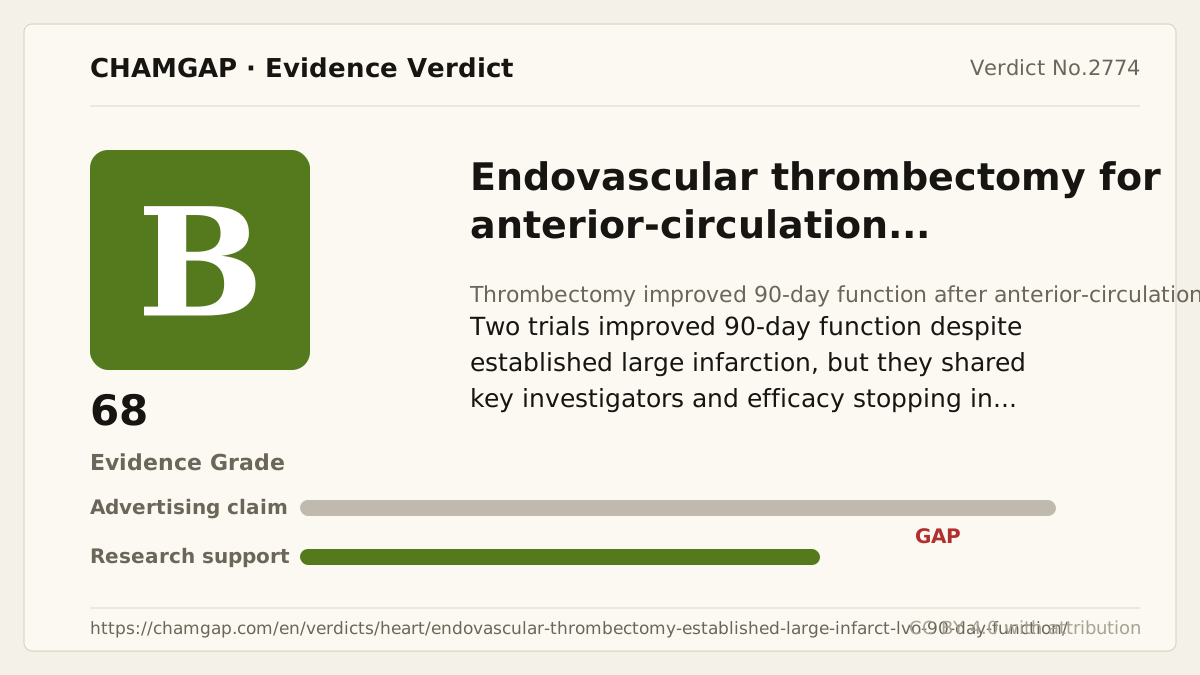
[Chamgap] Endovascular thrombectomy x 90-day function after large-infarct large-vessel stroke — Evidence Grade B·68. 2 cited sources checked. Source: https://chamgap.com/en/verdicts/heart/endovascular-thrombectomy-established-large-infarct-lvo-90-day-function/ · CC BY 4.0CC BY 4.0 — free to use with attribution; do not distort grades, numbers, or verdict meaning.
What this document does and does not do
Chamgap is an information source. It reports what research has and has not confirmed; it does not tell readers what to take or buy. That decision belongs to readers and, when needed, medical or legal professionals. This verdict reflects literature available up to the search date and may change as new research appears. Nothing here is medical advice.