
Xylooligosaccharides,
does it really help with Improved bowel movements and increased bifidobacteria?
research showsSmall human trials found that XOS increased fecal bifidobacteria, and a signal for improved stool form and constipation scores was also reported in patients with functional constipation. However, the clinical trials were short and had small samples per arm, and an increase in bifidobacteria is a surrogate marker rather than a clinical benefit itself. Independent replication of bowel improvement and long-term outcomes is limited, supporting a C rating.
ads claimAdvertisements use phrases such as 'growth of beneficial gut bacteria,' 'normalized bowel rhythm,' and 'improved gut environment.' The human finding supported most consistently is an increase in fecal bifidobacteria, while constipation-symptom improvement is limited to short, small trials of specific doses.
Useful facts when choosing a product
- Human-trial doses ranged widely from about 1.4 to 10 g/day, and ingredient purity and food forms differed.
- An increase in bifidobacteria is a fecal microbial marker and is not equivalent to clinical benefits such as less pain or better quality of life.
- XOS was generally tolerated in trials, but oligosaccharides can cause gas, bloating, and loose stools depending on dose.
- Pregnancy data are limited to one uncontrolled trial of 30 participants.
What the research actually shows
Finegold 2014 assigned 32 healthy adults to 1.4 g/day, 2.8 g/day, or placebo for eight weeks and reported that bifidobacterial counts increased in both XOS groups versus placebo. Tateyama 2005 gave 4.2 g/day for four weeks to 30 pregnant women with severe constipation in an uncontrolled trial and reported an increase in weekly bowel movements from 1.1 to 6.7. Yi 2024 assigned 87 patients with functional constipation to XOS 3, 5, or 10 g/day, FOS 10 or 20 g/day, or placebo for one month and observed signals of improved stool form and bifidobacterial markers with XOS 5 and 10 g/day. However, groups contained only 13-17 participants and the overall microbial-community structure did not change significantly.
Why this is classified as C (48)
Increased bifidobacteria has been repeated in several small human trials, but it is a surrogate marker. A recent randomized trial reported bowel outcomes in functional constipation, but each arm was very small and short, while the older pregnancy study had no control group. Combining the two subclaims supports C with 48 points and favorable short-term safety.
Counterpoint. Bifidobacteria may increase at low doses, and bowel markers may improve in people with functional constipation. This judgment does not extend to long-term constipation treatment or improvement of overall gut health.
Rejudgment record. New judgment — The functional-constipation RCT was short with small groups, and the center of repeated evidence, increased bifidobacteria, is a surrogate marker; therefore boundary rule ① supports C
Sub-claim grades by effect
This ingredient is marketed for several effects. A single overall grade blends strong and weak claims together, so each effect is graded separately here. The overall grade reflects the strongest disconfirming or core claim.
| Effect (sub-claim) | Grade | Basis |
|---|---|---|
| Improved bowel movements | C | The functional-constipation RCT had 13-17 participants per group and lasted one month, while the older pregnancy study was uncontrolled |
| Increased bifidobacteria | C | Repeated in healthy adults and patients with constipation, but it is a fecal microbial surrogate marker |
Cross-check — Codex and Claude
Evidence Table
| Study | Design | Sample | Funding | Endpoint | Result | Weight |
|---|---|---|---|---|---|---|
| Finegold SM et al. 2014 | Double-blind randomized placebo-controlled trial | 32 | Supported by Life Bridge International Corporation, which provided the products | Fecal bifidobacteria, microbiota, SCFAs, and tolerability | Both 1.4 and 2.8 g/day increased bifidobacteria versus placebo, but SCFAs and overall diversity did not change significantly. | Key |
| Tateyama I et al. 2005 | Single-arm before-and-after clinical trial | 29 | Unknown | Weekly bowel movements, stool form, and symptoms | After 4.2 g/day for four weeks, weekly bowel movements increased from 1.1 to 6.7, but there was no control group. | Supportive |
| Yi W et al. 2024 | Double-blind randomized placebo-controlled multi-arm trial | 6 | Chinese public grants; study products externally supplied | BSFS, CCCS, PAC-QoL, and 16S microbiota | XOS 5 and 10 g/day showed signals in stool form, some constipation scores, and bifidobacteria, but groups had 13-17 participants and overall microbial structure did not change. | Key |
Receipt — 3 References
All 3 cited sources were verified for existence at the original page (as of 2026-07-11).
Reviewed and approved: Chamgap Editorial Team · Approval date: 2026-07-11 · Corrections: none
Cite this verdict
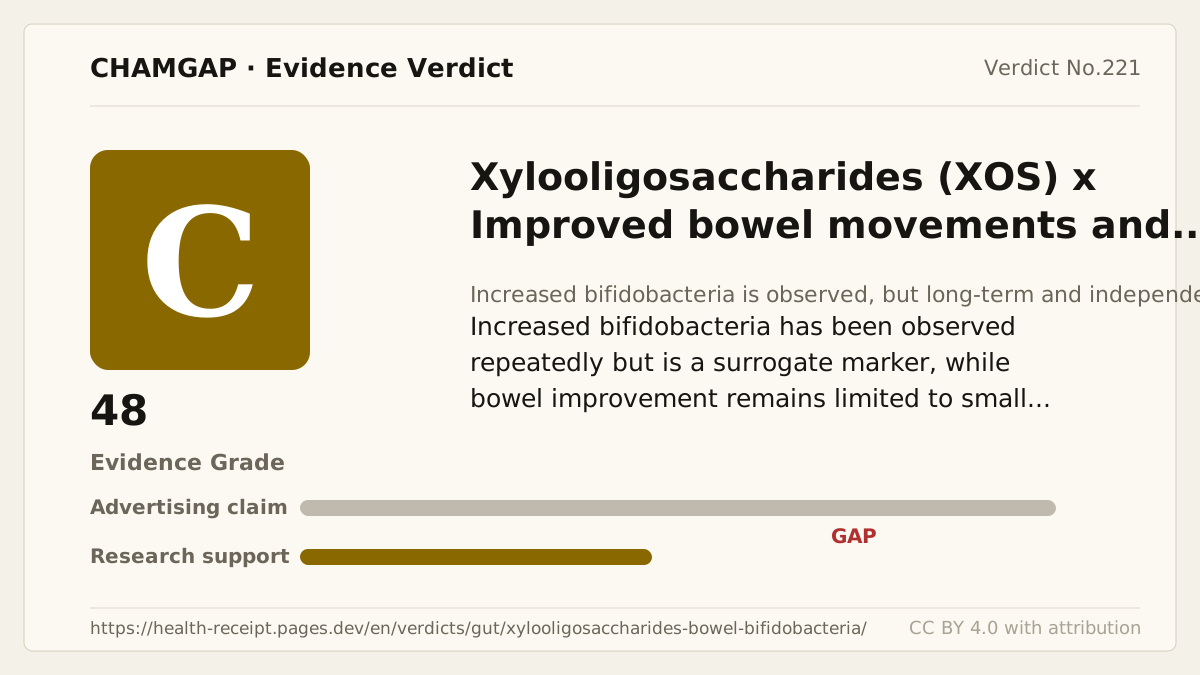
[Chamgap] Xylooligosaccharides (XOS) x improved bowel movements and increased bifidobacteria — Evidence Grade C·48. 3 cited sources checked. Source: https://chamgap.com/en/verdicts/gut/xylooligosaccharides-bowel-bifidobacteria/ · CC BY 4.0CC BY 4.0 — free to use with attribution; do not distort grades, numbers, or verdict meaning.
What this document does and does not do
Chamgap is an information source. It reports what research has and has not confirmed; it does not tell readers what to take or buy. That decision belongs to readers and, when needed, medical or legal professionals. This verdict reflects literature available up to the search date and may change as new research appears. Nothing here is medical advice.