
Saccharomyces boulardii,
does it really help with Diarrhea, gut health?
research showsS. boulardii has human RCT and meta-analysis evidence for preventing antibiotic-associated diarrhea and as adjunctive therapy for some acute diarrhea. However, if broadened to all of "gut health," effects differ greatly by strain, dose, and situation, and caution is needed in immunocompromised patients and patients with central venous catheters because of fungemia risk.
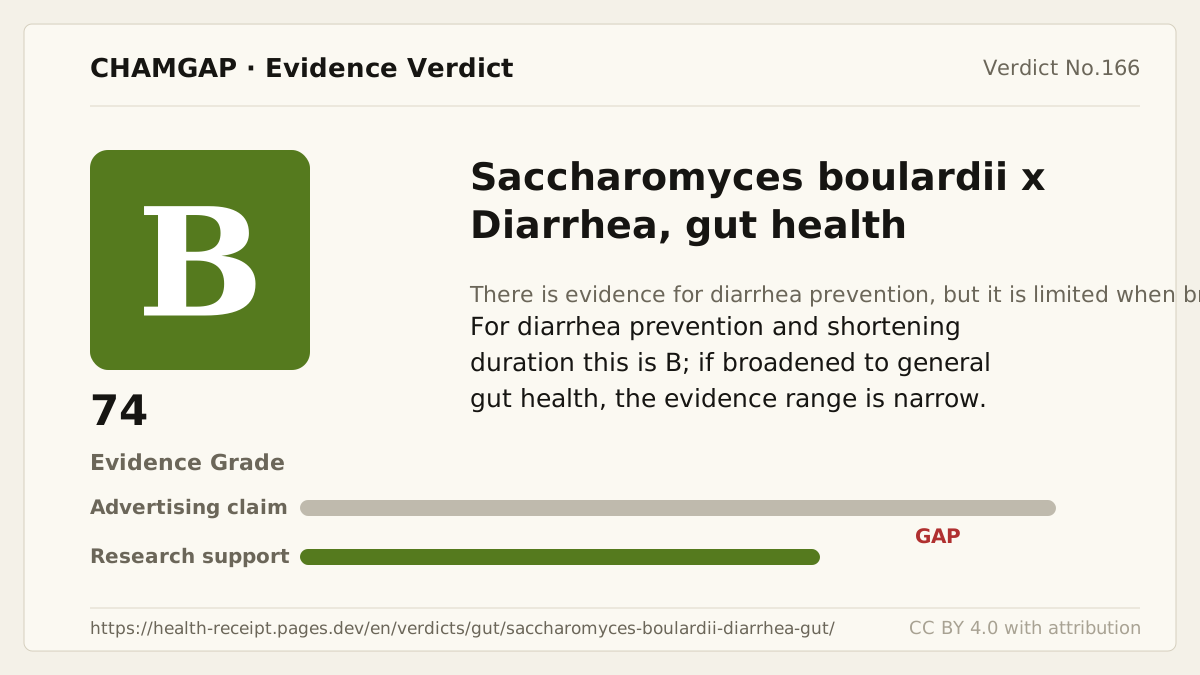
ads claimAdvertising mentions 'antibiotic diarrhea,' 'traveler's diarrhea,' 'restoration of gut flora,' 'intestinal immunity,' and 'irritable bowel syndrome' together. The firmest evidence is prevention of antibiotic-associated diarrhea.
Useful facts when choosing a product
- S. boulardii is a yeast, not a bacterium, so the context of use together with antibiotics has been studied.
- Representative study doses are difficult to compare directly because products label them in CFU or mg differently.
- Caution is needed in immunocompromised people, critically ill patients, and people with central venous catheters because of fungemia cases.
- In acute diarrhea, correction of dehydration is the foundation, and supplements do not replace it.
What the research actually shows
A 2015 meta-analysis reported that S. boulardii lowered the risk of antibiotic-associated diarrhea. A pediatric Cochrane review also concluded that high-dose probiotics, especially S. boulardii or L. rhamnosus GG, may show a moderate effect in preventing antibiotic-associated diarrhea. In acute infectious diarrhea, there are signals of duration shortening as adjunctive therapy, not as a treatment replacing rehydration.
Why this is classified as B (74)
For the direct clinical endpoint of antibiotic-associated diarrhea, there are meta-analyses and RCTs, so this is B. The advertising range broadened to general gut health and safety exceptions are reflected by keeping it at B rather than A, 74 points.
Counterpoint. In situations that fit the evidence, such as preventing diarrhea during antibiotic use, the evidence is relatively clear.
Rejudgment record. Draft — Positive RCT and meta-analysis evidence for prevention of antibiotic-associated diarrhea; extension to general gut health is limited
Cross-check — Codex and Claude
Evidence Table
| Study | Design | Sample | Funding | Endpoint | Result | Weight |
|---|---|---|---|---|---|---|
| Szajewska H, Kolodziej M. 2015 | Systematic review and meta-analysis | 4780 | Unknown/mixed by study | Incidence of antibiotic-associated diarrhea | S. boulardii significantly lowered the risk of antibiotic-associated diarrhea. | Core |
| Kotowska M et al. 2005 | Randomized double-blind placebo-controlled trial | 246 | Unknown/possible product provision | Incidence of antibiotic-associated diarrhea | Diarrhea occurred in 22/127 participants in the placebo group and 4/119 in the S. boulardii group. | Core |
| Guo Q et al. 2019 | Cochrane review | Cochrane/academic | Prevention of pediatric antibiotic-associated diarrhea | High-dose probiotics may lower AAD risk, and S. boulardii and LGG were summarized as major candidates. | Core |
Receipt — 4 References
All 4 cited sources were verified for existence at the original page (as of 2026-07-09).
Reviewed and approved: Chamgap Editorial Team · Approval date: 2026-07-09 · Corrections: none
Cite this verdict
[Chamgap] Saccharomyces boulardii × diarrhea, gut health — Evidence Grade B·74. 4 cited sources checked. Source: https://chamgap.com/en/verdicts/gut/saccharomyces-boulardii-diarrhea-gut/ · CC BY 4.0CC BY 4.0 — free to use with attribution; do not distort grades, numbers, or verdict meaning.
What this document does and does not do
Chamgap is an information source. It reports what research has and has not confirmed; it does not tell readers what to take or buy. That decision belongs to readers and, when needed, medical or legal professionals. This verdict reflects literature available up to the search date and may change as new research appears. Nothing here is medical advice.